Jackfield Type
Defining Attributes
A fine earthenware with a thin purplish to grey body covered with a lustrous black glaze. Often decorated with molded designs and gilding.1
Chronology
Jackfield developed in the 1740s and was most popular in the 1750s and 1760s, but "degenerate" versions continued to be made in small amounts into the 19th century (Barker and Halfpenny 1990:34-35). In the 1870s and 1880s, a revival of the Jackfield-type glaze occurred, this time on a terra cotta or white earthenware body. It is sometimes known as Jet Ware (Lewis 1999).
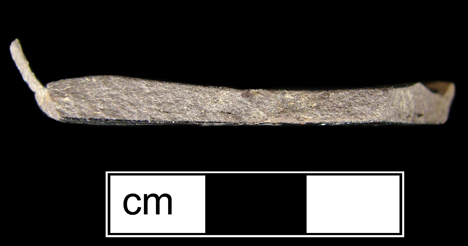
Figure 1. Jackfield-Type earthenware paste shot.
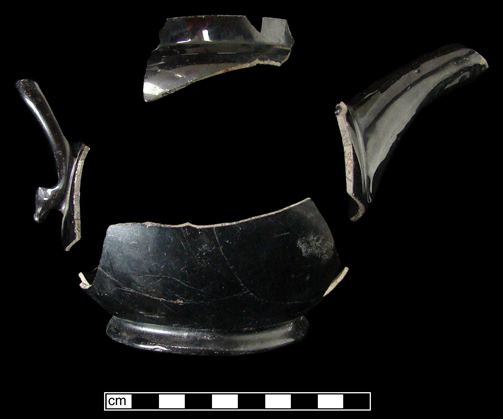
Figure 2. Jackfield-Type teapot.
Description
Fabric
A dense, homogenous earthenware body, grey to purplish-black in color. Jackfield produced by Thomas Whieldon, however, had a more reddish colored body (Noël Hume 1970:123).
Glaze
Thin, glossy black lead glaze.
Decoration
Vessels could be plain or decorated with white sprig-molding, and occasionally were enamel painted or oil gilded. Enamel painted and oil gilded decorative motifs included floral designs, cartouches with initials, and heraldic devices (Barker and Halfpenny 1990; Noël Hume 2001:277).
Form
This ware was made primarily in tea and coffee service forms. Vessels are typically thin-walled.
Footnotes
1 Although associated with the town of Jackfield in Shropshire, this ware was also commonly produced in Staffordshire by potters such as Thomas Whieldon. Therefore, the use of the term "Jackfield-type" or even "blackware" is preferred (Barker and Halfpenny 1990).
References
1990 Unearthing Staffordshire: Towards a New Understanding of 18th Century Ceramics. City of Stoke-on-Trent Museum and Art Gallery, Stoke-on-Trent, England.
1999 A Collector’s History of English Pottery. Antique Collectors’ Club, Ltd., Woodbridge, Suffolk. 5th edition, originally published in 1969.
1970 A Guide to Artifacts of Colonial America. Alfred A. Knopf, New York, NY.
2001 If These Pots Could Talk: Collecting 2000 Years of British Household Pottery. Chipstone Foundation, Milwaukee, WI.