Nottingham Type
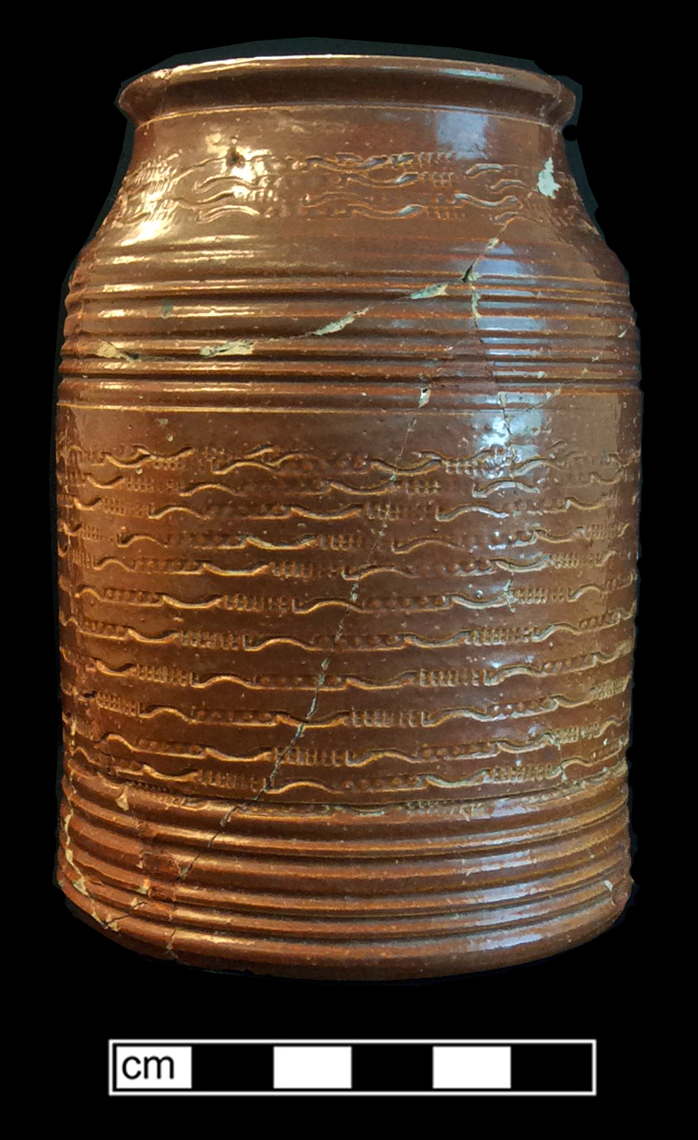
Figure 1. Nottingham stoneware jug with incised decoration.
Defining Attributes
Brown stoneware with a grey body covered with a lustrous salt-glaze that gives the appearance of burnished metal. Nottingham-type stoneware was decorated with incising, press molding, sprigging, piercings, raised cordons and bands of rustications.
Chronology
Developed by James Morley at Nottingham, England at the end of the 17th century, production continued until the early 19th century. However, production began to decline after ca. 1775 (Oswald 1974). The earliest dated piece is marked "1700" and the latest "1799" (Lewis 1999). Similar brown salt glazed stoneware was also manufactured at Derbyshire, Staffordshire, Liverpool, and Yorkshire (Noël Hume 1970; Hildyard 1985; Skerry and Hood 2009); hence the description of this ware as “Nottingham-type.”1
Description
Fabric
Nottingham-type stoneware is characterized by a homogenous body with no visible inclusions. The paste ranges in color from light to dark grey, but with buff to deep orange pastes occasionally present (Oswald et al. 1982:106). As typical of refined stoneware, the vessels are generally thin in cross-section.
Glaze
A lustrous brown wash of ferruginous clay under a salt-glazed surface creates the appearance of burnished metal. The highly metallic brown engobe has a tendency to smooth or obliterate the typical "orange peel" texture of salt glazes. Glaze color can vary from light brown to dark brown. On early pieces from Derbyshire with thin or spotty glaze, color can range from yellow to orange to grey-green to purple brown and dark brown (Oswald 1974).
In cross section, a thin layer of white slip often can be seen separating the glaze and body. Oswald et al. (1982:106) and Noël Hume (2001) note that, contrary to popular belief; the line of white slip is not always present on Nottingham-type stoneware. Furthermore, Noël Hume (2001:180) argues that the common rule of thumb that Nottingham products are milk chocolate or ginger brown, while those from Derbyshire are dark chocolate, is also not a reliable guide.
Decoration
While undecorated vessels were common in 18th-century North America (Skerry and Hood 2009:82), many Nottingham-type stoneware vessels were decorated, often using a combination of techniques, including incising, press molding, piercing, sprig molding, rouletting and rustication.
Double-walled vessels—usually puzzle jugs, mugs, jugs and loving cups dating to the late 17th and early 18th centuries—often display motifs carved or cut through the vessels’ outer walls. A common form of decoration used a pointed instrument to incise the clay body with names, dates, and floral and scroll motifs. Roulette wheels were also used to create horizontal and vertical bands of decoration, as well as floral and other motifs. Beginning around 1750, press molding was used to create floral elements (Oswald et al. 1982:290-291). Applied sprig molded elements, including flowers and armorial devices, were employed between 1760 and 1780 (Oswald et al. 1982:118). Clay shavings (rustication) were used to decorate mugs, teapots and other hollow vessels from ca. 1750 – ca. 1780 and to simulate fur on animal figurines into the 19th century (Oswald et al 1982:126-127). Manganese was sometimes used to create a polychrome effect during the third quarter of the 18th century (Oswald 1974:147).
Form
Forms include baluster-shaped pitchers, two-handled loving cups, straight-sided tankards and baluster-shaped mugs, pipkins, puzzle jugs, and punch bowls, as well as specialized vessels such as inkwells and boxes. Less commonly found vessels included porringers, tea and coffee pots, bowls, nappies, dishes, and chamberpots (Skerry and Hood 2009:84). Animal figurines decorated with clay shavings for fur were also made. Oswald (1974), Oswald et al. (1982) and Hildyard (1985) illustrate many 18th-century forms and decorations.
Footnotes
1 Lustrous salt-glazed stonewares are commonly named after wares produced in Nottingham, but this type of ceramic was also produced in Staffordshire, Derbyshire, Liverpool, and Yorkshire (Noël Hume 1970; Hildyard 1985).
References
1985 Brown Muggs: English Brown Stoneware. Victoria and Albert Museum, London.
1999 A Collector’s History of English Pottery. Antique Collectors’ Club, Ltd., Woodbridge, Suffolk. 5th edition, originally published in 1969.
1970 A Guide to Artifacts of Colonial America. Alfred A. Knopf, New York, NY.
2001 If These Pots Could Talk: Collecting 2000 Years of British Household Pottery. Chipstone Foundation, Milwaukee, WI.
1974 Nottingham and Derbyshire Stoneware. English Ceramic Circle Transaction& 9(2): 140-189.
1982 English Brown Stoneware 1670-1900. Faber and Faber, London.
2009 Salt-Glazed Stoneware in Early America. Colonial Williamsburg Foundation, Williamsburg, Williamsburg, in association with University Press of New England, Hanover.