Bodkins
Defining Attributes
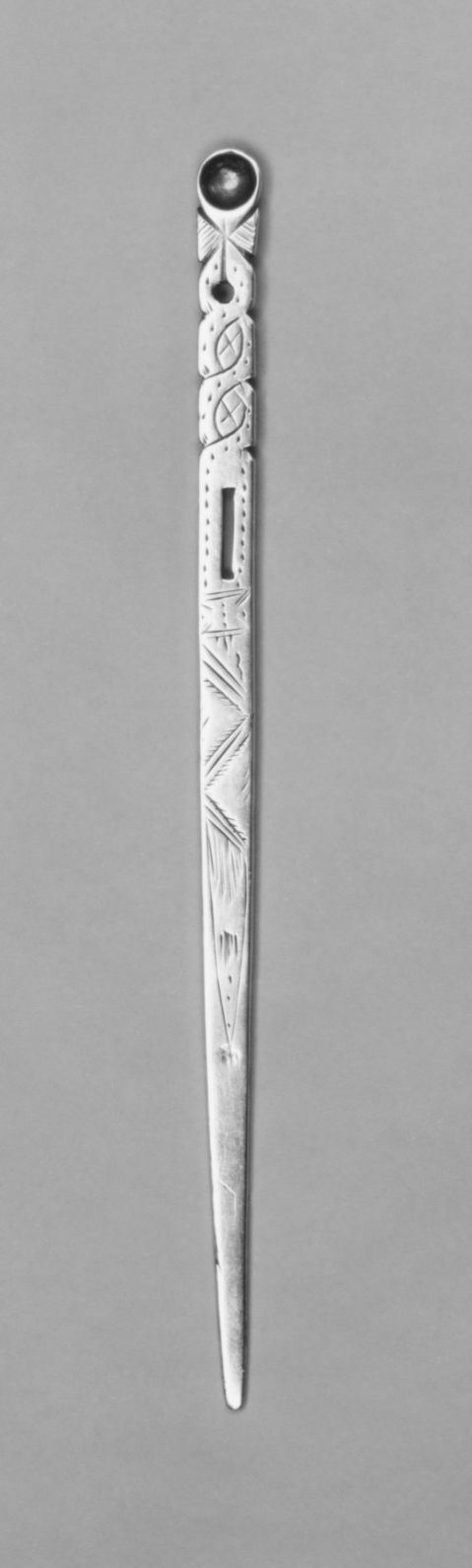
This section of the website features the kind of bodkins that are blunt needles with an eye large enough to facilitate ribbons, cords, or laces. Bodkins of the 17th and 18th centuries were typically large with a long eye for ribbons, a small hole for cords, and sometimes an ear scoop (Figure 1). This type of bodkin was an important personal item for women, and many were personalized with the owner's name or initials. The materials used to make them varied by the means of the purchaser. Metals used include gold, silver, silver plate, and copper alloys. Organic materials such as wood and bone were also used to make bodkins.
Bodkins changed over time in both form and function. In the 17th and 18th centuries, bodkins were tools of a lady's toilette, and their primary function was dressing hair. Sometimes women also displayed bodkins like jewelry by wearing them in their caps, and these bodkins might have a decorative bauble hanging from the end (Beaudry 2006; Sullivan 2004). By the 19th century bodkins had become smaller and served primarily as tools for running drawstrings, laces, and ribbons in clothing.
History
The first mention of the term "bodkin" being like a "needle" – and presumably having an eye – comes from John Baret's Quadruple Dictionary of 1580. Baret (1580) offers two definitions of bodkins, "A bodkine or fine instrument that women curle their heare withall… a friseling iron," and, "bodkine or big needle to crest the heares, discriminale" (OED 1991:353). In the first definition, bodkins were curling tools, since a frizzle was a "short, crisp curl" (OED 1991). Literary references to bodkins in the early 17th century invoke this definition. For example, in Thomas Decker's play The Honest Whore, the character Bellafront "with her bodkin curls her hair" (Sewell 1889).
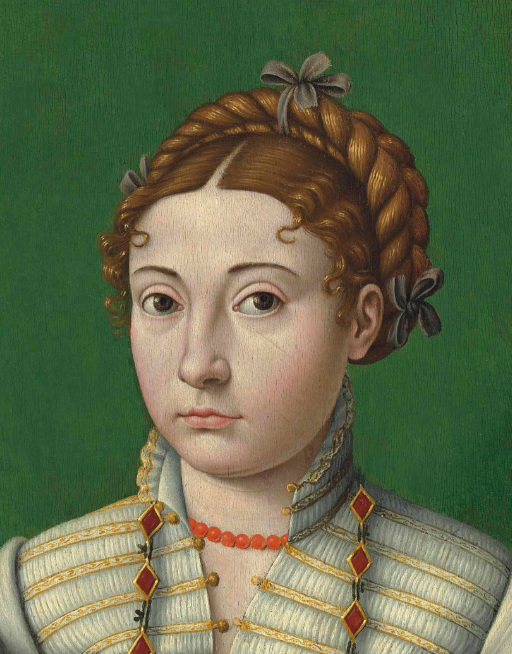
As for Baret's second definition, to crest the hair was to give it a ridge or tuft, and discriminale implies some separation of the hair like a part. Neither definition explains why an eye hole would be needed, but it would certainly be helpful for sewing cords and ribbons into the hair as was popular during the 16th century. According to Bradfield (1938:73), women wore their hair, "bound with silks or ribbons into two long tails, and wound round the head, crossing in front" (Figure 2).
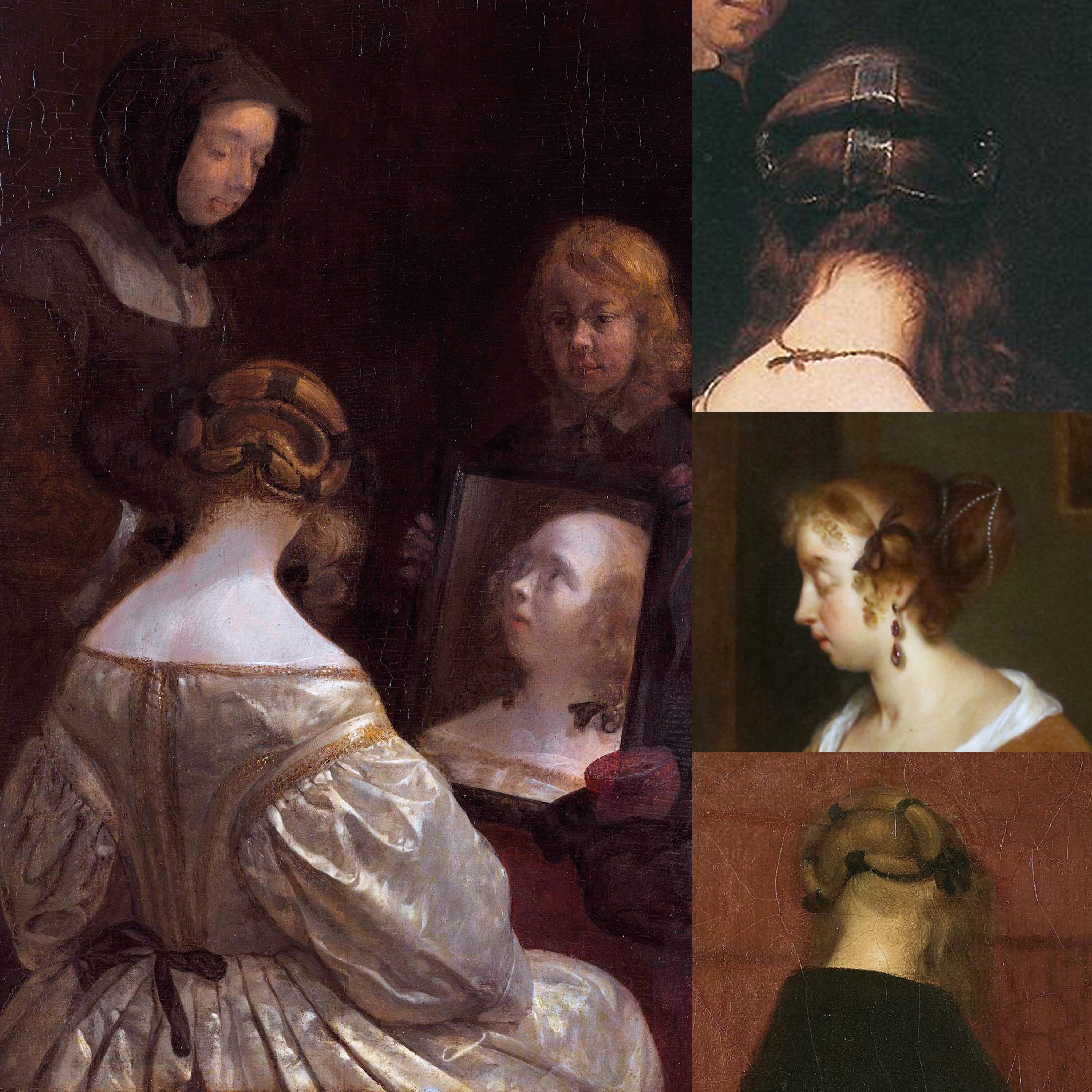
Seventeenth-century sources also discuss the use of bodkins for dressing and confining the hair, and many hairstyles incorporating ribbons and cords can be seen in period artwork (Figure 3). In his play The Mistaken Husband, John Dryden (1675) mentions "a silver Bodkin to rectify [thy wife's] stairing hairs" in a list of fashionable goods offered as a bribe. This suggests the bodkin helped to secure hair in some way rather than just adding decoration.
The best source from this period, however, is Randle Holme's 1688 Academy of Armory which outlines various types of bodkins and provides an explanation of "the Lady's bodkin" with illustrations of how the style changed over time from a larger decorative knobbed end to a narrower end with a small knop (Figure 3). Holme compiled the Academy of Armory between 1649 and 1688, so the transition in bodkin styles must have taken place at some point in that period.
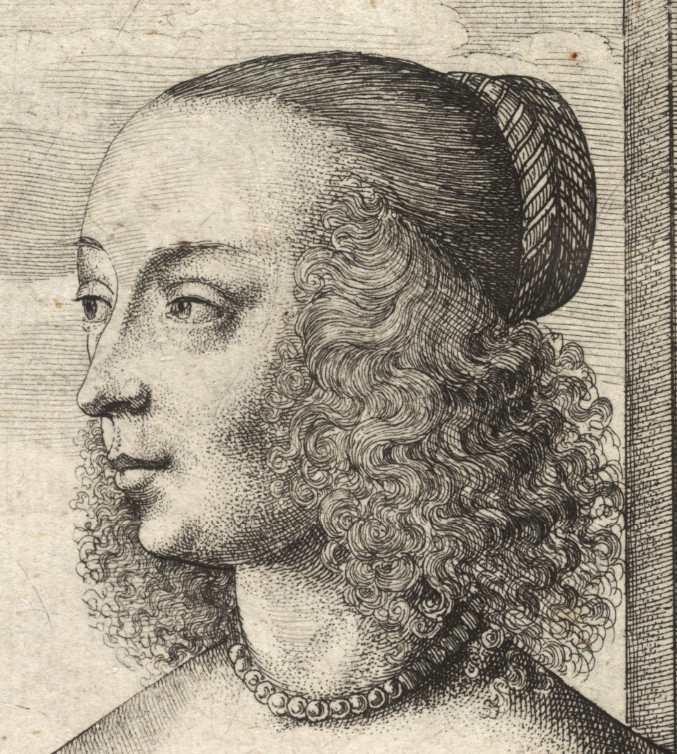
According to Sewell (1889), the small hole in a bodkin was for a fine cord known as "bobbin." Beck's (1882:22) The Draper's Dictionary says that bobbin is, "A fine cord in haberdashery, in which sense the word is very ancient. In 1578 we find 'Skotish bobin sylke,' and ‘bobbing' appearing in an inventory." The association between bobbin cord and bodkins is supported by a stage direction in the 1663 play The Parson's Wedding which states, "He pulls her bodkin that is tied in a piece of black bobbin" (Sewell 1889:141). Figure 5 depicts a woman with coiled hair wrapped in cords that may be bobbin.
Lady's bodkins continued in use for hairdressing into the 18th century according to references in poetry and various dictionaries. Alexander Pope's The Rape of the Lock, a mock heroic poem involving the involuntary taking of a lock of hair, includes the line, "Was it for this you took such constant care/ The bodkin, comb, and essence to prepare?" (1712). Joseph Thurston's 1730 poem The Toilette also features a bodkin:
…When the full Tresses, with bewitching Grace,
In swelling Ringlets wanton o'er the Face,
Or by the Bodkin's forceful Art confin'd,
With shining Sable grace the Neck behind…
[Thurston 1730:9]
The Universal Etymological English Dictionary by Nathan Bailey (1737) defines a bodkin as, "an Utensil Women roll their Hair on, and also for other Uses," while a 1740 Dictionary of Spanish and English refers to a bodkin, "with which Women part their Hair" (Pineda 1740:643).
These sources are all of interest for tracing the uses of bodkins because at some point between 1740 and 1800 the function shifted away from hairdressing. Modern bodkins are used as threading tools for running drawstrings, lacing eyelet holes, or decorating clothing with ribbons and trimmings. Sources disagree about when the latter uses became dominant.
According to Beaudry (2006:66), "Bodkins were used by both men and women for dunning in drawstrings and for threading and re-threading ribbons, cords, and laces; their chief purpose has always been to thread bands or cords through corsets and bodices." Beaudry cites Sullivan (2004:74-75) when making this statement, while Sullivan cites no sources when stating that bodkins have always primarily been for lacing clothing.
In addition to the "lady's bodkin" (Figure 4), Holme's Academy of Armory includes a list of tailor's tools that describes a different kind of bodkin used for making eyelet holes for lacing. It has a wooden handle and lacks a hole for threading. Today such a tool would be called an awl or stiletto, and would be used for making lacing holes, not running laces through them. It is possible, however, that the use of the same term for both tools has caused confusion about bodkins being used for lacing clothing in the 17th century.
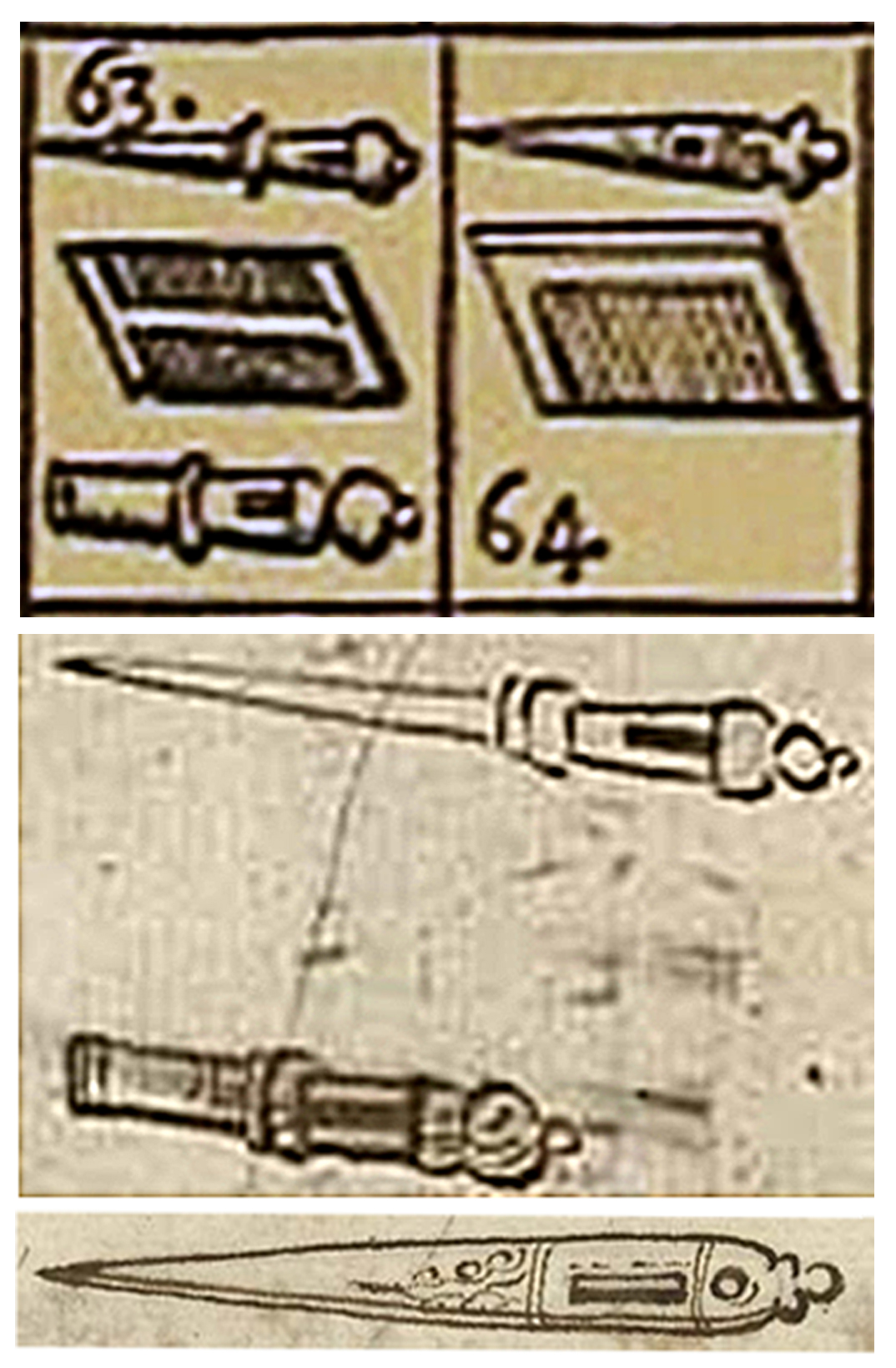
63. He beareth Azure, a combe or head combe, Or: betweene a Bodkine, and an othere rebated, or broken in the half, Argent. These are Instruments for the head, the one for a man and both for a woman…
The Bodkin is a thing usefull for women to bind vp their haire with and aboute, they are usually made of siluer and gold the inferiour haue them of Brasse, but the meanest content them selues with a scewer of sharp pointed stick.
There are seuerall sorts of Bodkin as Bodkins with Haftes and are put in sheathes like kniues and worne in the pocketts of Attorneys, clerks, and such as use to fill their writtings; also Bodkins so called being instrumentall tooles belonging to seuerall trades, of a contrary makeing of these, of which you may se seuerall amongst their trades, all which haue an additionall terme of the trade to whom they belong. This being the Lady's bodkin is the only Bodkin without any other terme added to it: yet this is but the old fashion makeing of it.
64. In the cheife of this quarter is a Lady’s Bodkin of the new mode, which I haue set here to shew the difference betw: the new fashion and the old. [Alcock and Cox 2000]
The "lady's bodkin" with its threading holes, however, always seems to be used in context with hair up to c. 1740 in the primary literature, and most bodkins of the 17th and 18th centuries were too large to fit through lacing holes of the period. Surviving garments with aglets on the laces suggest an alternate means for lacing clothing in the 17th century that makes more sense (Hart and North 1998:138). Unlike bodkins, aglets of the period were narrow enough to pass through eyelet holes.
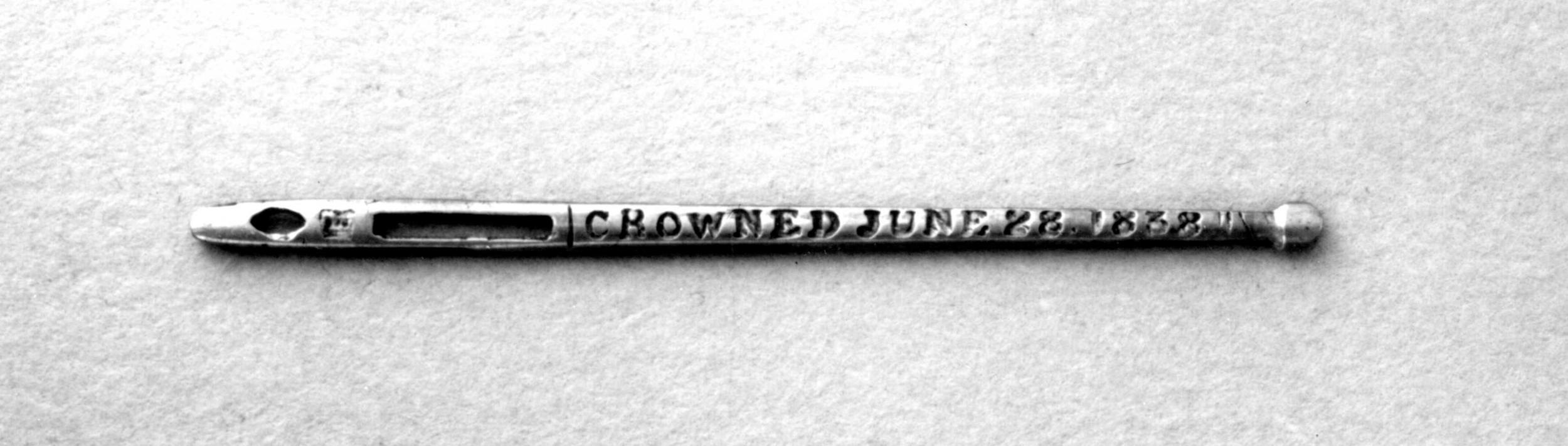
After 1750, bodkins were popular gifts and souvenirs, and they continued to be personalized with inscribed phrases or initials, but as the century wore on the tools gradually got shorter and smaller in scale (Beaudry 2006; Meacham 2006). Some 19th-century bodkins have forms that are almost indistinguishable from their 17th- and 18th-century counterparts while others have ball-point tips, flattened cross-sections, or circular cross-sections that would not have been as common in earlier centuries (Figure 6). No longer associated with the hair, the smaller bodkins of this period facilitated running laces, drawstrings, and ribbons through small eyelets and casings. They also became useful for running elastic into clothes in the 1840s (Beaudry 2006:67).
Rather than enjoying status as highly personal objects, bodkins of the 19th century were typically one tool among many to be found in sewing and needlework tool sets on chatelaines or in boxes (McConnel 1999; Sullivan 2004).
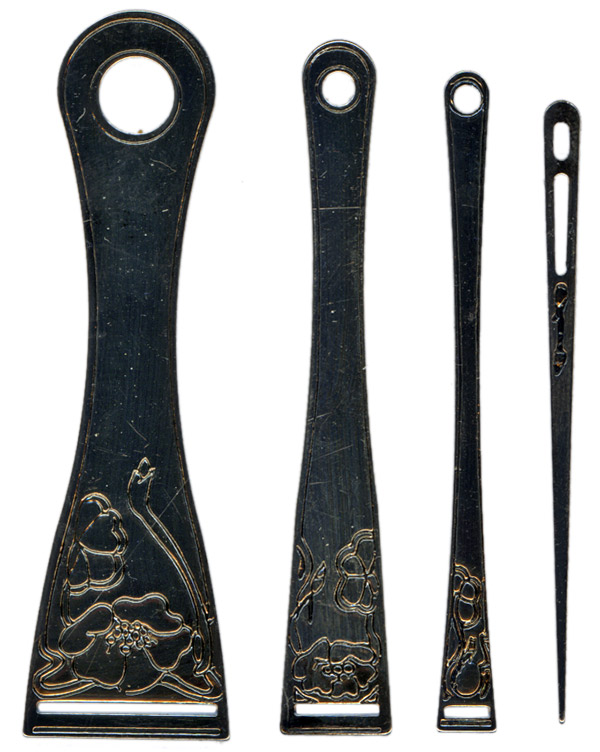
With new uses came new variations in shape, form, and decoration. Bodkins of the late 19th and early 20th centuries were sometimes made wider, flatter, and with less durable materials than metal (Meacham 2006). Late 19th- and 20th-century variations include wide flat tools with the long eye oriented differently to prevent ribbons or tapes from twisting. These tools are often called "ribbon threaders" (Figure 7).
As the 20th century wore on, bodkins continued in use, with some being mass produced and strictly utilitarian, and others being made for fancy sets. The term "bodkin" is still used today to describe sewing notions for threading elastic, ribbon, and drawstrings.
References
2000 Living and Working in Seventeenth Century England: Descriptions and Drawings from Randle Holme's Academy of Armory. CD-Rom. London: The British Library Board.
1737 The Universal Etymological English Dictionary. London: Cox. Internet Archive, https://archive.org/details/universaletymolo02bailuoft/page/n1/mode/2up, accessed May 26, 2026.
1580 An aluearie or quadruple dictionarie, containing foure sundrie tongues. Internet Archive, https://archive.org/details/bim_early-english-books-1475-1640_an-aluearie-or-quadruple_baret-john_1580/mode/2up, accessed May 27, 2026.
2006 Findings: The Material Culture of Needlework and Sewing. New Haven, Connecticut: Yale University Press.
1882 The Draper's Dictionary: A Manual of Textile Fabrics, Their History and Applications. London: The Warehousemen and Drapers' Journal Office.
1938 Historical Costumes of England from the Eleventh to the Twentieth Century. Third edition. London: George G. Harrap and Co. Ltd.
1675 The Mistaken Husband. London: Printed for F. Magnes and R. Bentley. Internet archive, https://archive.org/details/bim_early-english-books-1641-1700_the-mistaken-husband-_dryden-john_1675, accessed May 27, 2026.
1998 Historical Fashion in Detail: The 17th and 18th Centuries. London: V & A Publications.
1999 The Story of Antique Needlework Tools. Atglen, Pennsylvania: Schiffer Publishing Ltd.
2006 Bodkins: An Overview. Elegant Arts Antiques Points of Interest: A Newsletter for Collectors. September 2006. http://www.samplercovedesigns.com/content/tools/BodkinsArticle_07-2006.pdf, accessed August 25, 2008.
1991 The Compact Oxford English Dictionary, Second Edition. Oxford: Clarendon Press.
1712 The Rape of the Lock. Internet Archive, https://archive.org/details/the-rape-of-the-lock-pope/mode/2up, accessed May 26, 2026.
1889 A Silver Bodkin Found at Yaxley, Suffolk. Notes and Queries 8(191):141-142.
1740 A new dictionary, Spanish and English and English and Spanish. London: Printed for F. Gyles, T. Woodward, T. Cox, J. Clarke, A. Millar, and P. Vaillant. Internet Archive, https://archive.org/details/bim_eighteenth-century_a-new-dictionary-spanis_pineda-pedro_1740, accessed May 26, 2026.
2004 Needlework Tools and Accessories: A Dutch Tradition. Woodbridge, UK: Antique Collector's Club.
1730 The Toilette. London: Printed for Benjamin Motte. Internet Archive, https://archive.org/details/bim_eighteenth-century_the-toilette-in-three-b_thurston-joseph_1730/mode/2up, accessed May 26, 2026.