Religious Artifacts
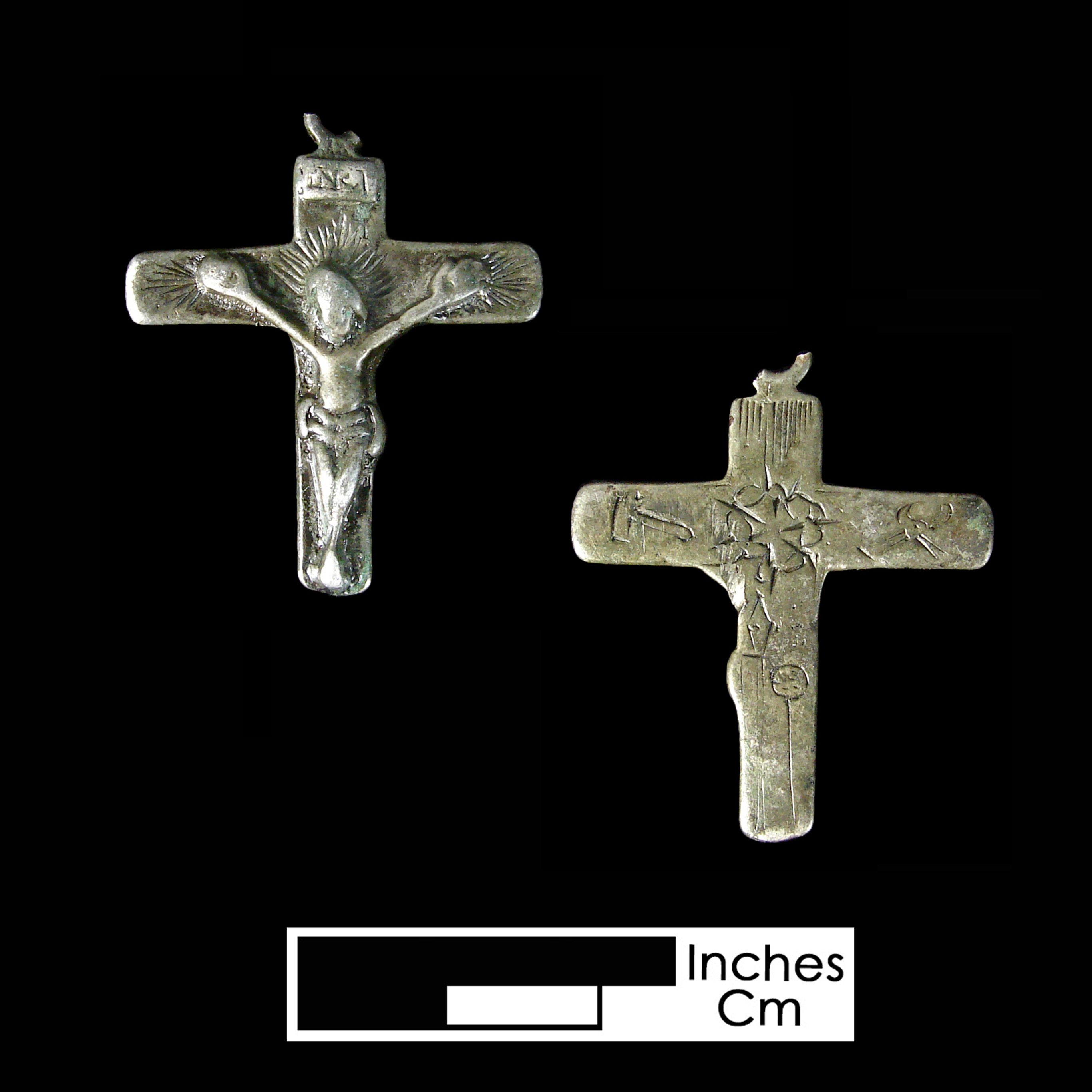
Defining Attributes
This section discusses various religious objects found archaeologically in Maryland. Religion is a complicated topic for archaeologists, since it can be impossible to know the nature of spiritual meaning that people placed upon certain finds. For example, taken alone, a bird bone in the archaeological record has little meaning other than as a possible food source, but if found with copper pins, buttons, and a crystal, the bone may have been part of a deliberate spiritual offering. Such caches have often been discussed in literature on African-American archaeology. Unfortunately, identification and interpretation of ordinary items that were used in a spiritual way requires a more in-depth and nuanced approach than this section is intended to offer. The MAC Lab is exploring other ways to share such data. This section will only discuss artifacts that were deliberately manufactured to have religious meaning, and are easily recognizable as religiously symbolic in their own right. These artifacts only appear in limited numbers, so it is possible to add images, measurements, site summaries, and context data for every example we have found in our collections.
Background
Maryland's 17th-century colonial founders, the Calvert family, were Roman Catholics at a time when Catholicism was banned in England. Many Catholics decided to immigrate to Maryland to be part of a colony that was friendly to their beliefs. Jesuits were among the earliest Europeans to sign up for the Maryland venture, and by the 1630s they had established plantations and engaged in missionary work to convert American Indians and other non-Catholics. The Franciscans later launched similar efforts. Not all European settlers in Maryland were Catholic, however, and there was a great deal of struggle between Catholics and Protestants at various times in the 17th century. The Calvert proprietary government was overthrown by Protestant forces in 1689, but by then the Catholic presence in Maryland was already well-established.
Roman Catholic practices can involve a great deal of iconography since a variety of objects such as saint pendants, crosses, and rosaries are considered sacred. Some Protestant groups who broke with Rome over liturgical differences rejected the use of icons, but other non-Catholics, such as Anglicans, had separated from the Catholic Church for more political reasons and they often continued to use sacred objects in daily worship. As with any household item used or worn on a daily basis, it is not uncommon to find religious artifacts on archaeological sites in Maryland dating from the 17th century to the present.