Spoons
Introduction
This essay will provide basic dating information, shapes, and characteristics for the types of spoons commonly found on U.S. archaeological sites dating from the 17th through the 19th centuries. While some examples of 20th-century spoons are included on this webpage, the reader is advised to consult printed sources and websites devoted to the wide range of patterns and styles that are characteristic of this period. For makers’ marks, hallmarks, in-depth discussions of materials and plating techniques, and technology production changes over time, the reader is advised to seek more comprehensive sources listed in the References section.
Spoons were first used around 3,000 years ago, appearing in Egyptian archaeological collections from this period. The earliest record of spoons in England dates to the mid-13th century, when spoons are documented among King Edward I’s possessions (Chisholm 1911:733).
Spoons, forks and knives began to be used together during the late 17th century (Moore 1987:8). Matching services were not common until the late 18th century (Snodin and Belden 1976:7).
Over the centuries, spoons have been made from numerous materials, including wood, bone, and horn. These materials generally do not survive archaeologically, but many archaeologically recovered spoons were made from non-precious metals, like pewter, brass/copper alloy, Britannia metal and iron. Silver spoons (and more often silver-plated spoons) are sometimes part of archaeological assemblages. Please consult sources in the references section for more information on dating materials.
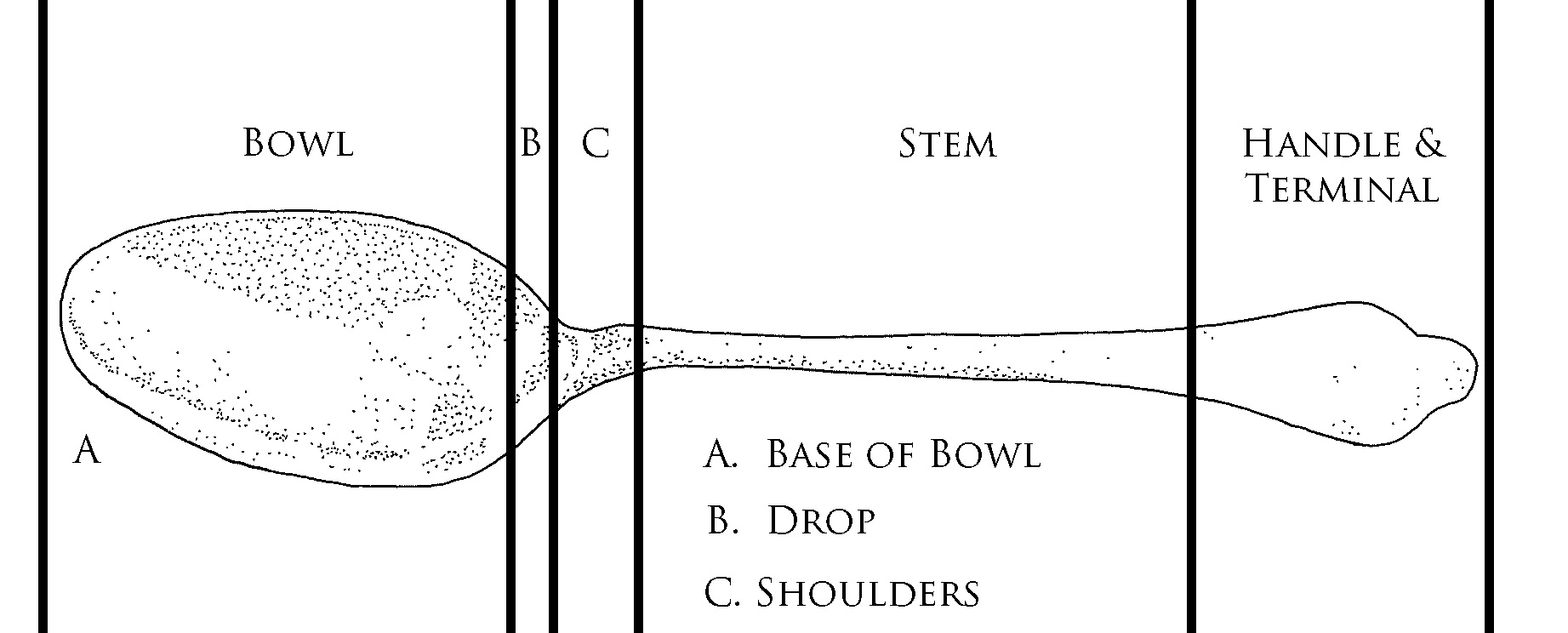
Spoon Anatomy
Spoon Style Chronology – 17th – 19th centuries
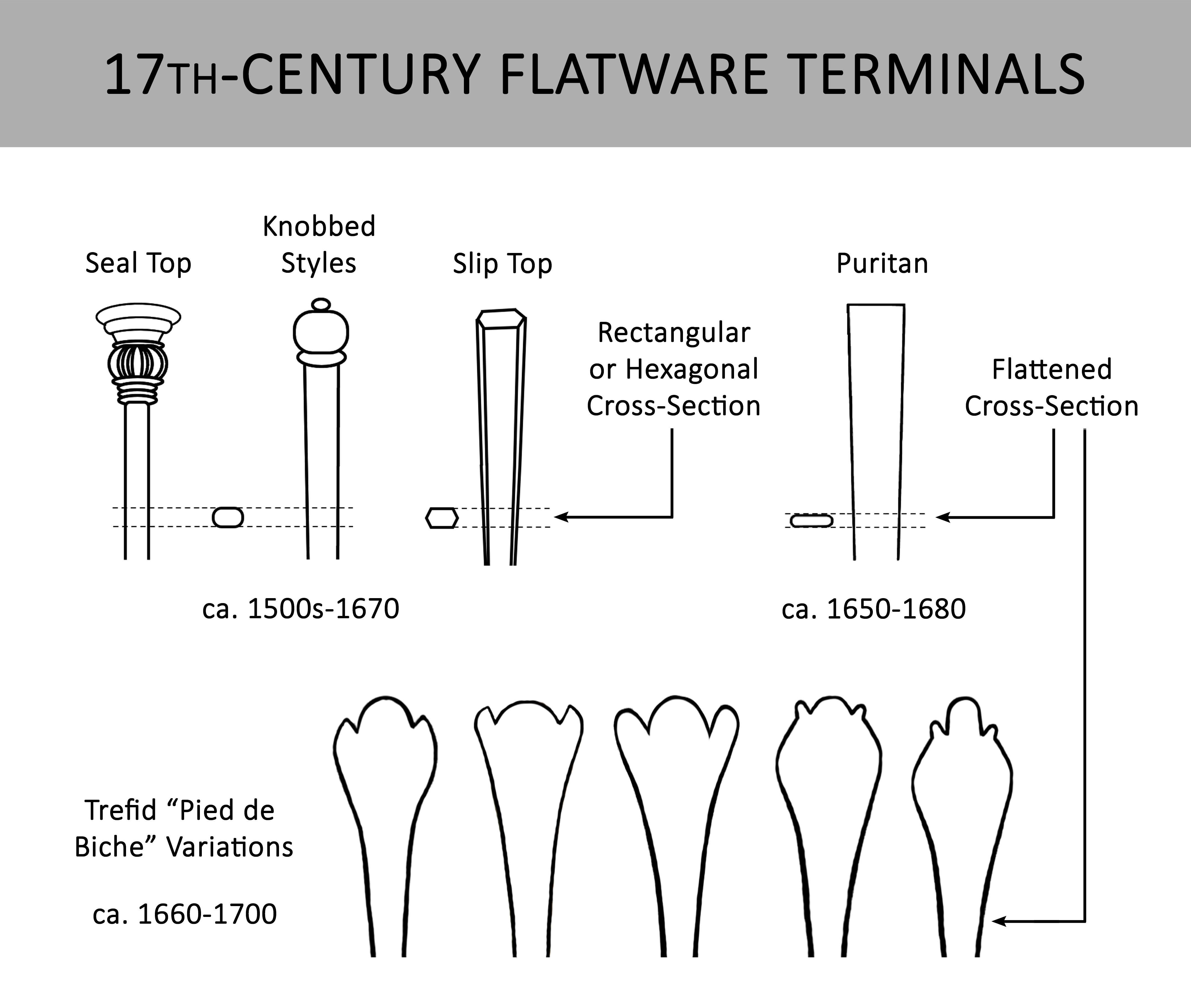
The following table provides a brief introduction to the styles of spoons most commonly found on U.S. archaeological sites. Each type will be accompanied by a simple line drawing. Additional illustrations depict chronological developments in bowl shape, back treatments, terminals, and stem shapes.
Table 1.
| Spoon Style | Defining Characteristics | Dating | |
|---|---|---|---|
| Knop or Knobbed |
|
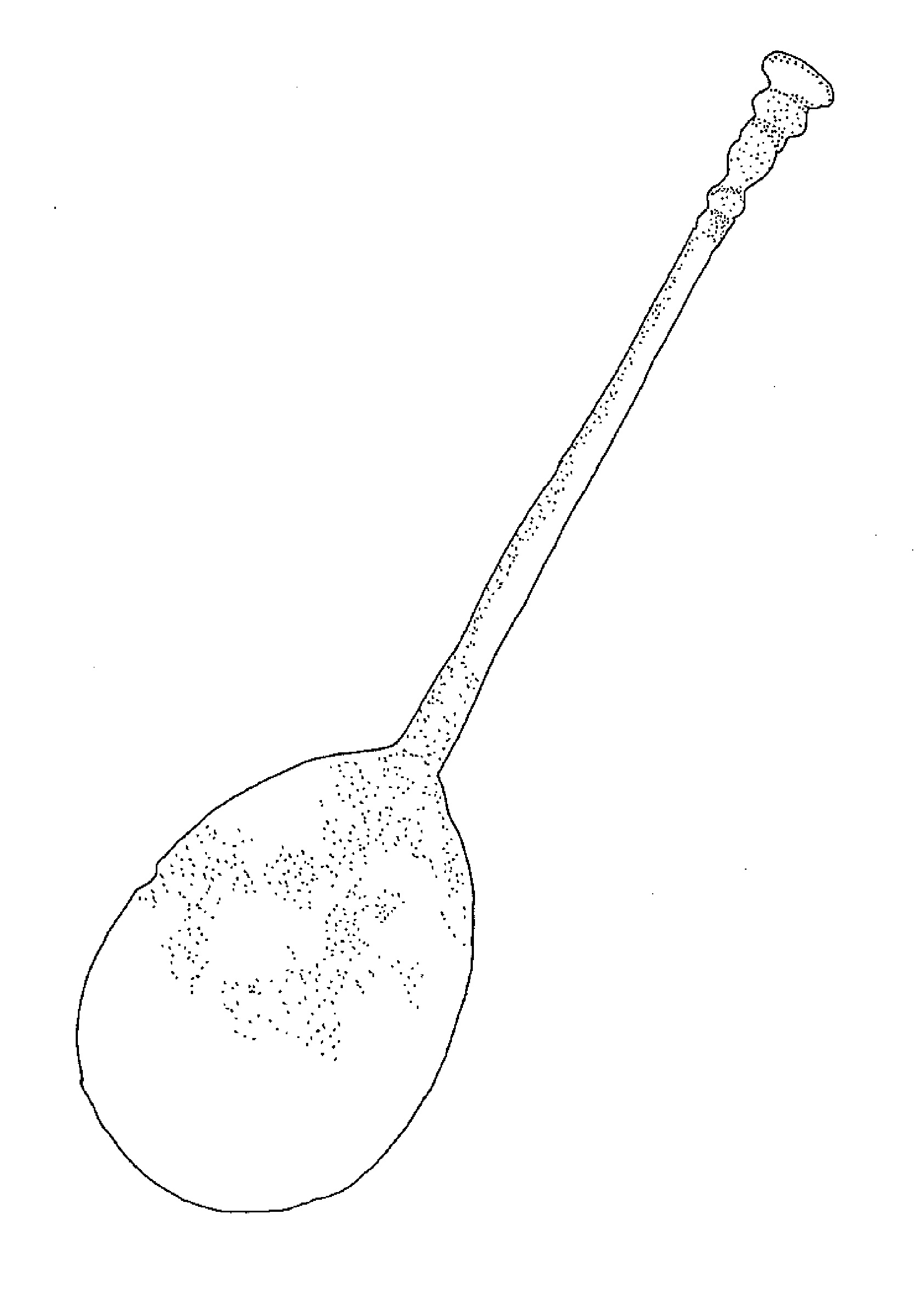
This style of spoon is characterized by decorative knobs (acorns or diamond points) on the terminals; the seal top and the apostle spoon (with figures of apostles or saints on the handle) are types of knobbed style spoons. Seal top – flat end of terminal; owners name or initials could be engraved on it. These spoons also typically had fig shaped bowls and stems that were hexagonal or sub-rectangular in cross section. |
Knobbed spoons date from the 16th century through the first half of the 17th century (Moore 1987:5). |
| Slip Top |
|
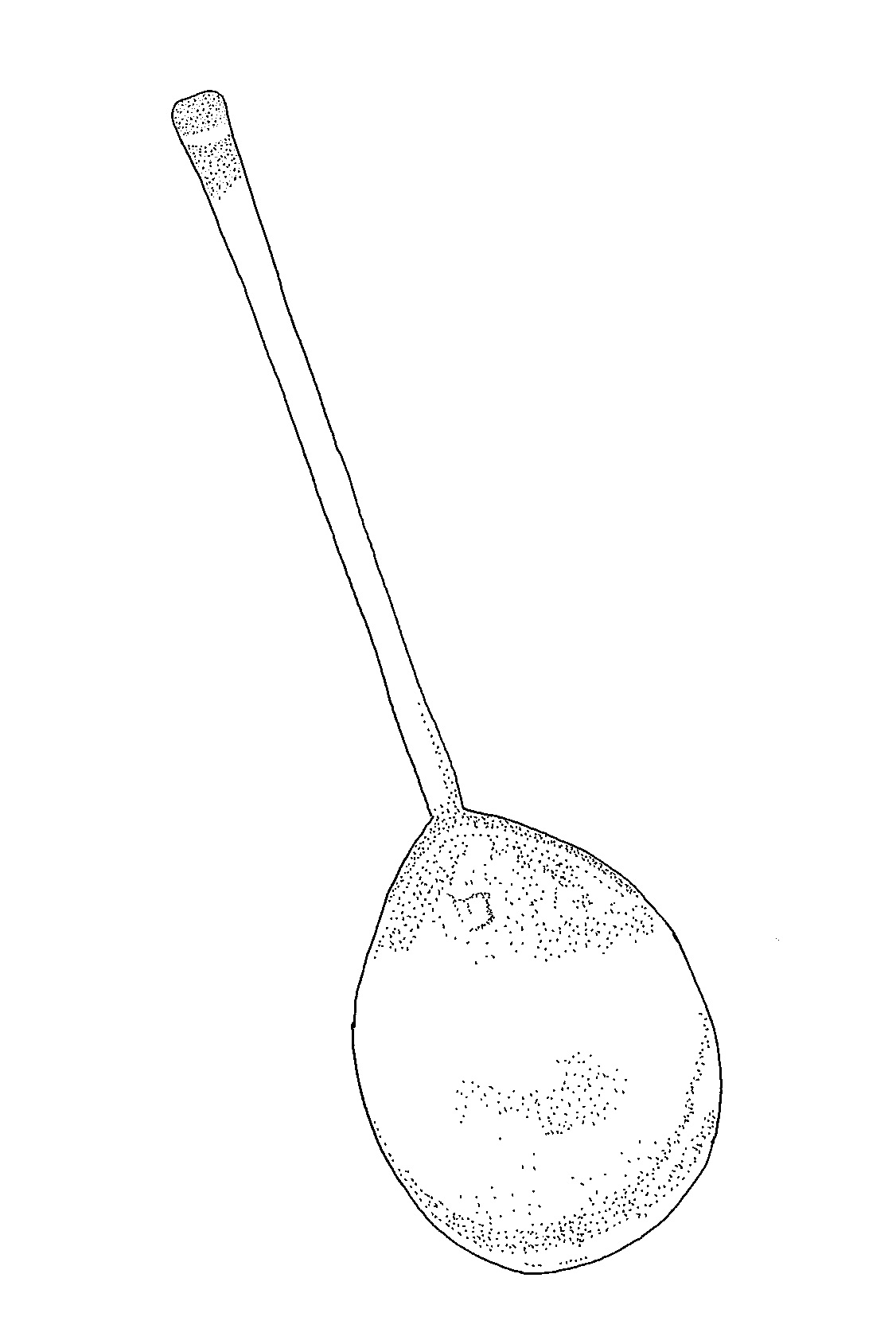
Like knop spoons, slip top spoons are characterized by hexagonal stems and fig shaped bowls. The end of terminal is cut off at an angle on slip top spoons. |
Slip top spoons date to the late 16th and early to mid-17th centuries. |
| Puritan |
|
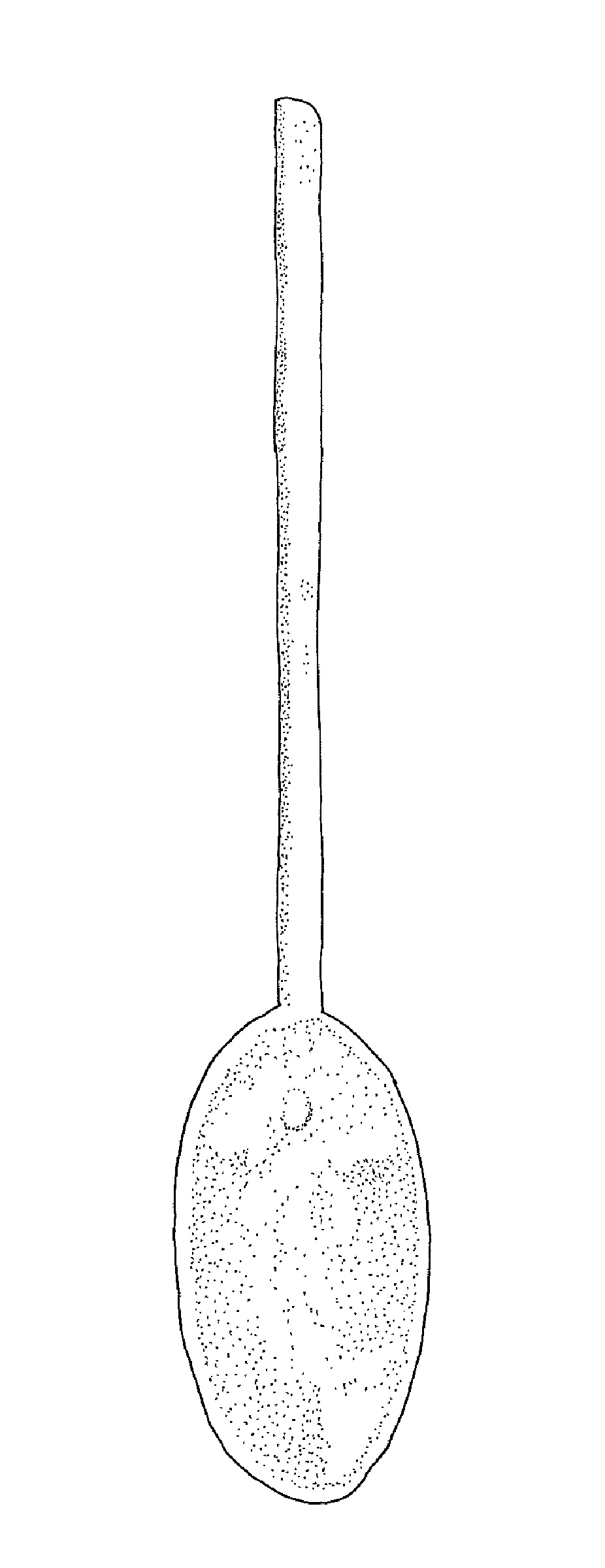
Puritan spoons are characterized by flattened stems and elliptical bowls. Puritan spoons are sometimes filed with notches at the top of the handle (in what might be a precursor to trefid spoons of the later 17th century). |
Puritan spoon are most common c. 1650 – late 17th century. According to Snodin (1974), the earliest English examples appear in the 1630s. |
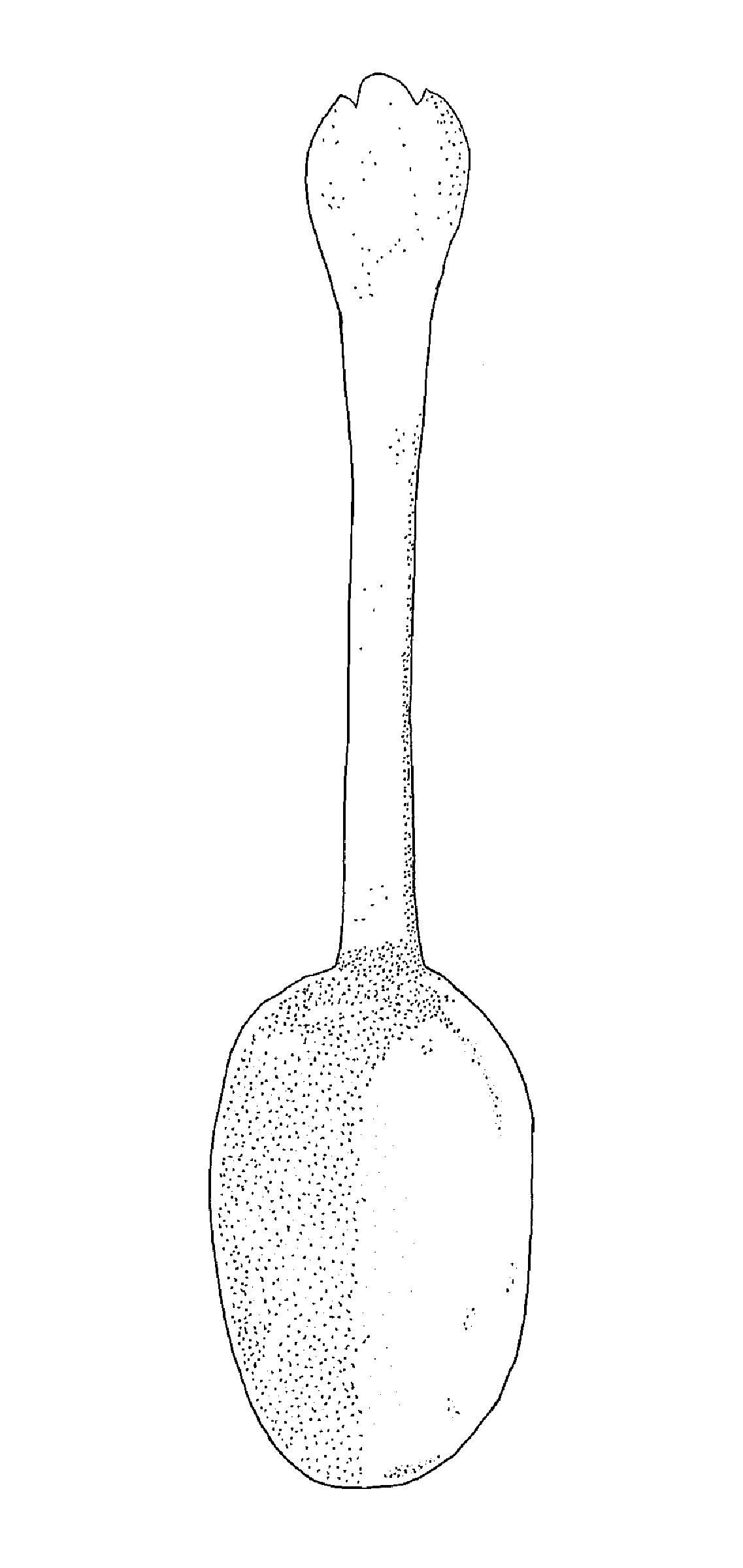
| Trefid |
|
Trefid spoons have a terminal end with three lobes and two notches, often with the appearance of a cloven hoof. They are also called “pied de biche.” Trefid spoons are characterized by a rat-tail support running longitudinally under the spoon bowl (see Bowl Reinforcing below). They could be either cast or produced by the traditional method of hammering. Trefid spoons are often seen with foliate designs or engraved initials (Moore 1987). |
Trefid spoons are commonly made between c. 1660 and 1700. |
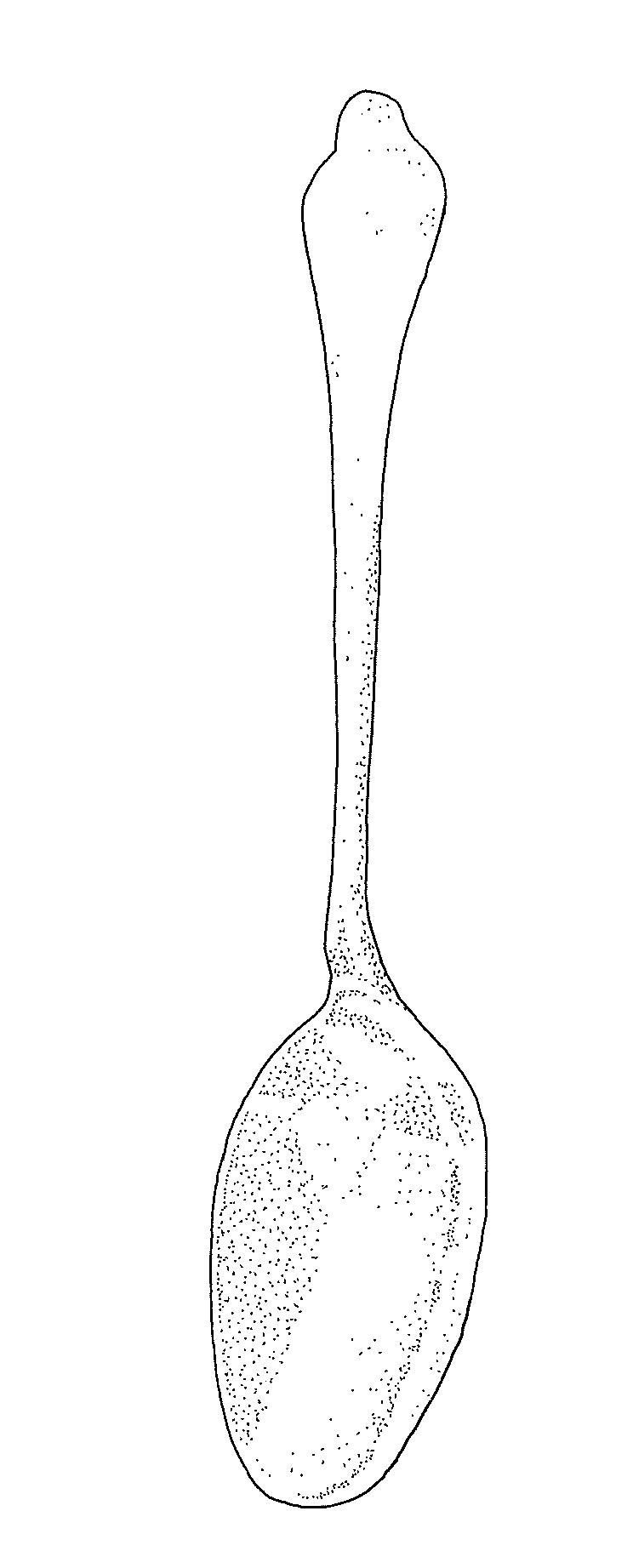
| Dognose, Wavy End or Shield Top |
|
In these spoons, the trefid notches disappear, but the end of the terminal still has a three lobed appearance. A rat tail supports the spoon bowl (see Bowl Reinforcing below) and the stem end sometimes has an upward turn. |
These spoons are common in the Queen Anne period (1690-1715). |
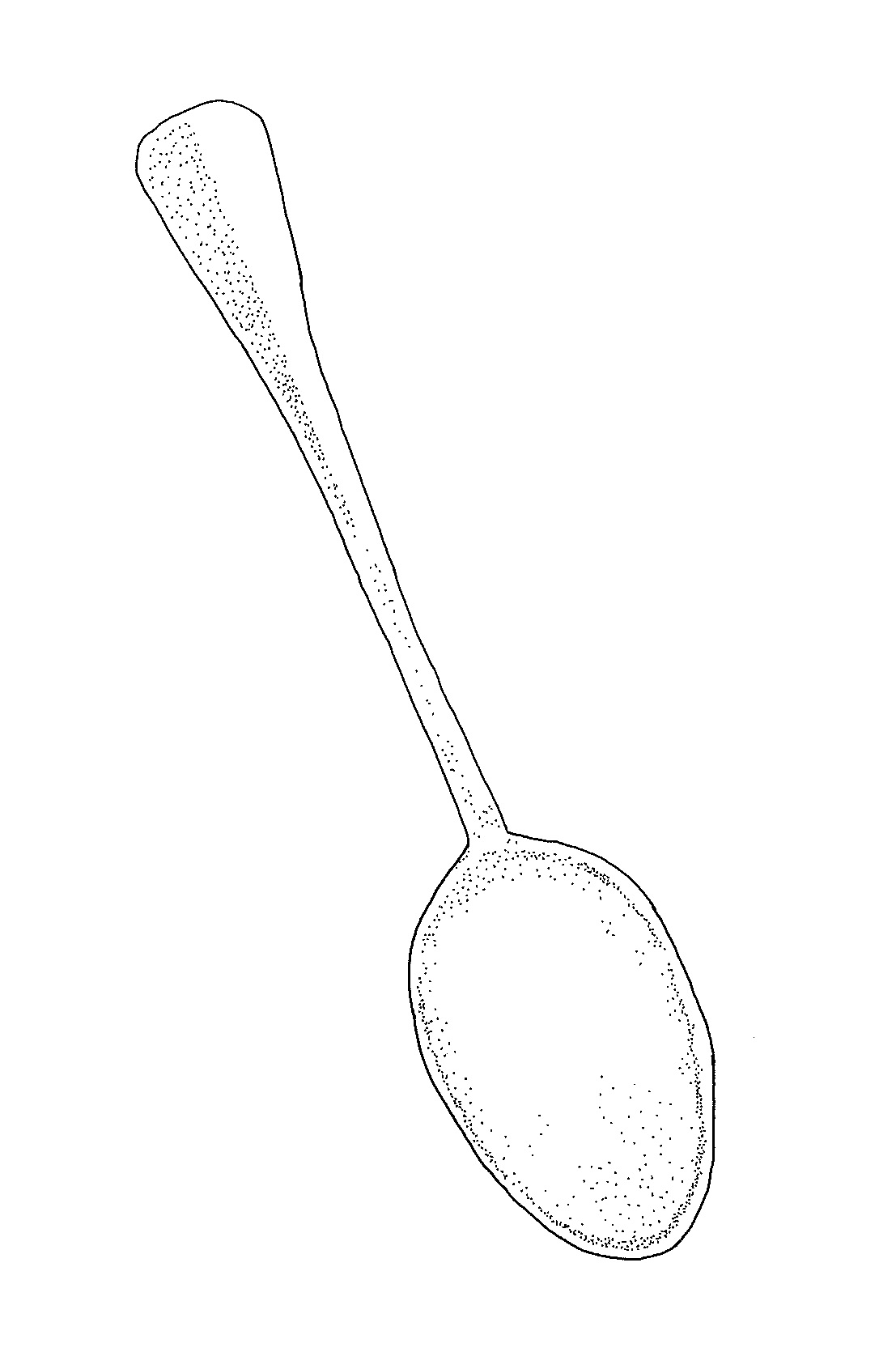
| Hanoverian |
|
Hanoverian spoons are characterized by rounded terminal ends that are often slightly upturned. |
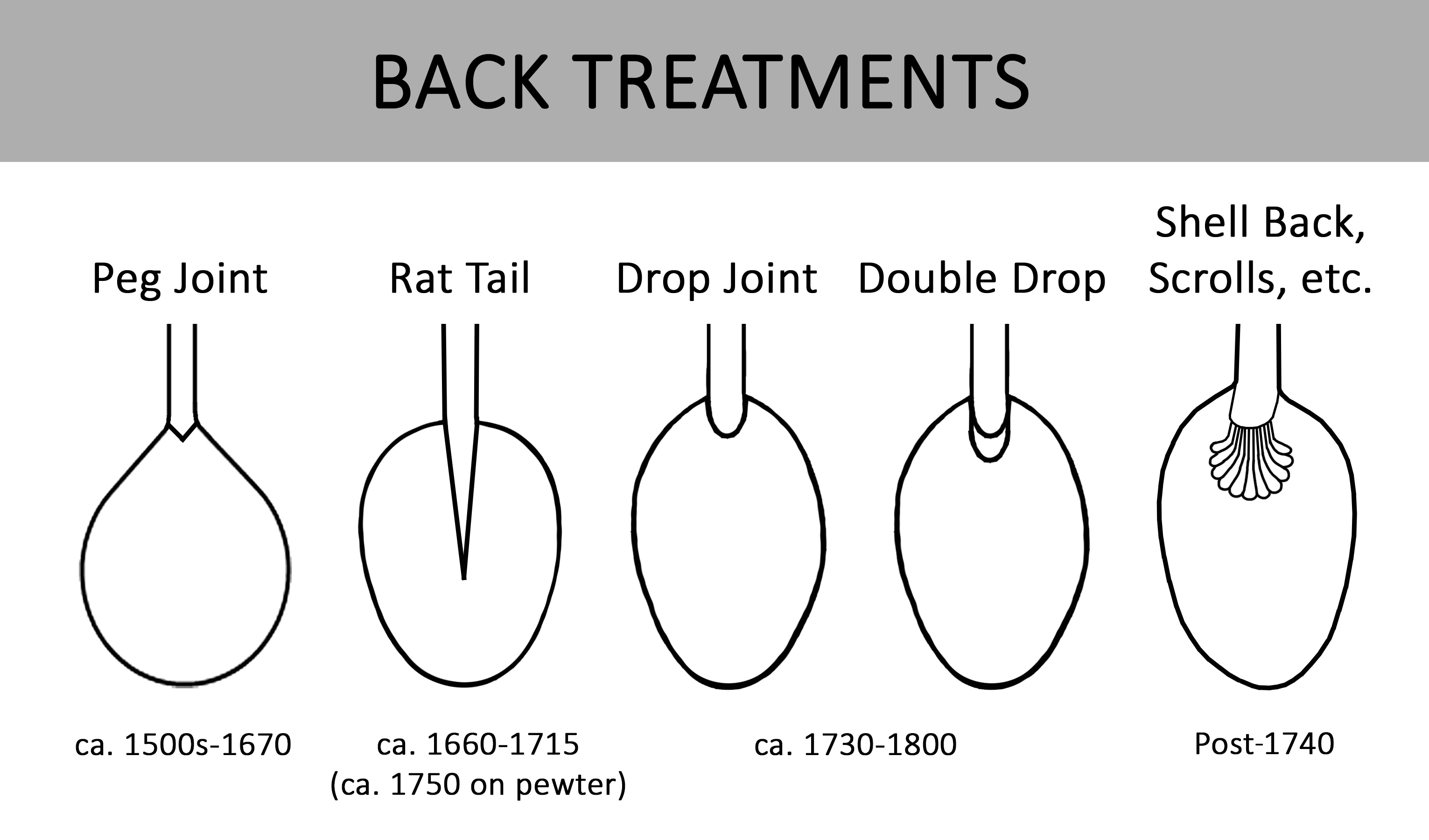
Hanoverian spoons date c. 1700 – 1760. Narrow and deep bowls with rat tails were more common to about 1730. Wider bowls were more common post 1730 and the rat tail support was replaced with drop reinforcing. Hanoverian style spoons survive into the 1780s but began to be replaced in the 1760s by the Old English style spoon. |
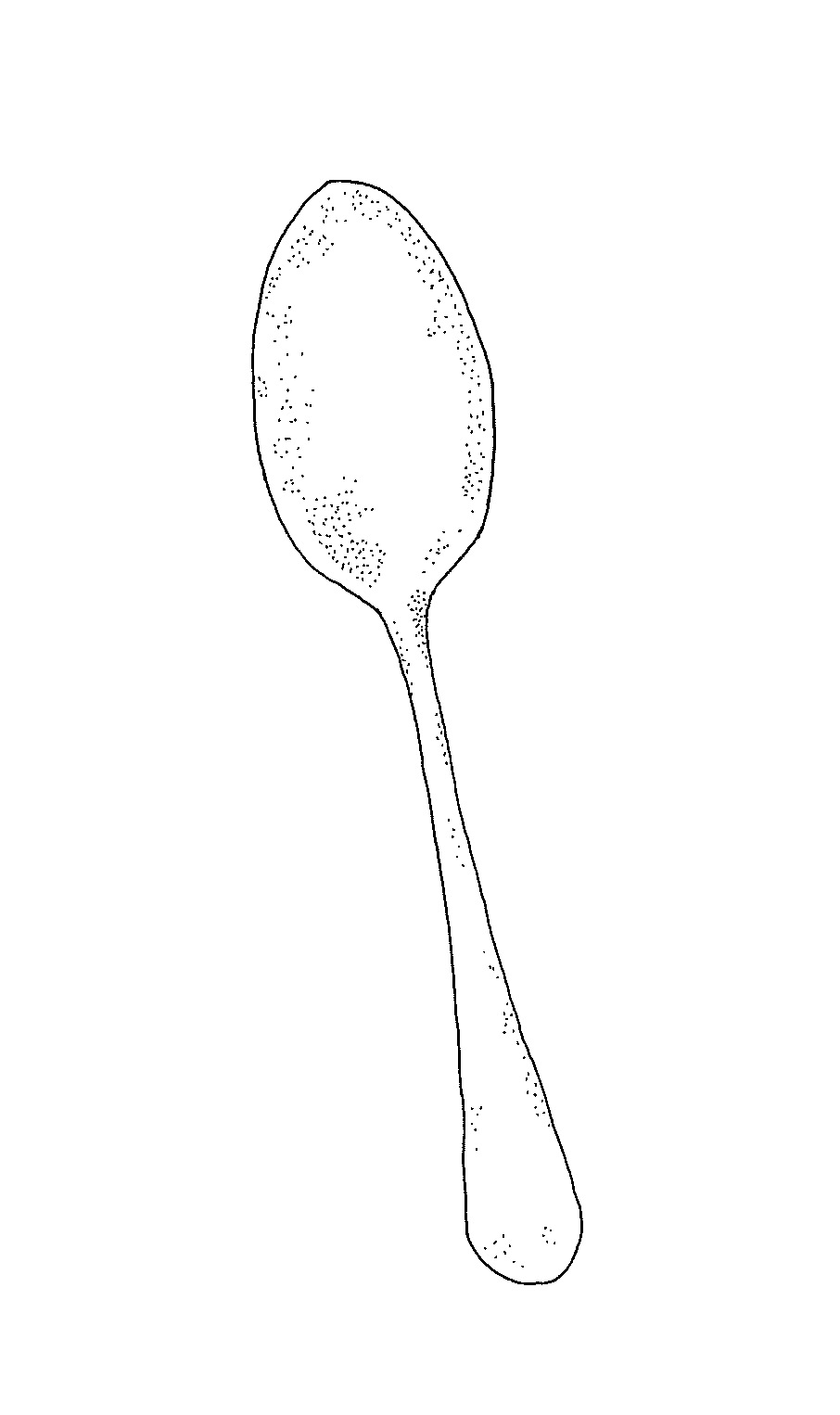
| Old English |
|
Old English spoons are similar to Hanoverian, with rounded ends and egg-shaped bowls The rounded terminal end of Old English spoons are turned down. |
Old English spoons were produced post 1750 and were most common c. 1770-1800. |
| Fiddle |
|
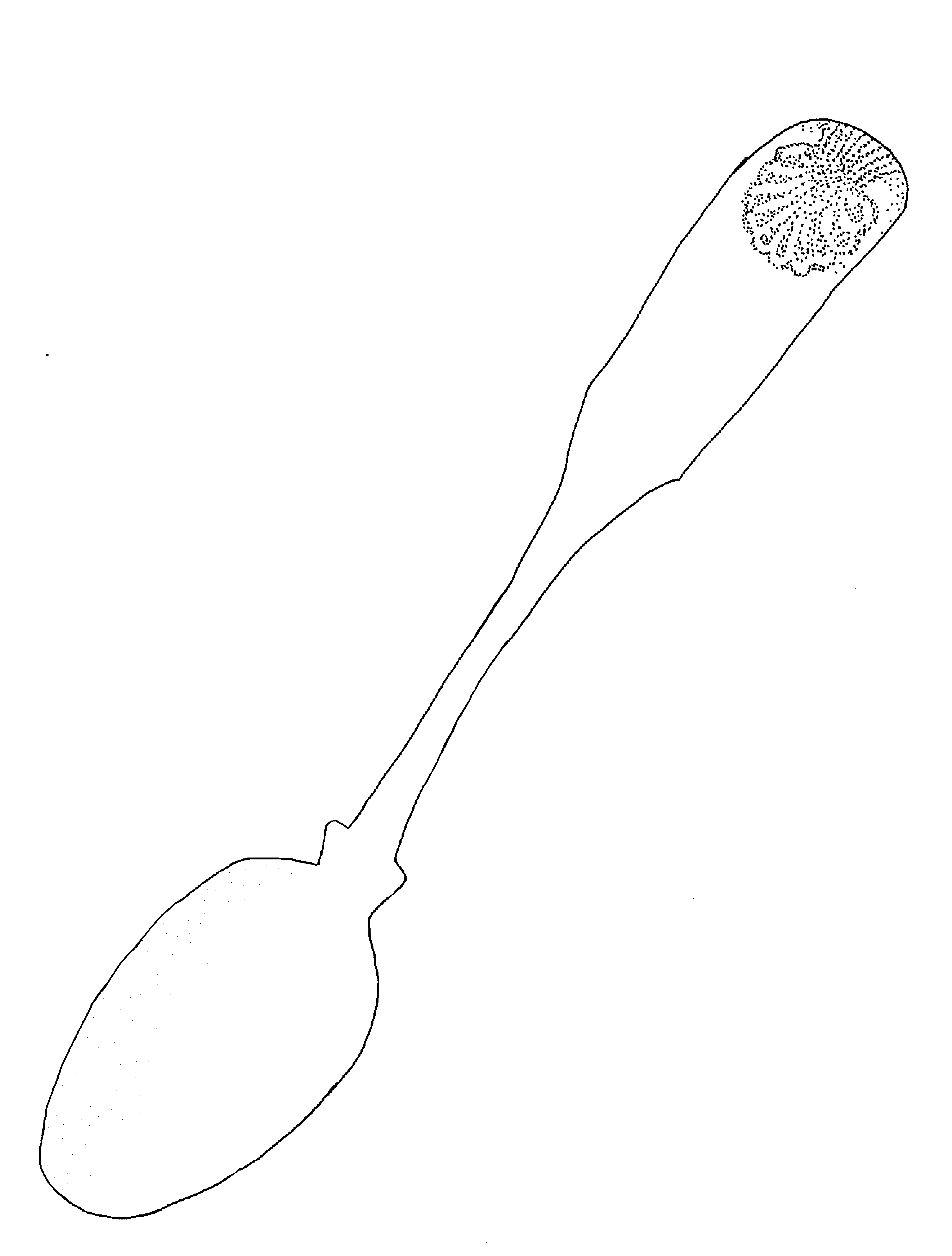
Fiddle spoons and forks have broad fiddle shaped handles that narrow abruptly from a broad, flat upper portion. There are a number of fiddle style variations and fiddle spoons and forks often display threading (incised lines outlining the stems/handles). |
This style begins around 1780 and grew popular around 1800 (Snodin and Belden 1976:48). Fiddle spoons dominated in the 19th century, but lost favor around 1900. |
| Spoon illustrations by Patricia Samford. | |||
Bowl Shapes
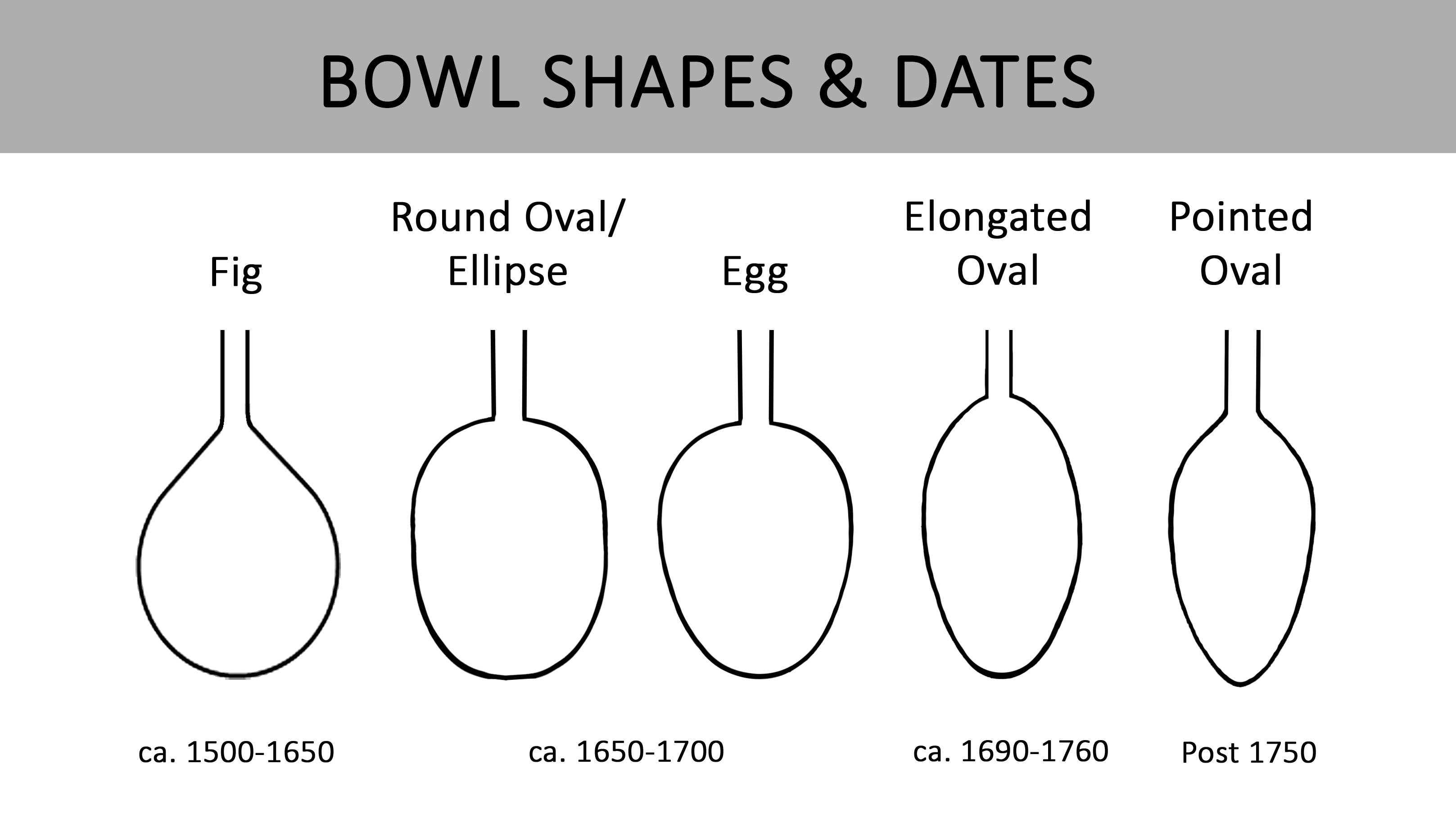
Spoon bowl shapes changed over time and are often associated with a particular style of spoon.
Bowl Reinforcing/Back Treatments
Handle/Terminals and Stem Shapes
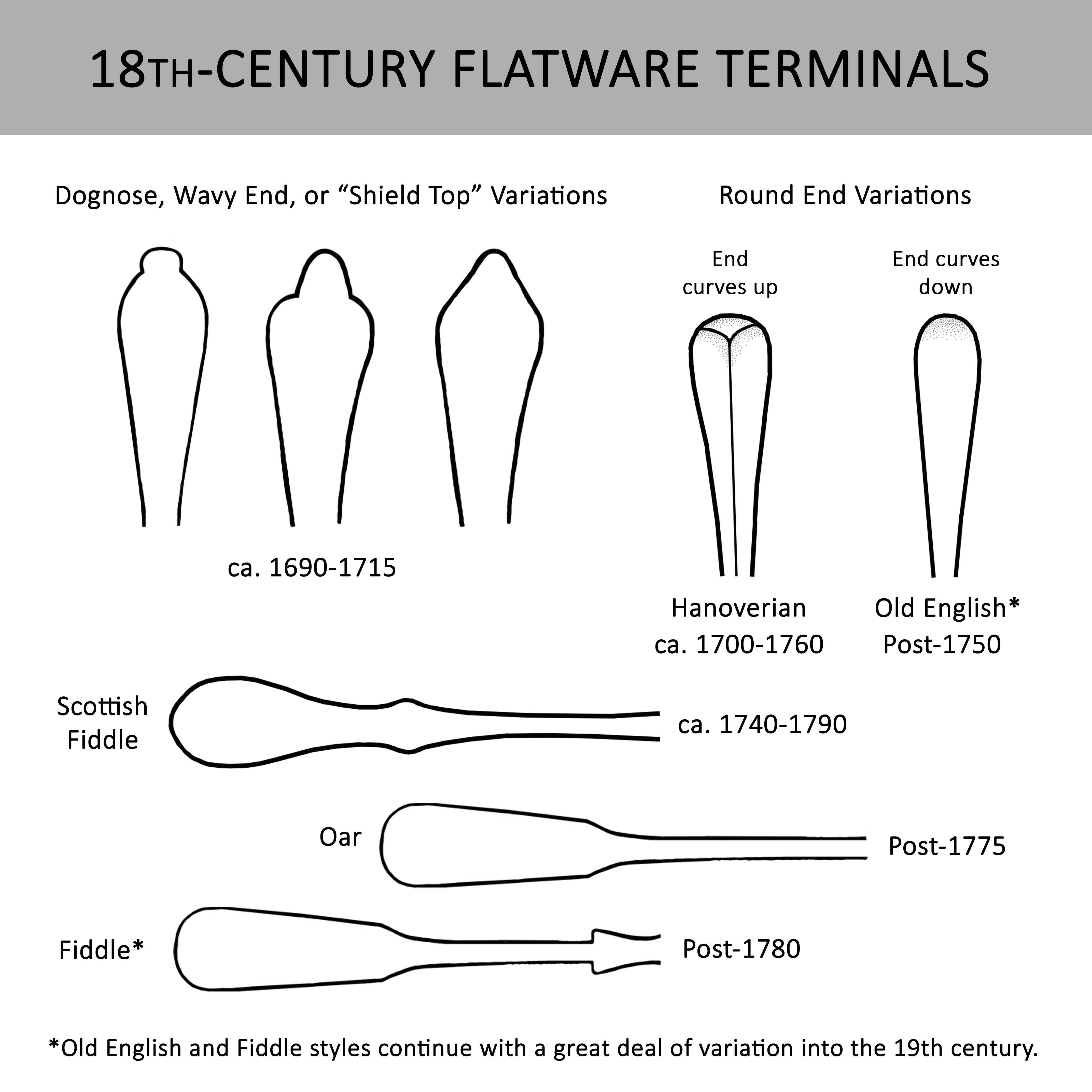
Previous four drawings by Sara Rivers Cofield.
References
2001 British Cutlery: An illustrated history of design, evolution, and use. York Civic Trust. London: Philip Wilson Publishers, Inc.
1911 "Spoon." Encyclopaedia Britannica. Vol. 25 (11th ed.). Cambridge University Press. p. 733
1993 An Identification and Value Guide 1830’s to 1990’s American Sterling Silver Flatware. Books Americana, Florence Alabama.
1987 Spoons 1650-1930. Shire Album 211. Shire Publications Ltd., Buckinghamshire.
1999 Cutlery for the Table: A History of British and Pocket Cutlery. Sheffield, England: The Hallamshire Press.
1969 A Guide to Artifacts of Colonial America. Philadelphia, PA: Alfred A. Knopf, Inc.
2007 Old Base Metal Spoons; A Guide to Antique Pewter Cutlery and its Marks. JM Classic Editions. Originally published in 1908.
2022 Utensil Handout. Workshop material manuscript on file at the Maryland Archaeological Conservation Laboratory, Jefferson Patterson Park and Museum.
1974 English Silver Spoons. Letts Collectors’ Guides. Charles Letts Books Limited, London. 1974. Revised edition 1982.
1976 Collecting for Tomorrow; Spoons. BPC Publishers, Ltd., Great Britain.
1982 Cutlery from the Fort at Coteau-du-Lac, Quebec. Parks Canada. History and Archaeology 61.