Jaw Harps
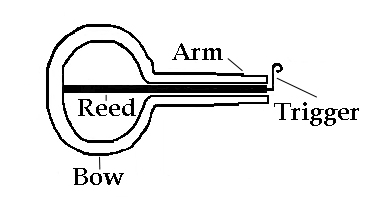
A jaw harp is a simple musical instrument consisting of a two-tined copper alloy or iron frame with a steel tongue (also called a reed) between the tines. When found archaeologically, the flexible tang has usually disintegrated, or remains only as a remnant where it joins the head of the bow.
Jaw harps are believed to have originated in Asia several thousand years ago and are a relatively common archaeological finding on North American sites dating from the 17th century on.1 They were regularly included as goods exchanged in the fur trade, beginning in the early 17th century. Although vast quantities of jaw harps were imported into England from the Low Countries well into the 18th century, Birmingham became a center of production for jaw harps (Wright 2011).
Jaw harps were manufactured using three primary methods: casting, forging and cold bending from a rod (Kolltveit 2006:43). The first method is almost always used for creating copper alloy jaw harps and the latter two for instruments made of iron. In an extensive sample documented by Kolltveit, the most common material for jaw harps was iron, and 82% of the iron jaw harps sampled were forged. The manufacture method is reversed for copper alloy jaw harps; Kolltveit’s sample showed 87% were made by casting (Kolltveit 2006:41).
Kolltveit’s (2006) research focuses on jaw harps from Europe from the medieval period to the end of the 19th century and should be consulted for detailed information on jaw harp history and manufacture. This essay will focus only on the post-medieval jaw harp forms likely to be found in North America.
Iron jaw harps in the collections of the Maryland Archaeological Conservation Lab out-number copper alloy specimens over 2 to 1.
Jaw Harp Typology
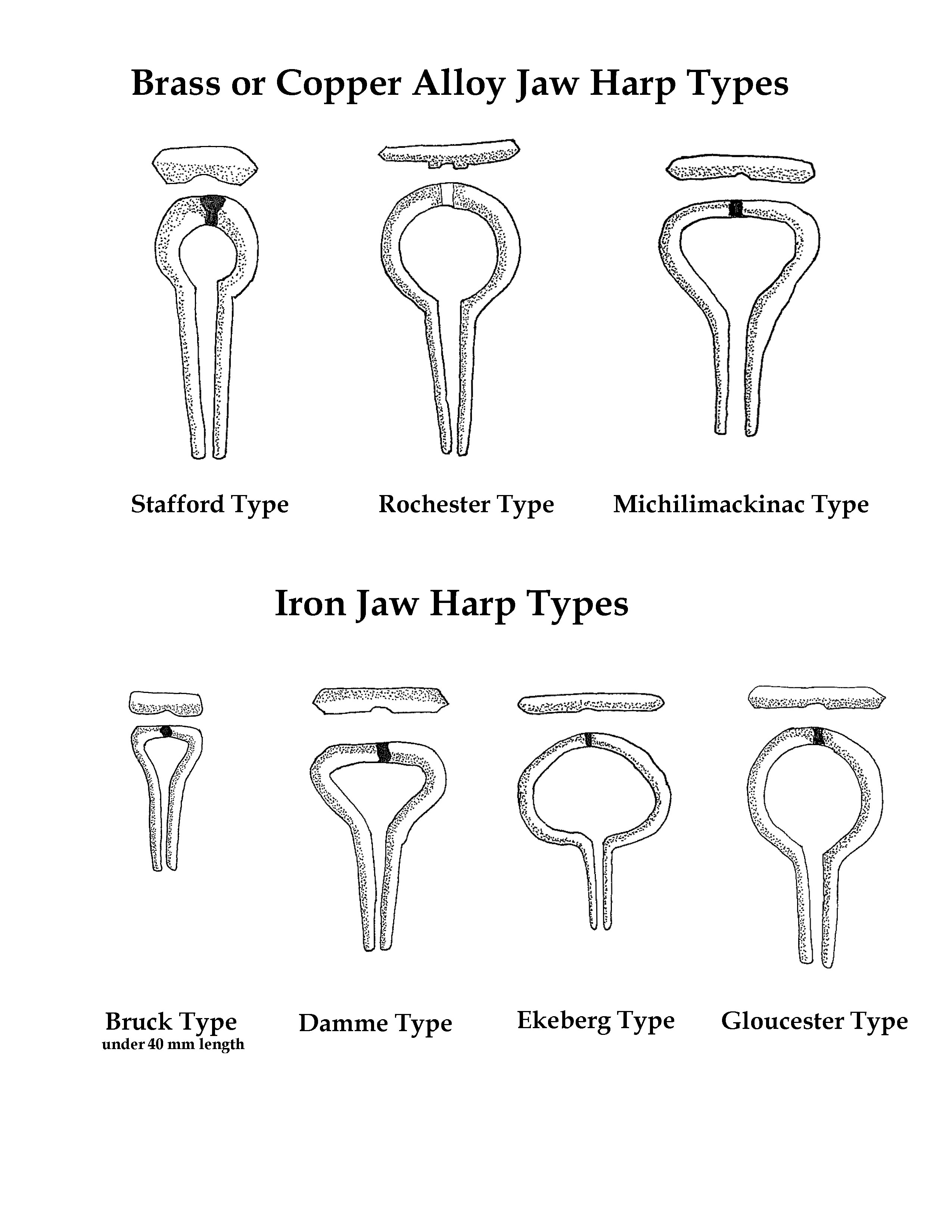
Kolltveit (2006) has created a named typology of jaw harp shapes and Wright (2011) shows 5 of those shapes that have been found on archaeological sites in North America. A sixth shape – Michilimackinac – was added by Wright (2011: 212). A seventh type (Damme) has been found in the MAC Lab collections and is also included here. These post-medieval jaw harp types, their primary characteristics, and date ranges are as follows:
Wright (2011:211) states that Stafford are the most commonly found jaw harp in America and available in a variety of sizes. This is followed by Gloucester. 19th and 20th century English mass-produced jaw harps show a wide variety of bow shapes (Kolltveit 2006:44).
Table 1. Jaw Harp Types
| Type | Shape | Dating and Citation |
|---|---|---|
| Damme | Iron. Large, open triangular bow, flattened frame top; diamond shaped cross section to bow. Hammered placement of reed. | Mid 16th to mid-18th centuries (Kolltveit 2006:54). |
| Gloucester | Iron. Large, open bows in a circular to oval shape; relatively short tapering arms; diamond shape cross section of bow. Hammered placement of reed. | Beginning of 16th century; very common by 17th century, but most common type up to the 20th century (Kolltveit 2006:65-66) |
| Ekeberg | Iron. Large, open D-shaped bow; diamond shape cross section of bow | Existed by 15th century. Most common in 19th century, but made into the 20th century (Kolltveit 2006: 54) |
| Bruck | Iron. Open triangular bow. Measure under 40 mm in length. | Circa 1475 to circa 1650. May be seen as late as c. 1700 (Kolltveit 2006:54). |
| Stafford | Copper alloy. Circular bow, created by casting. Tapering arms; diamond shape cross section. Hammered placement of reed. Heavy and solid with a thick frame. | Made possibly as early as 16th century. Made in 17th and 18th centuries and more common in 18th century (Kolltveit 2006:54). |
| Rochester | Copper alloy. Circular bow, created by casting. Hexagonal cross section of bow. Reed attachment created with thickened section of metal that juts out from around point of attachment. | 17th through mid-18th centuries (Kolltveit 2006: 54) |
| Michilimackinac | Copper alloy. Triangular bow with rounded to flattened top, Parallel arms. Similar to Bruck or Damme shape but made from copper alloy. | Found in 18th century contexts at Fort Michilimackinac, occupied 1715-1781 (Stone 1974; Wright 2011). |
Chronology/Dating
Kolltveit’s (2006:50-52) analysis has suggested that there is some chronological relevance in the ratio between the length of the arms and the overall length of the jaw harp. Earlier instruments (note that his work analyzed European jaw harps dating back as early as the 12th century), the arms are longer, comprising 65 to 85% of the overall length of the instrument. In 18th century jaw harps, the arm length only comprised 40 to 65% of the overall length. Kolltveit also noted a progression over time from small frames (also called bows) and long arms to shorter arms and large, open frames (2006:50-52).
Kolltveit illustrated maker's marks punched into the top of the bows of 14th century iron jaw harps excavated in the Netherlands.
Footnotes
1 Jaw harps have also been called mouth harps, Jew’s harps or juice harps.
References
2006 Jew's Harps in European Archaeology. British Archaeological Reports, International Series, No. 1500. Archaeopress, Oxford.
2009 The Jew's Harp in Western Europe: Trade, Communication, and Innovation, 1150-1500. Yearbook for Traditional Music 49:42-61.
1974 Fort Michilimackinac 1715-1781; An Archaeological Perspective on the Revolutionary Frontier. Publications of the Museum Michigan State University in cooperation with the Mackinac Island State Park Commission.
2011 The Jew's Harp Trade in Colonial America. The Galpin Society Journal 64 (March 2011): 209-218.