Bottle Seals
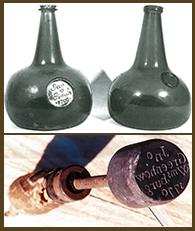
Colonial and post-colonial sites in the eastern United States often yield bottles to which stamped glass seals have been affixed. These bottle seals, typically round in shape, bear identifying marks of individuals, taverns, merchants, vintners, or manufacturers. Bottle seals were generally affixed around the shoulder of the bottle. The earliest known seals on glass bottles occurred as early as 1571, with the use of bottle seals widespread throughout Europe by the 18th century (McNulty 2004:53). Sealed bottles cost up to 5 pence extra per dozen by the late 17th century (Dumbrell 1983:152).
Shortly after a bottle had been blown or molded, a small pad of molten glass was placed on the still-warm vessel. A die (usually brass, but ceramic dies have also been noted) containing initials, a name, or some other motif, was used to stamp the molten glass (Dumbrell 1983, Roviello 2001). A type of seal produced during the 17th and early 18th centuries involved the use of interchangeable letter heads. These letters could be arranged in desired combinations and stamped onto the molten seal glass. Known as matrice seals, they are easily identified by the distinct oblong or rectangular die impression visible around each letter (Dumbrell 1983:157, 186).
Designs on bottle seals fall into several major categories: names or initials, armorial or coats of arms, merchant-style marks, and commercial marks.
Names or Initials – Initials and full names (or a combination of initials and names), sometimes with dates, usually indicate an individual bottle owner. The purchase of personalized bottles was almost certainly viewed as a mark of status. Diarist Samuel Pepys noted with some pride in October of 1663: "Thence to Mr. Rawlinson's and saw some of my new bottles made, with my crest upon them, filled with wine, about five or six dozen" (Pepys 1663).
The date on a seal may not always correspond to the year the bottle was manufactured, but could represent a marriage or birth or a particular vintage, for example (Jones 1986). In the 16th and 17th centuries, seals were sometimes stamped with three initials, with two letters representing the first names of a husband a wife, and the third representing their surname (Ruggles-Brise 1949, Noël Hume 1969). Noël Hume (1969:61) notes that this practice died out in the 18th century.
Armorial or Coats of Arms – Armorial seals contain coats of arms or other armorial devices.
Merchant-style Marks – Merchant-style seals, which appear on bottles between circa 1660 and 1760 (but most commonly between 1680 and 1730), contain a mark based on the "rune four" symbol (Dumbrell 1983:155; Van den Bossche 2001:108). This symbol, consisting of the numeral 4 joined by a vertical bar to a set of XX's, makes reference to the Four Gospels, the four seasons, the four elements (earth, air, water and fire) or the four evangelists (Van den Bossche 2001). Merchant marks appear to have been used by large guilds and corporations as a way to identifying ownership (Dumbrell 1983). They often appear on colonial American archaeological sites in conjunction with the initials of individuals who owned the land where the site was located.
Commercial Marks – Commercial bottle seals bear the name of commercial establishments, like taverns, text or designs that indicate what is contained within the bottle, and/or manufacturer's information. It was a common practice to purchase bottle of wine from taverns in the colonial period – a seal bearing a mark of the tavern where the wine was purchased would help insure that the empty bottle would make its way back to the tavern to be refilled for the next customer (Leeds 1941). Commercial seals from the Maryland archaeological collections include examples for olive oil, liquors like absinthe and kirsch, mineral water, and specific types of wine. Other seal types included whiskey, bitters, beer, and cordials.
The metal dies used to stamp the seals were usually circular, but other shapes – ovals, oblongs, and squares – have been recorded. Oval stamps appear to have been more typical of 19th-century commercial seals (Dumbrell 1983:186).
For more information and data on bottle seals found in the United States, visit the Culture Embossed website at https://www.cova-inc.org/wineseals/.
References
1983 Understanding Antique Wine Bottles. Antique Collector’s Club, Baron’s Publishing, Woodbridge, Suffolk.
2004 Dutch Glass Bottles of the 17th and 18th Centuries; A Collector’s Guide. Medici Workshop, Bethesda, Maryland.
1969 A Guide to Artifacts of Colonial America. Philadelphia: University of Pennsylvania Press.
1663 The Diary of Samuel Pepys; Daily Entries from the 17th Century London Diary. Website accessed April 17, 2014. http://www.pepysdiary.com/diary/1663/10/23/.
2001 Wine Bottle Seals of Colonial Southern Maryland. St. Mary’s College of Maryland. In vertical file, JPPM.
1949 Sealed Bottles. Country Life, London.
2001 Antique Glass Bottles; Their History and Evolution (1500-1850). Antique Collectors’ Club, Baron’s Publishing, Woodbridge, Suffolk.