Forks
Introduction
This essay will provide basic dating information, shapes, and characteristics for the types of forks commonly found on U.S. archaeological sites dating from the 17th through the 19th centuries. While some examples of 20th-century forks are included on this webpage, the reader is advised to consult printed sources and websites devoted to the wide range of patterns and styles that are characteristic of this period. For makers' marks, hallmarks, in-depth discussions of materials and plating techniques, and technology production changes over time, the reader is advised to seek more comprehensive sources listed in the References section.
Unlike knives and spoons, forks were relative latecomers to Britain and were not in wide use until around the early fourth quarter of the 17th century (B. Brown 2001:14). Indeed, the earliest use of forks in Britain was not for transferring food to the mouth (this was done with a knife), but for holding down meat for cutting (P. Brown 2001:81). In the first half of the 17th century, forks and knives were often paired as a set contained in a carrying case for travel (Mitchell 2001:25). By the early 18th century, fork use had extended to the middle classes (Mitchell 2001:27). Spoons, forks and knives began to be used together during the late 17th century (Moore 1987:8), with matching services not common until the late 18th century (Snodin and Belden 1976:7). During the 18th century, fork and spoon design changed slowly, particularly in silver flatware (P. Brown 2001:101).
Fork Anatomy
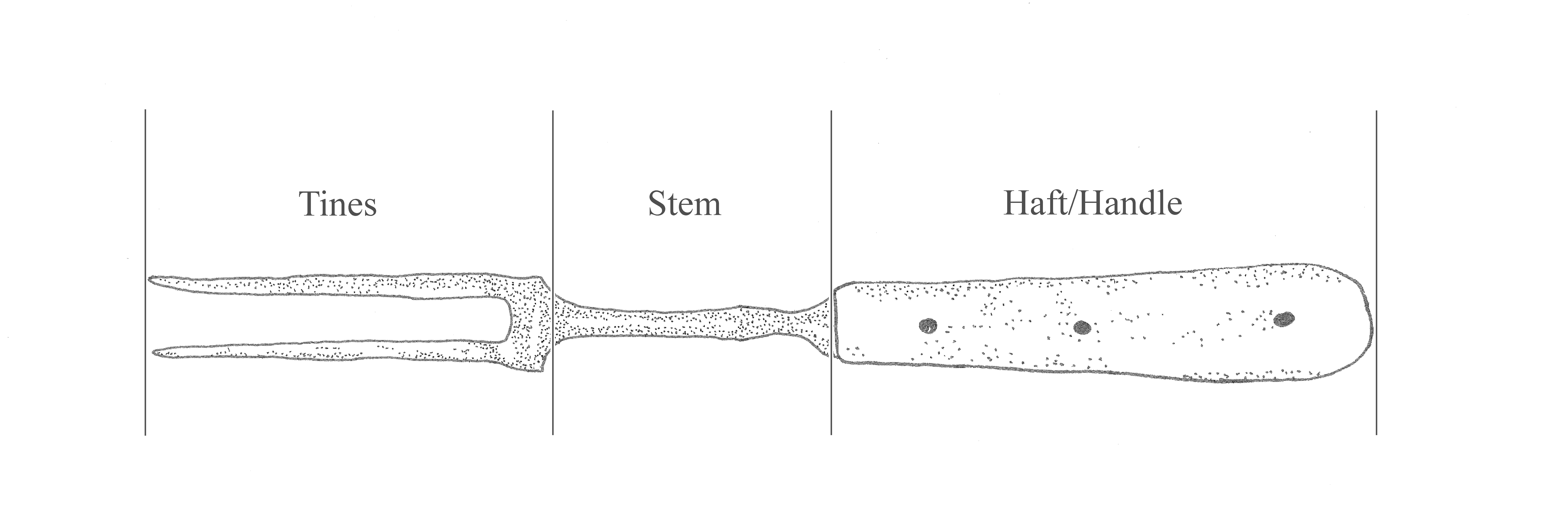
The number of fork tines—from two to four—cannot always be used as a reliable dating method (Wilson 2012:194). For example, two-tined forks produced in steel were common in Britain and North America from the last quarter of the 17th century to the beginning of the 19th century, but three-tined forks in silver were produced in England in the 17th century (Noël Hume 1969:180). In general, though, the number of tines increased through time, as the fork changed function from holding down food for cutting to that of transferring food to the mouth. The first four tine fork appeared around 1760 with the "Old English" flatware pattern (Moore 1999:233), and by the 19th century, forks almost always have four tines.
Forks in the MAC Lab collection fall into two main types: tanged forks and forks made completely from metal. Haft (handle) shape and decoration are the most useful characteristics for dating all metal forks; they followed the same designs as spoons of the same period (Wade 1982:29). In general, tanged forks date earlier than the all-metal forks in the Maryland collections.
Tanged forks have tangs—projections or extensions used to attach the handle to the metal business end of the fork.1 Many of the forks in the MAC Lab collections have bone handles and tangs of different shapes and configurations were used to attach the handles/hafts (Table 1). Hafts were also produced in ivory, antler, wood, and in metals like silver; these are less commonly found. Occasionally ceramic flatware handles appear in archaeological assemblages; ceramic handles (Chinese hard paste porcelain, English soft paste porcelain, refined earthenware) were introduced by the 1720s (P. Brown 2001:101).
Table 1. Types of tang haft attachments for forks and knives (after P. Brown 2001:156)
| Tang Style | Defining Characteristics | |
|---|---|---|
| Scale Tang |
|
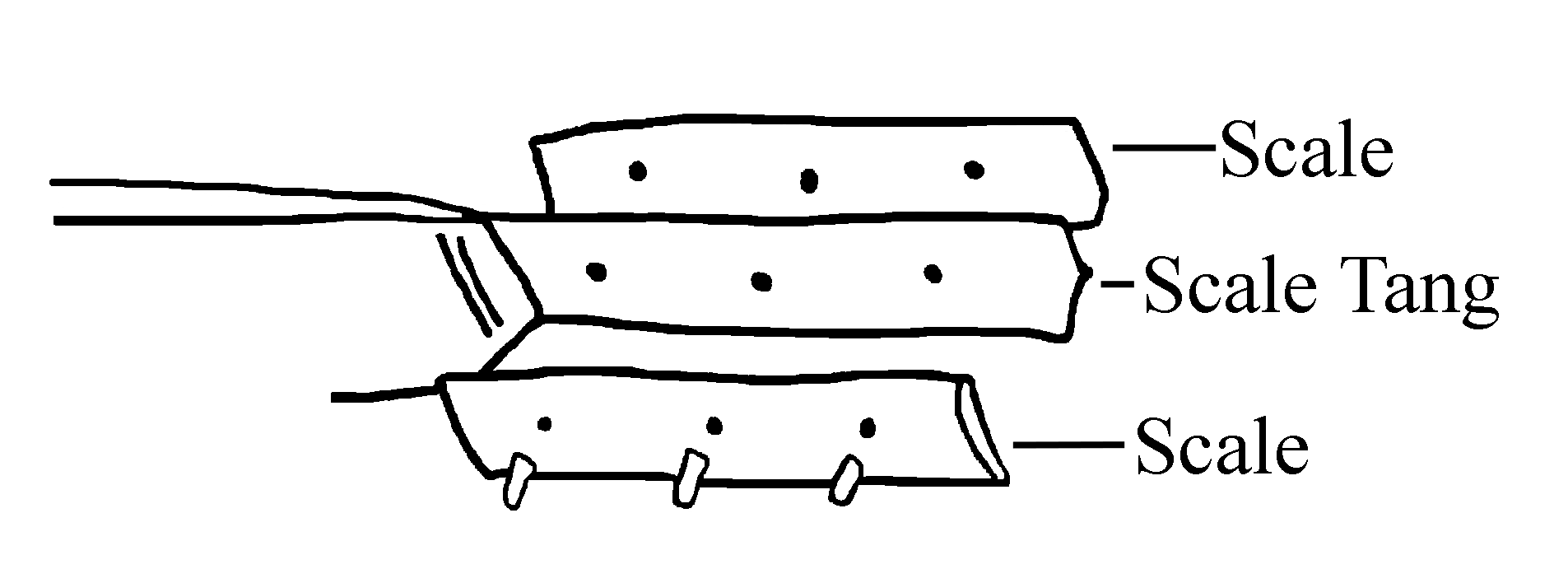
A scale tang represents a continuation of the fork shank as a flat plate to which scales (generally two pieces of shaped bone or wood) are fitted on either side with rivets. |
| Pin and Knock-on Tangs |

|
A pin tang is a non-tapering metal spike used with a resin-based filler inside a hollow utensil handle, like those made of ceramic (Moore 1995:23). A knock-on tang is a pointed spike onto which a handle is hammered. Knock-on tangs reach approximately three-quarters of the way to the end of the haft (Moore 1999:276). |
| Through Tang |
|
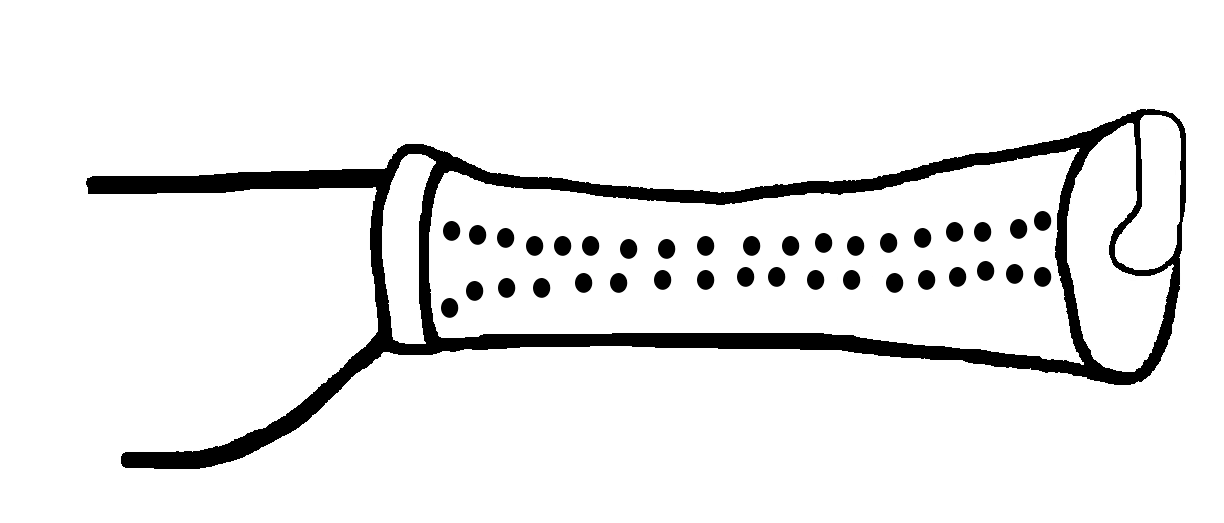
With a through tang, a thin metal rod runs the entire way through the length of the handle, coming out at the end and then capped where it protrudes with a disc washer or bent over like a candle wick. |
| Traverse Tang |
|
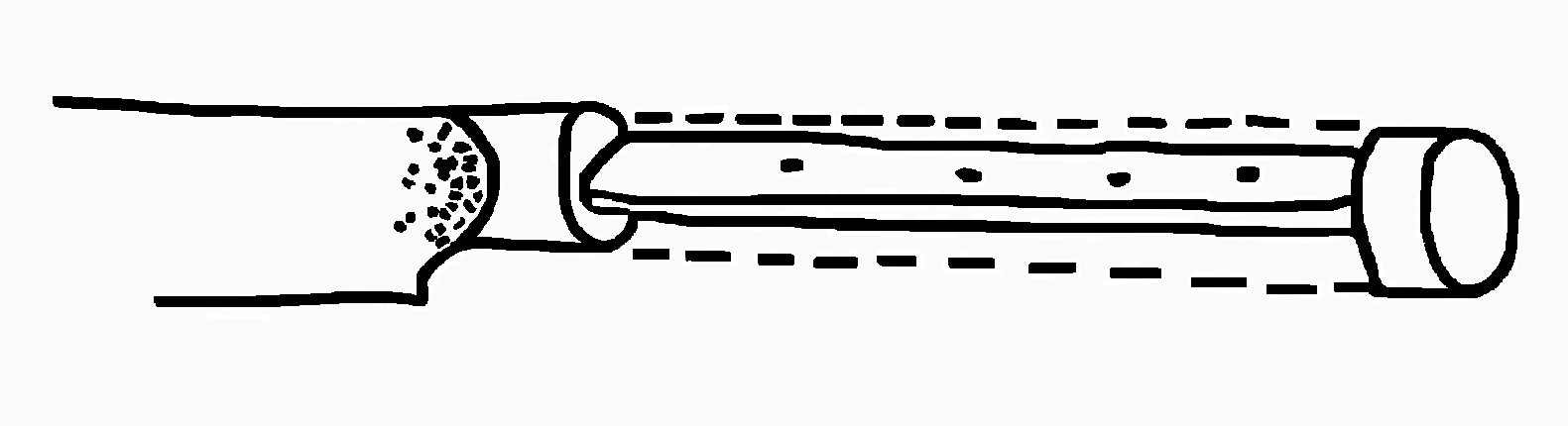
Traverse Tang – a scale tang that is placed at right angles to the plane of the fork. |
Haft or handle shapes can provide dating clues. Cylindrical or tapered round hafts were seen in the 17th c. in ceramic and other materials (Moore 1995:22). The pistol grip – one with a bulbous projection at the end of the haft – became common during the 1720s, before gradually being phased out in the 1770s for flat ended or diagonally truncated hafts (Moore 1999: 22-24).
Other clues in all metal forks can provide dating assistance. From circa 1670 to circa 1770, spoons and forks were set at the table with their bowls and tines facing down (Pickford 1983:19). In order for any crests or initials to be visible at the set table, they were placed on the backs of the utensil stems and hafts/handles. Additionally, in order for the spoons and forks to rest steadily on the table, the stem ends were turned up along the front sides of the utensils.2
While molded and engraved designs switched to the fronts of spoons around 1770 when these utensils began to be placed bowl side up on the table, forks continued to be placed tines down. The tops of forks continued to turn up until around the turn of the 20th century, when they became straight (Pickford 1983:19).
Footnotes
1 Knives are also attached to hafts with tangs.
2 For spoons, turned up ends and crests and initials on the backs of the utensils are typical of Trefid, Dog Nose, and Hanoverian patterns.
References
2001 An Introduction to Evolution and Design. In British Cutlery; an Illustrated History of Design, Evolution and Use. Edited by Peter Brown. York Civic Trust, Philip Wilson Publishers, London, pp. 11-18..
2001 British Cutlery; an Illustrated History of Design, Evolution and Use. York Civic Trust, Philip Wilson Publishers, London.
2001 The Clerk's View. In British Cutlery; an Illustrated History of Design, Evolution and Use. Edited by Peter Brown. York Civic Trust, Philip Wilson Publishers, London, pp. 19-29.
1995 Table Knives and Forks. Shire Publications.
1999 Cutlery for the Table: A History of British and Pocket Cutlery. Sheffield, England: The Hallamshire Press.
1969 A Guide to Artifacts of Colonial America. Philadelphia, PA: Alfred A. Knopf, Inc.
1983 Silver Flatware; English, Irish and Scottish 1660-1980. Antique Collector's Club, Woodbridge, Suffolk.
1976 Collecting for Tomorrow; Spoons. BPC Publishers, Ltd., Great Britain.
1982 Cutlery from the Fort at Coteau-du-Lac, Quebec. Parks Canada. History and Archaeology 61.
2012 Consider the Fork; A History of How We Cook and Eat. Basic Books, New York.