Linked Buttons
Defining Attributes
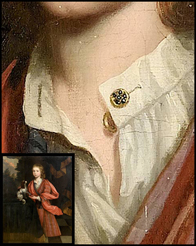
This section covers button-like clothing attachments that were not actually sewn to the garment. For the most part, this category consists of pairs of buttons attached by a metal chain link or bar, known today as cufflinks. Each button could be inserted into a buttonhole, and the tension between the two buttons connected by the metal link would hold the garment together. This closure type was most common for shirtsleeve cuffs starting in the late 17th-century, but such attachments were also used for collars (see image on right). Both men and women wore linked buttons throughout the 18th century.
Studs are also included in this section of the website as fasteners that are not actually sewn to clothing. Studs generally have one button-like face for display which is connected by a rigid bar to a back that would not show. Studs are usually smaller than cufflinks, with a shorter connection between the two pieces that would secure the garment. Cufflinks have often been accompanied by matching studs for the front of the shirt, particularly for formalwear from the 19th and 20th centuries.
Archaeologists have yet to publish a detailed typology and chronology of linked buttons and studs from the colonial and early industrial period. This section of the website currently offers comparative chronological data in the form of images, measurements, context, and site information for every colonial linked button and stud available at the MAC Lab and cooperating regional repositories. For more information on the social history and significance of these linked buttons, see the article Linked Buttons of the Middle Atlantic, 1670-1800, by Sara Rivers Cofield, published in the Journal of Middle Atlantic Archaeology (2012, 28:99-116).
At present, this site does not include cufflinks and studs from our 19th and 20th-century collections. Later examples are more abundant, and often more uniform, so it will probably not be feasible or worthwhile to put every example at the MAC Lab on this website. We ask that you please be patient with us as we endeavor to expand our exploration of small finds in a way that will adequately address the challenge of mass-produced goods.
Terminology
From the mid-17th century through the 18th century the term used to describe cufflinks was "sleeve buttons." This referred specifically to shirtsleeve buttons and did not include buttons found on coat sleeves or waistcoat sleeves. Other terms that have been used are "sleeve links," which appears in later 18th-century and 19th-century literature, and "link buttons," which may refer to large buttons for breeches or coats that used the same type of attachment as sleeve buttons (Luscomb 1967; White 2005).
The term "cufflink" may not have come into regular use until the late 19th century. The earliest use of the term cited in the Oxford English Dictionary comes from the 1897 Sears Roebuck Catalog. The shift in terminology may coincide with the invention of new styles such as asymmetrical links connected by a rigid bar, or links with a T-post or flip hinge. These styles were easier to insert through the stiffly starched cuffs that became popular in the 19th century.
References
1967 The Collector’s Encyclopedia of Buttons. New York: Crown Publishers, Inc.
2012 Linked Buttons of the Middle Atlantic, 1670-1800. Journal of Middle Atlantic Archaeology 28:99-116.
2005 American Artifacts of Personal Adornment 1680-1820: A Guide to Identification and Interpretation. New York: Rowman & Littlefield Publishers, Inc.