Table Knives and Utensil Handles
This essay deals with table knives, as well as utensil handles in the MAC Lab collections that cannot be positively identified as having been from a fork or a knife (or in some cases, pocket or clasp knives), since the metal components that would allow this identification are missing. While there are many published sources that discuss high quality cutlery and eating utensils (Brown 2001; Moore 1999, for example), most of the specimens in the lab's collections are less expensive examples commonly called "composite cutlery" (because they are made from two or more materials—generally steel and bone, horn, ivory, or antler). Composite cutlery has received less attention in published sources; one notable example is Phil Dunning's "Composite Table Cutlery from 1700 to 1930" (Dunning 2000). This essay will rely heavily on Dunning’s publication.
Because of stylistic changes, differences in handle materials, and innovations in manufacturing processes, it is possible to assign date ranges to utensils and cutlery (Dunning 2000). Important factors to consider when trying to identify and date knives and utensils include handle material, the type of tang used to secure the metal working end of the utensil to the handle, blade shape for knives,1 and the handle shape.
Handle Material
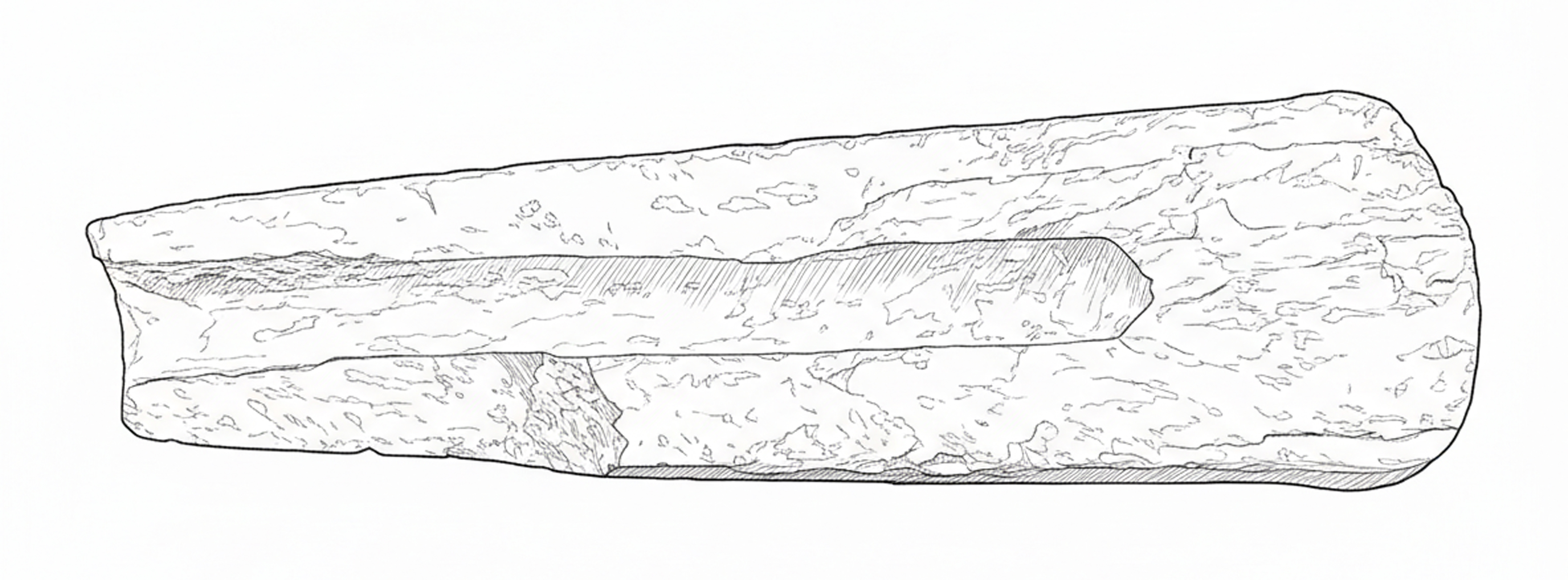
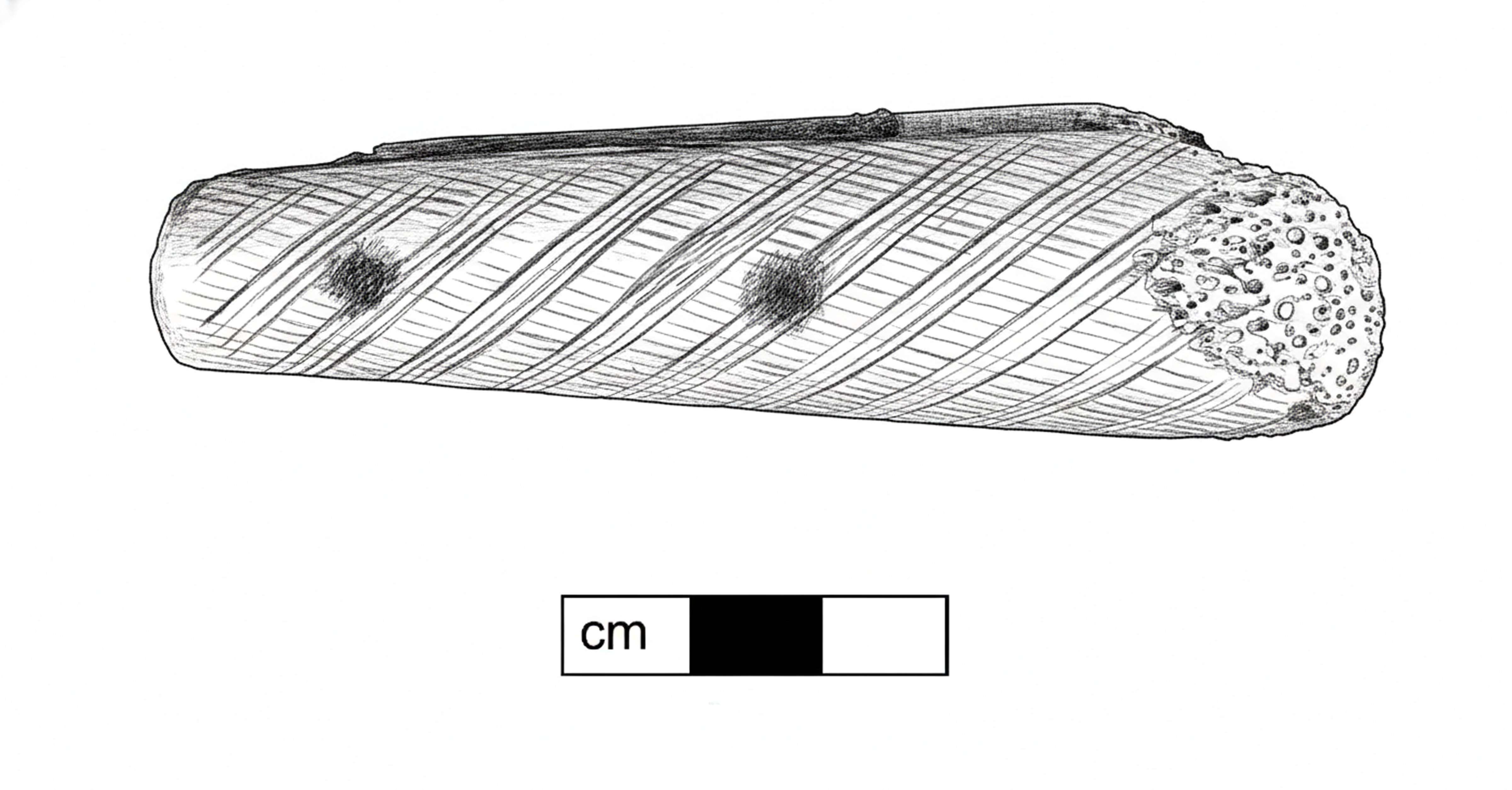
The physical traits of bone, ivory, antler, wood, and other materials determined the type of handle that could be crafted (Unwin 2017). The dense nature of ivory made it a good material for a solid, shaped handle that was drilled with a narrow channel down its center to insert a knock-on or pin tang. Examples in the MAC Lab collections that have been drilled (Figure 1) for the insertion of a tang are made from ivory and these solid handles are generally more rounded in cross section and have solid ends. Ivory (and bone) handles were sometimes dyed green (Dunning 2000:36). Ivory can be easily distinguished from ivory substitutes and from bone since it fluoresces a blue-white color under long wave ultraviolet light (Doub 2023). Most of the ivory handles in the lab collections are from sites dating to the 17th and 18th centuries.
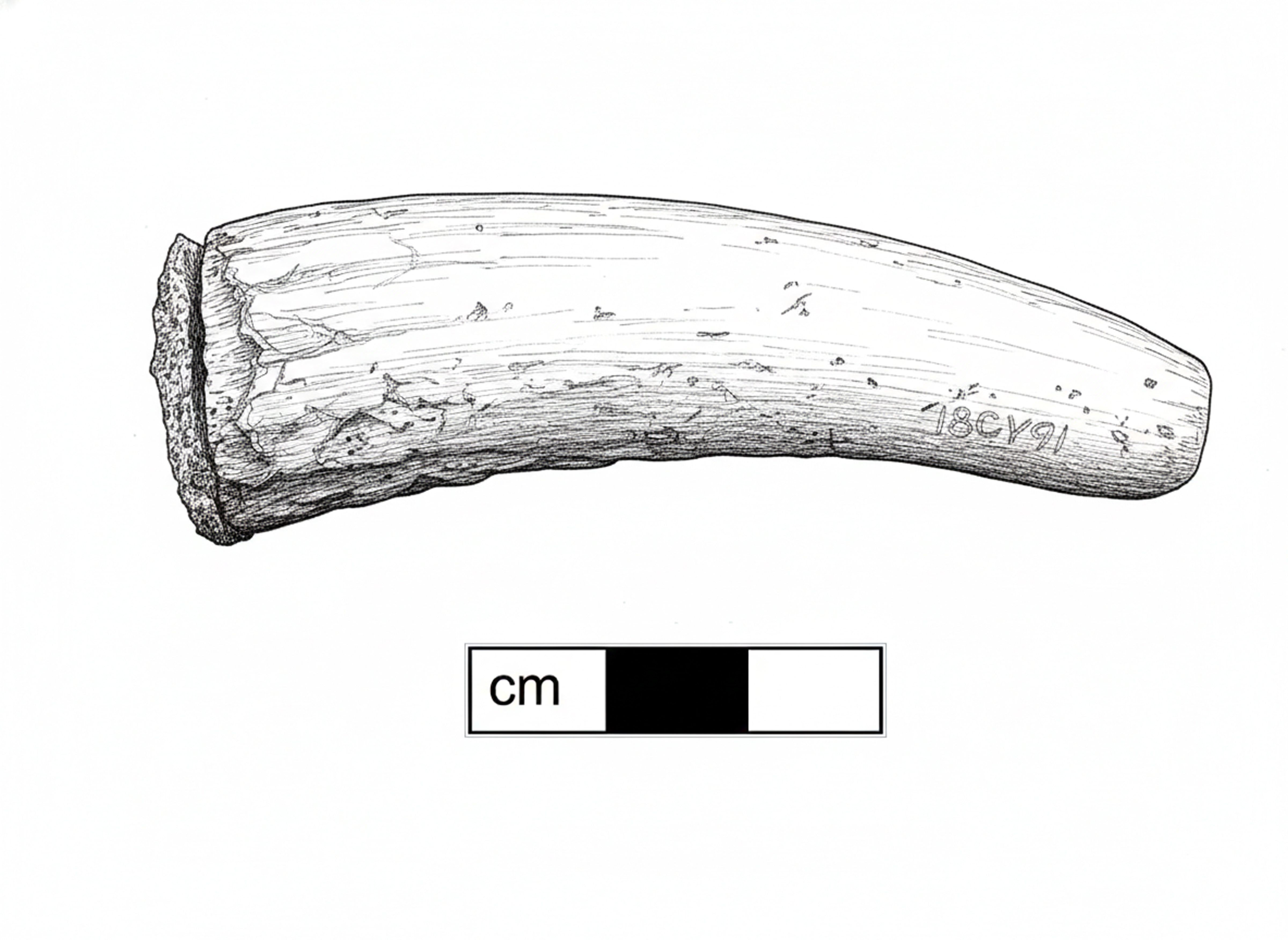
Antler and horn could also be used for handles, particularly for the curved handles typical of carving knives and forks (Unwin 2107). Handles made from antler, bovine horn, or metapodial bones of sheep often have an iron or copper alloy butt cap (either flat or domed in shape) attached with pins to help secure the tang through the center of the handle and help hide the spongy core (Figure 2). Heated and pressed horn handles were popular through the middle of the 19th century (Dunning 2003:37).
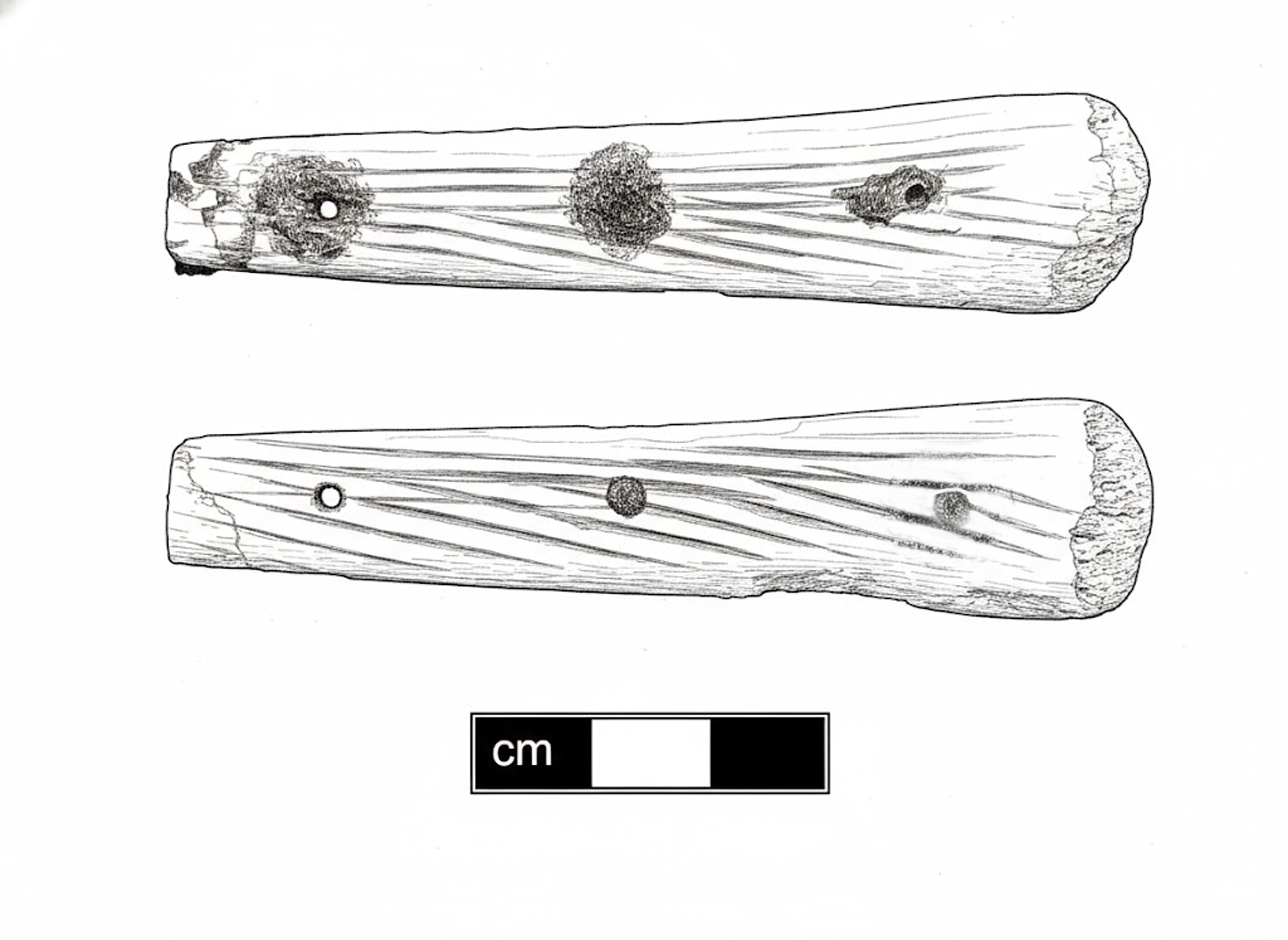
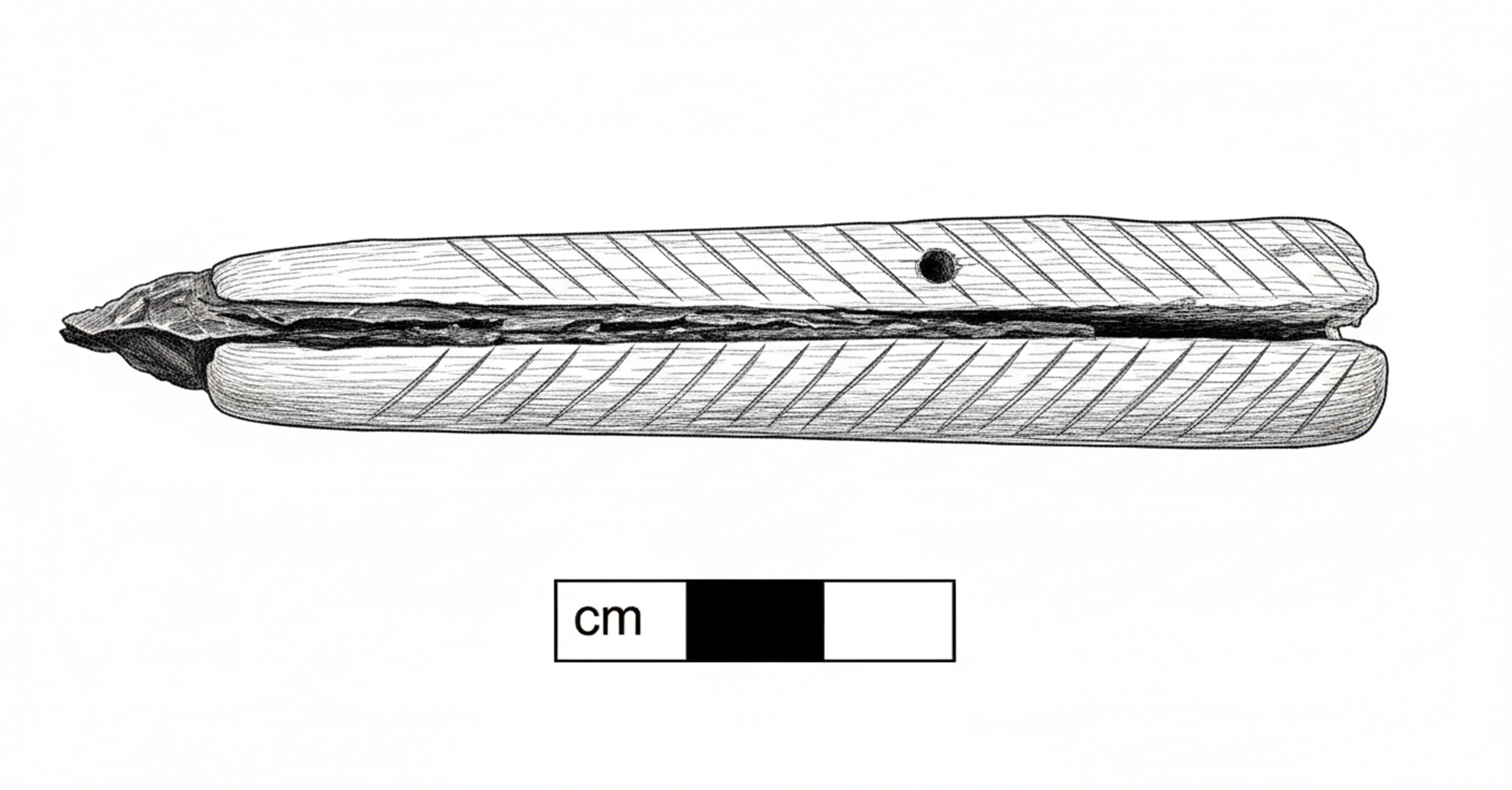
Most of the handles in the MAC Lab collections were made with animal bone. Animal long bones were first cut into handle length pieces, prior to having the dense outer bone removed from the spongy core bone. These pieces, semi-circular in cross section, were known as scales (Unwin 2017). Bone scales were often decorated with lines and ridges using files, lathes, or cutting tools (Figure 3). These bone scales were used with utensils that had scale tangs — small rivets or nails were used to attach the two bone scales to either side of the utensil's scale tang. The metal scale tang is visible along the length and at the end of the handle (Figure 4).
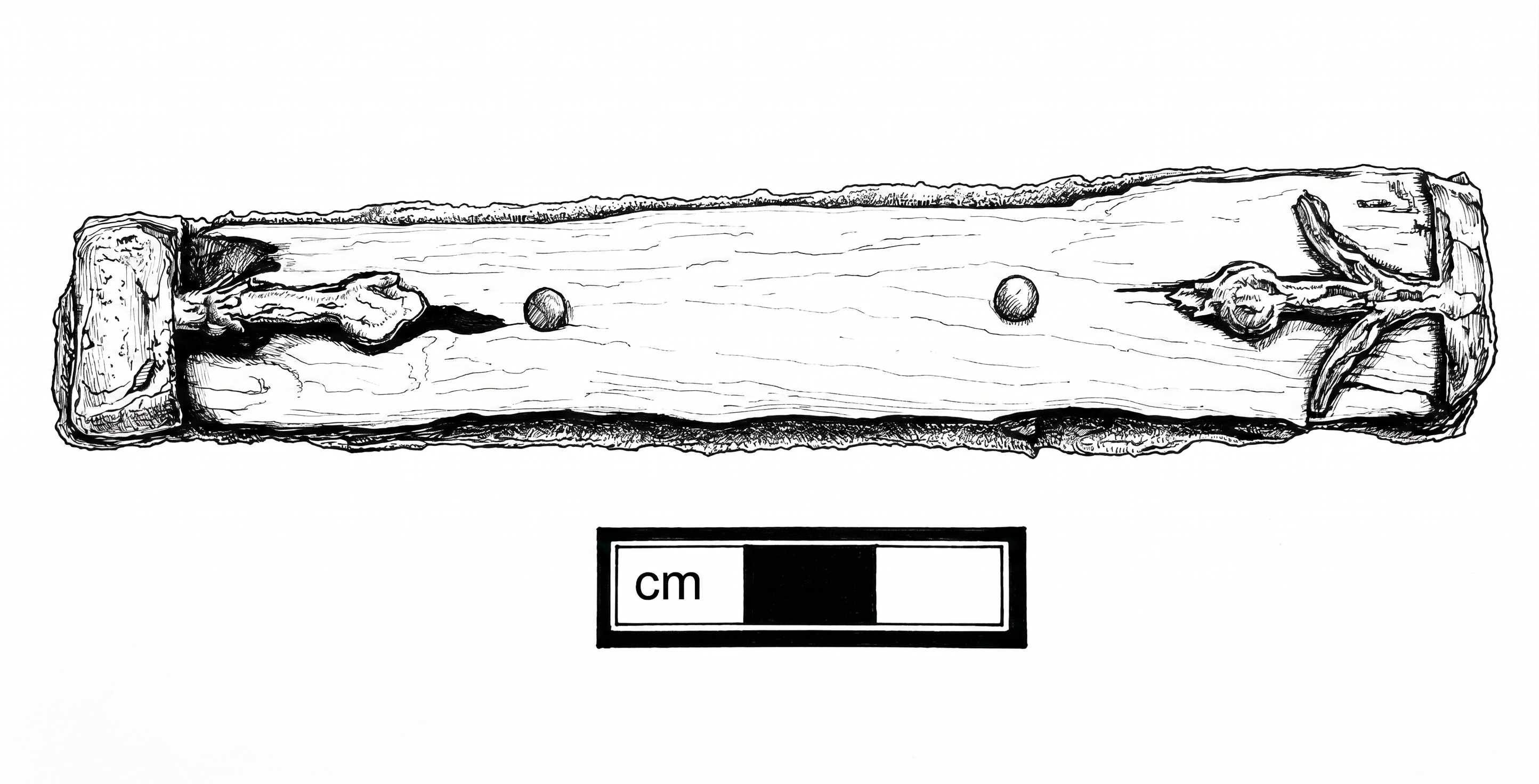
Some handles in the MAC Lab collection have wooden, rather than bone scales. Exotic hardwoods like ebony, cocobolo, or rosewood were often used for these handles (Sears and Roebuck 1895; Museum of Industrial Heritage 2026). Some wooden handles were made with half (or slot) tangs — short flat tangs that were inserted into a slot in the handle and held in place with rivets (Dunning 2000:40). By 1866, a decorative technique was introduced that consisted of cutting or pressing designs into wooden scales (Dunning 2000; Museum of Industrial Heritage 2026). These areas were then flooded with a low melting point molten metal like pewter or some other white metal (Figure 5). Utensil handles decorated in this fashion continued until 1920 (Museum of Industrial Heritage 2026).
Solid steel cutlery, with all parts of the knife formed from one piece of steel and often plated with nickel or silver, was first introduced in the late 1860s (Dunning 2000:40). While the dominant form of cutlery available to today's consumers, this type of cutlery was not immediately competitive.
Tang Configurations
There are three main types of tangs represented in the MAC Lab collections. For illustrations of these tang types, see the essay on forks.
Through tang – long narrow tang that extends the entire length of the handle and is secured by being bent over a washer or butt cap at the end of the handle.
Pin tang/Knock-on tang – tang is secured or pinned into the handle. Channels to accommodate these tangs were drilled into the handles using tools like augers or hand operated drills (Hawley Tools 2026). These tangs are also sometimes referred to as rat-tail tangs (Wade 1982). Some handles with this type of tang were drilled deeper so that a weight could be inserted below the pin/knock-on tang (Dunning 2000:37). These weights provided a counterbalance so that the knife blade would not touch the table.
Scale tang – a flat iron plate with rivet holes that allows the two matching scales (usually bone handle halves) to be attached to it. These tangs are also called flat or full tangs (Dunning 2000:33). Scale tangs began to be used regularly by the 1720s. Employing a flat scale tang allowed thinner and smaller pieces of bone to be used to create the scales. By 1844, U.S. manufacturers began forging the blade, bolster, and tang from one piece of steel (Dunning 2000:38).
As a general rule for handles in the MAC Lab collections, it seems that the through tangs were most often (although not exclusively) used on antler handles. Knock-on/pin tangs — where a narrow, deep channel is drilled lengthwise into the center of the solid handle (see Figure 1) and the metal pin/knock-on tang inserted and secured inside the handle with glue — seem to be more common on sites dating to the 17th and the first half of the 18th centuries and were almost always used on ivory handles. This type of attachment was also used with ceramic handles, of which there is one example in the MAC Lab collections. The use of iron scale tangs secured to two matching bone handle scales is sometimes present on examples dating to the 18th century, but in the MAC collections it is more common for 19th-century utensils.
Blade Shapes
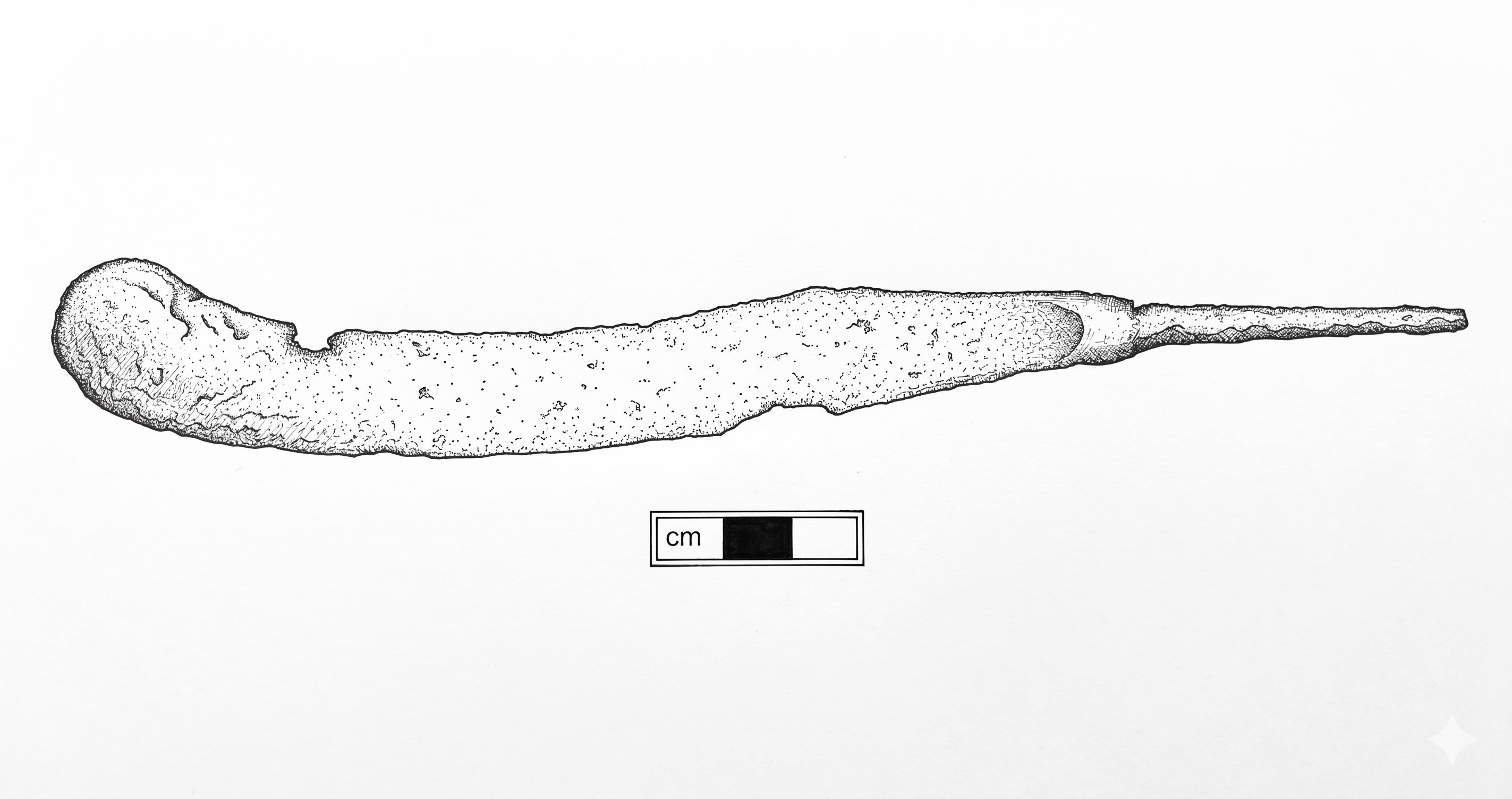
Bulbous End (c. 1700-1740) – Knives with bulbous, rounded ends have a strongly concave back (spine) and convex cutting edge (Figure 6). Blades of this type were normally secured to the handles by knock-on or pin tangs, with a bolster (section of steel at the junction of the handle and blade whose purpose is to add weight and balance) forged as an integral component between the blade and tang (Dunning 2000: 32).
French Shape (c. 1700-1760) – These blades are narrow and tapering, with an upturned blade tip. They were attached to the handle with either knock-on/pin tangs or with scale tangs. These knives are more common on sites of French occupation in North America (Dunning 2000:32).
Scimitar/Humpback (1720-1770) – These blades have a small hump or projection on the top or spine of the blade, close to the bolster or handle end of the blade (Figure 7). Between the 1780s and the 1820s, the humpback disappeared, with the spine and cutting edge of the blade becoming parallel (Figure 8) (Dunning 2000:38).
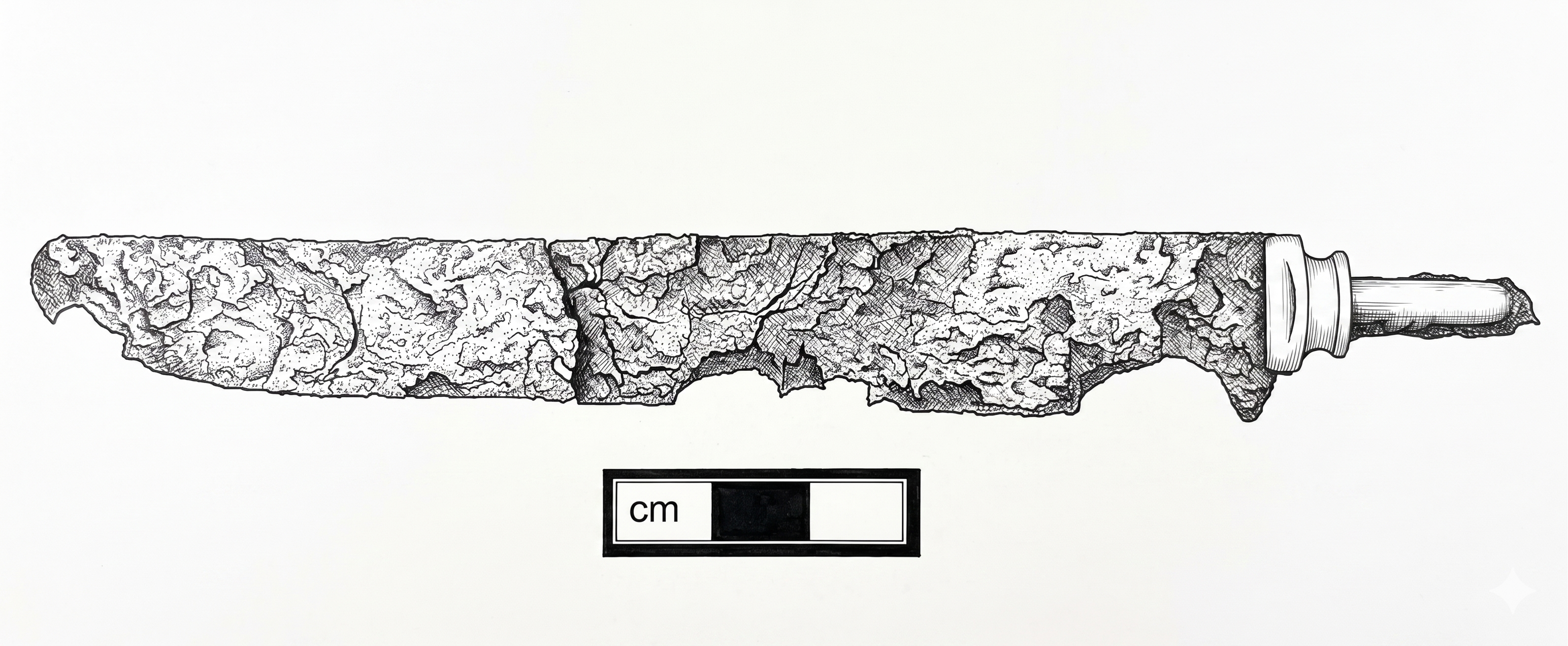
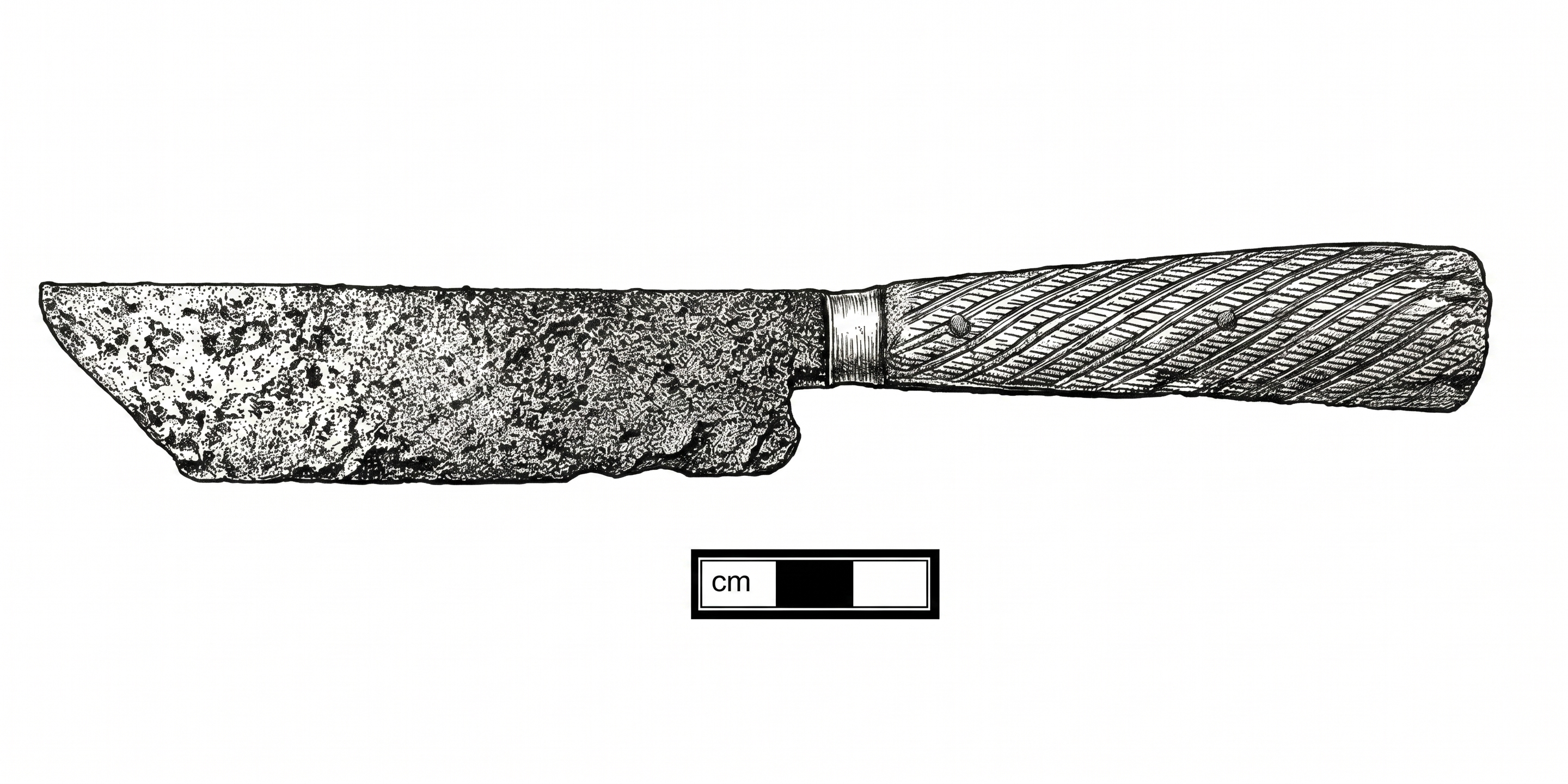
Choil/Heel (by 1760s) – Knife blades began to be produced with a choil (also called a heel) at the end of the blade adjacent to the bolster (Dunning 2000:37). The purpose of the choil (Figure 9) is to allow the knife blade to be easily sharpened to the very end of the blade (Russell 2026) and help protect the knife handle from being damaged by the sharpening instrument.
Knife blades with curved blades and spines or with parallel blades and spines continued to be produced into the fourth quarter of the 19th century (Dunning 2000:38). While blade lengths and sizes decreased over time from the 18th to the 19th centuries, using blade length is not a reliable dating indicator (Dunning 2000:38).
Handle Shapes
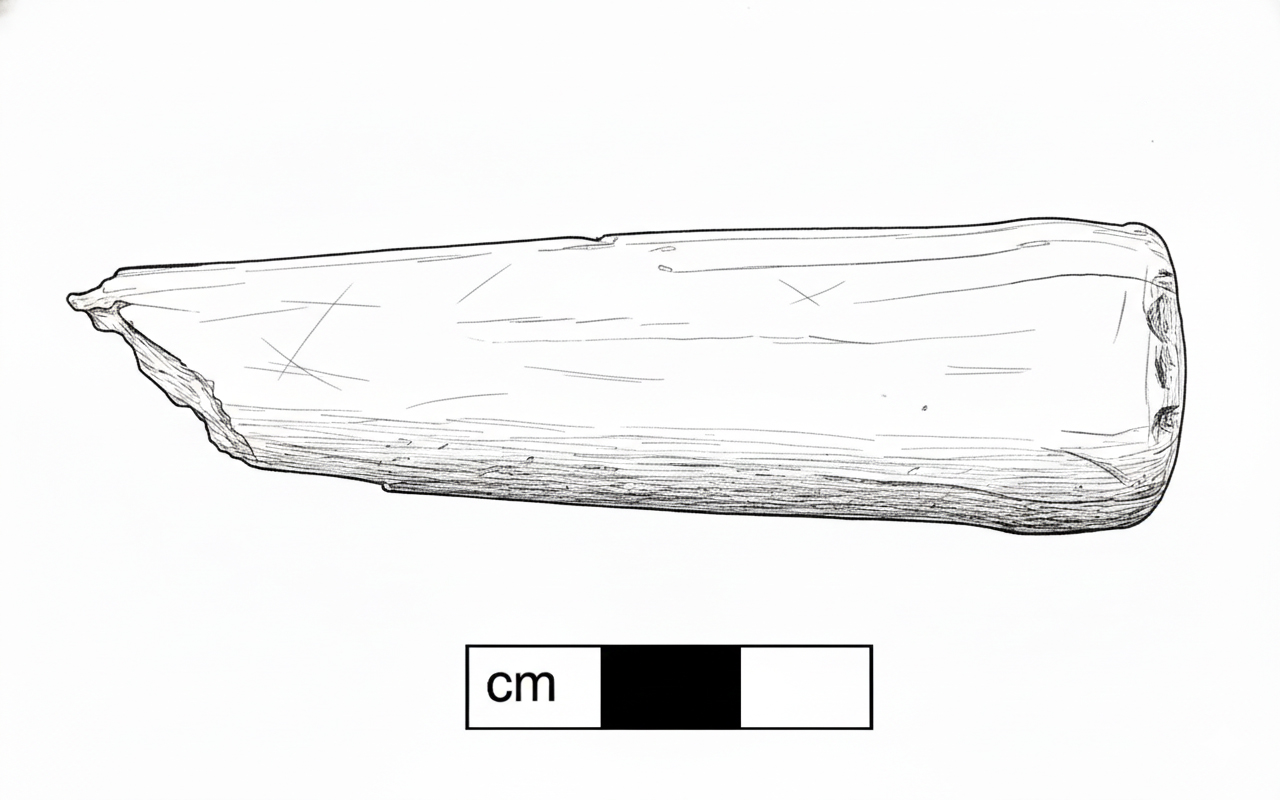
Handle shapes changed over time. Cannon-shaped handles (circular cross section and tapering towards the blade or fork end of the utensil) were typical of the late 17th century (Figure 10).
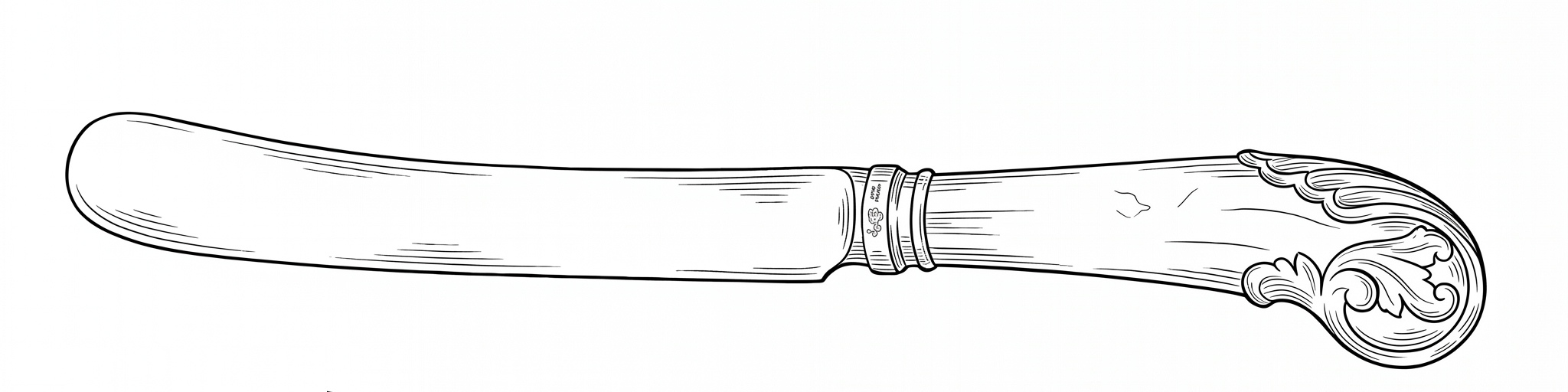
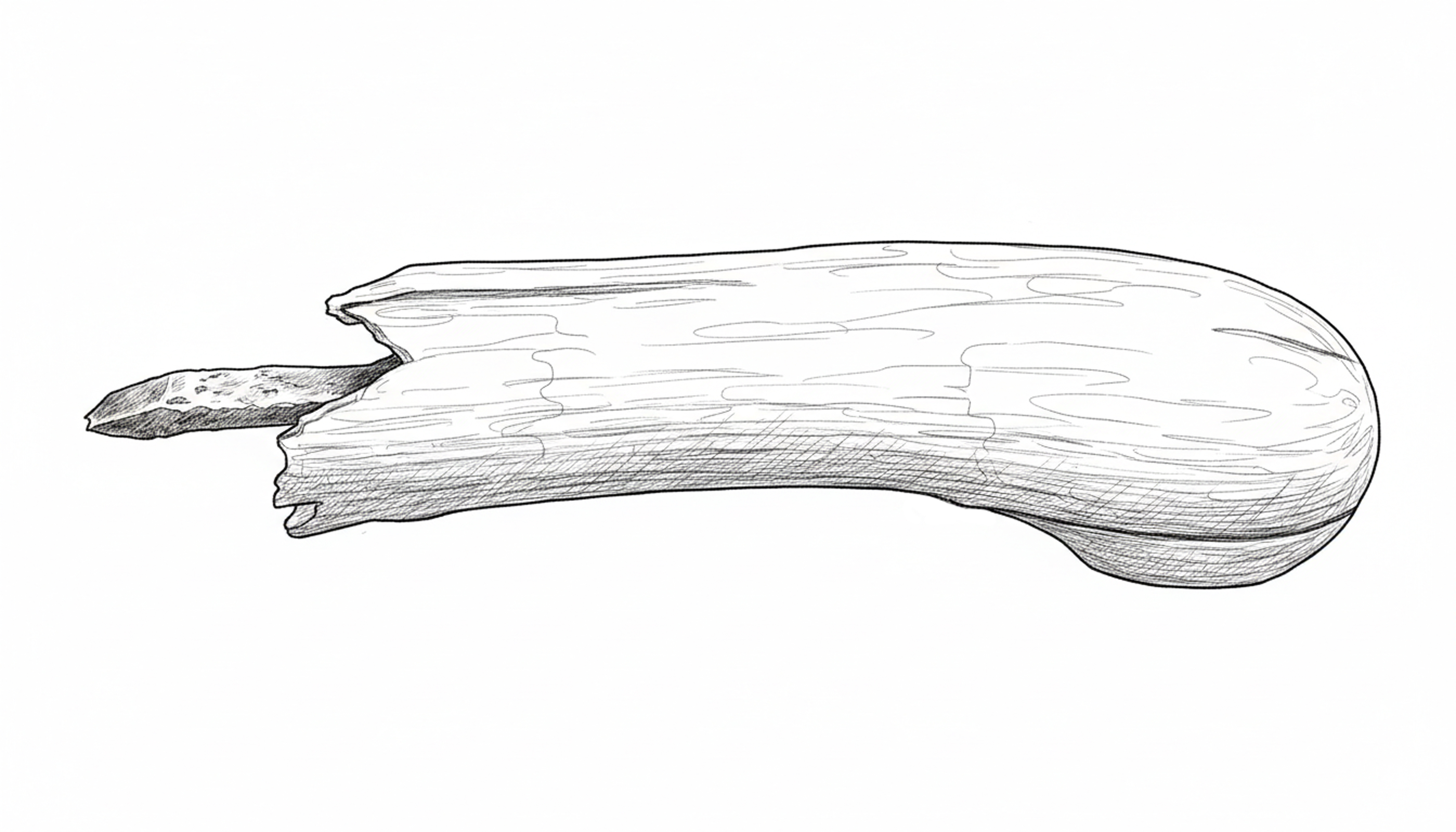
The most common shape for the circa 1700 to 1740 period being the "pistol grip" (Dunning 2000:32). First appearing in the late seventeenth century, this handle had a turned-down bulbous shape that resembles the butt of an eighteenth-century pistol (Figure 11). Pistol grip utensils were generally used with a pin tang but could also be used with a scale tang. The wedge-shaped utensil handle appeared around 1720, alongside the more regular use of scale tangs (Dunning 2000:35) and was common through around 1770. The wedge shape tapers towards the knife blade or fork tines (Figure 12). Scored hatching and cross hatching on the scales were often used to decorate wedge-shaped handles.
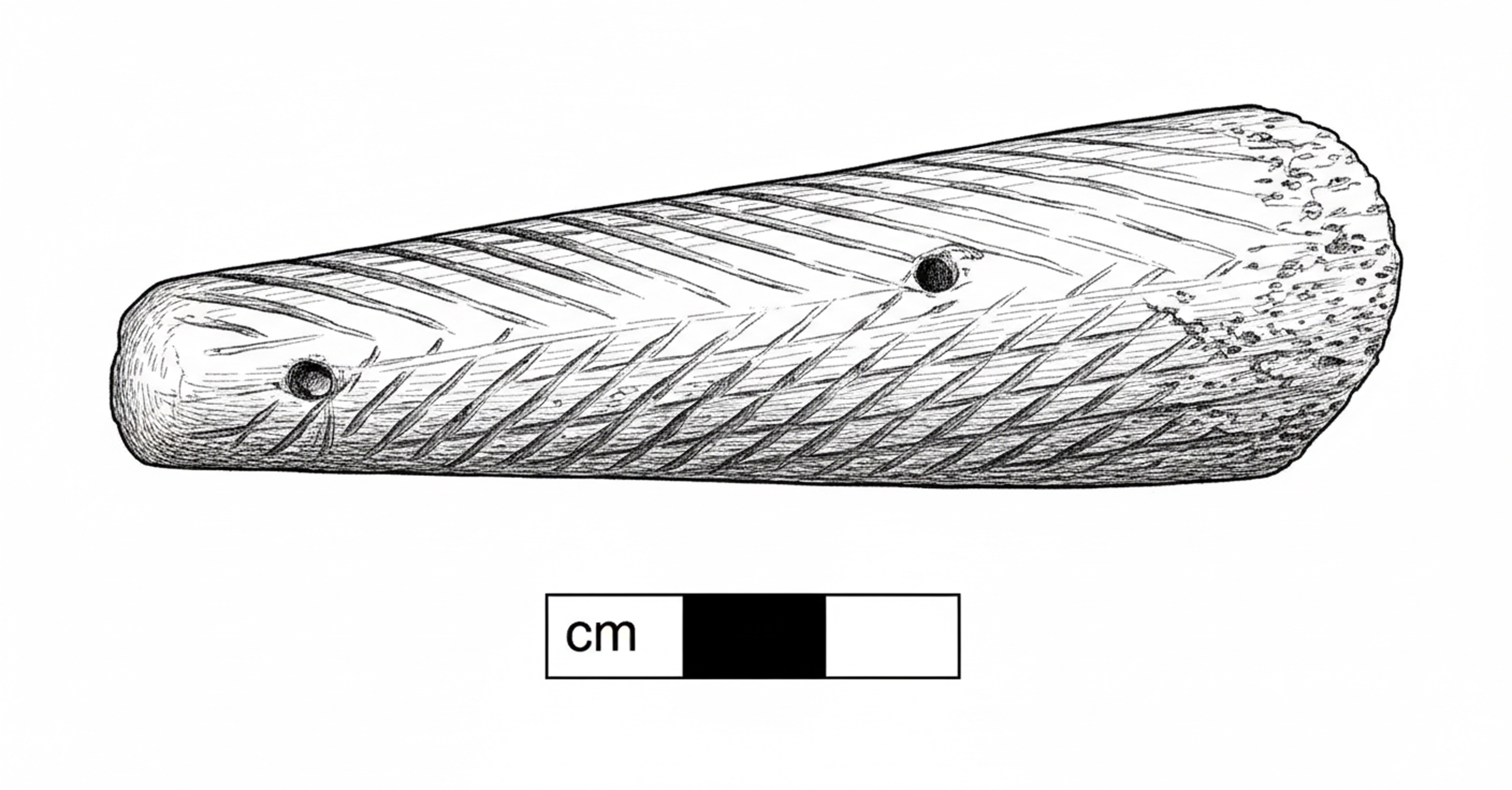
Beginning around 1760 and continuing until the turn of the 19th century, handles began to narrow and become less wedge shaped (Figure 13). This wedge shape was used with scale tangs and with pin tangs. A variation of this more narrow, wedge-shaped handle had an angled butt end, which remained popular until around 1820 (Dunning 2003:36). Additionally, more care began to be taken with scored hatching, as well as the creation of more complex hatched designs (Dunning 2000:36).
Advances in technology around the time of the U.S. Civil War led to patents for applied bolsters (the band that joins the metal portion of the utensil to the handle). Cast-on bolsters of tin or tin alloy were created by clamping the utensil tang and scales in a mold and pouring the molten metal in to secure the tang and create the bolster (Dunning 2003:39). Elaborate decorations created by pressing or cutting designs into wooden or bone scales and then filling them with molten metal began to be produced in the 1880s (Dunning 2003:39).
Starting around 1870, new handle materials were introduced, including black colored rubber and a semi-synthetic ivory colored material created from cellulose and nitric and sulfuric acids (more commonly known as celluloid). Celluloid handles began to be sold in 1872, becoming common by the 1880s (Dunning 2003:41-42). Forks and knives with cast iron handles began to appear in the 1890s (Dunning 2003:42).
Footnotes
1 Since knives were often polished and sharpened over the course of their use lives, the shape of the blade could have been significantly altered and make identification challenging.
References
2001 British Cutlery; an Illustrated History of Design, Evolution and Use. York Civic Trust, Philip Wilson Publishers, London.
1951 "Knife/Fork/Spoon." Everyday Art Quarterly 18/19:2-63.
2023 Artifact Recovery: The Material Management Field Guide. Society for Historical Archaeology.
2000 "Composite Table Cutlery from 1700 to 1930." In Studies in Material Culture Research, edited by Karlis Karklins, 32-45. The Society for Historical Archaeology.
2026 Handles and Scales. How It Was Made. Hawley Collections @Kelham Island Museum. Electronic resource accessed January 16, 2026 at https://www.hawleytoolcollection.com/uploads/PDF/How%20it%20was%20made%20-%20Handles.pdf.
1999 Cutlery for the Table; a History of British Table and Pocket Cutlery. Hallamshire Press Limited, Sheffield, England.
2026 Inlaid Cutlery Pattern Display. Electronic resource accessed April 16, 2026 at https://industrialhistory.org/k/2039/Inlaid-Cutlery-Pattern-Display.
2026 A.G. Russell Knives Knife Encyclopedia. Electronic resource accessed April 16, 2026 at https://agrussell.com/encyclopedia/c.
2014 The versatility of bone, ivory and horn – their uses in the Sheffield cutlery industry. Anthropozoologica 49 (1): 121-132. Accessed at https://sciencepress.mnhn.fr/sites/default/files/articles/pdf/09-az2014n1a09-unwin.pdf.
2017 Knife Handle Making–the Subsidiary Trades in the Sheffield Cutlery Industry. In Os, bois, ivoire et corne: l’exploration des matieres dures d’origine animale. Artefact: Techniques, Histoire et Sciences Humaines. https://doi.org/10.4000/artefact.1237.
1982 Cutlery from the Fort at Coteau-Du-Lac. Parks Canada History and Archaeology 61. National Historic Parks and Sites Branch, Parks Canada, Quebec.