Accokeek
Defining Attributes
Accokeek is an Early Woodland ware that is sand-tempered or crushed quartz-tempered with cord-marked exterior surfaces. This pottery is often identifiable by the pronounced oblique cord-marking, slanting to the right from the vessel rim.
Chronology
Stratigraphic sequences and radiometric dating indicate that Accokeek dates from ca. 900 B.C. – 300 B.C.
Distribution
Accokeek pottery is found throughout the Coastal Plain of Maryland and into Virginia to the James River. On the Western Shore of Maryland, Accokeek’s core distribution extends into the Piedmont beyond the headwaters of the Patuxent River and into the Patapsco drainage. It is also found up the Potomac River valley to the Monocacy drainage. Accokeek ceramics have been recorded on sites throughout the lower Eastern Shore in both Maryland and Delaware from Dover south.
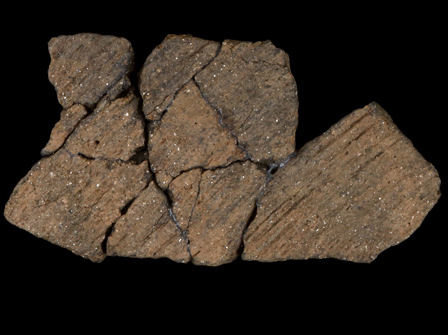
Figure 1. Example of Accokeek pottery.
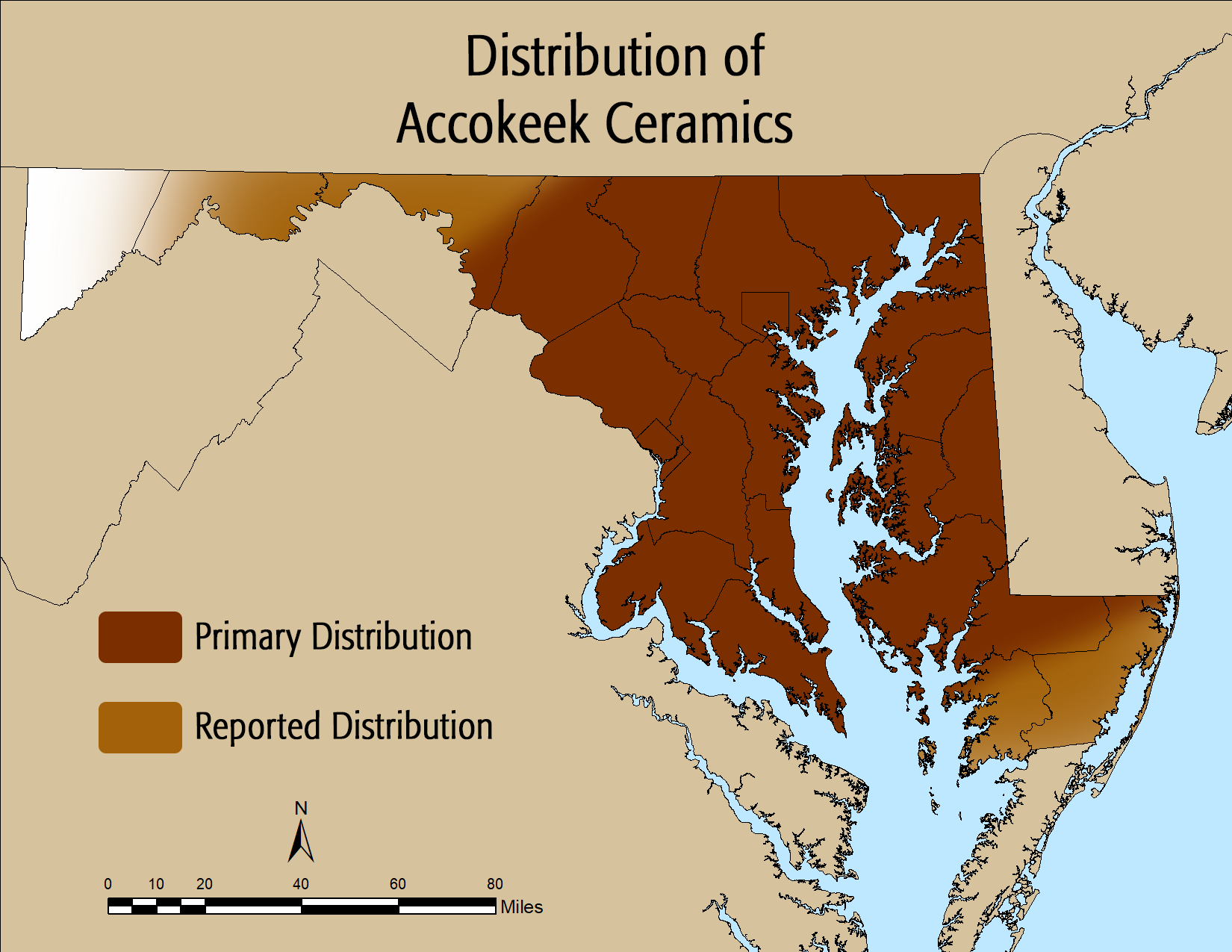
Figure 2. Distribution map.

Figure 3. Paste close-up.
Description
Paste/Temper
The paste has a sandy texture, ranging from coarse and soft to medium fine and hard, and is usually friable. Composed of fine-grained, moderately compact clay, Accokeek pottery is often reddish due to the clay’s ferruginous content. The temper consists of coarse to medium fine sand or crushed quartz that comprises 20% – 50% of the paste. Small amounts of angular quartzite, mica, and gneiss are sometimes added. Accokeek pottery as defined in the Potomac River drainage is tempered with medium to coarse sand and has a very sandy, gritty texture. In the Patuxent drainage, crushed quartz temper predominates and the pottery feels less sandy. The Moh’s hardness for Accokeek sherds ranges between 2.0 and 3.0. Color varies from an oxidized dull black through brown, red, orange, and gray to tan and buff, with reddish tans or gray browns generally the norm.
Surface Treatment
Exterior surfaces are roughened with cord-wrapped paddle impressions made in a wet clay. The cord-markings are nearly always oriented diagonally downward to the right from the rim, but horizontal and vertical impressions have been observed. The cordmarking is thick and commonly spaced 1 mm – 8 mm apart. Sometimes when the cordage is loosely wrapped around the paddle resulting in an overstamped appearance. Cord-marking commonly extends from the lip to the base. Smoothed rims and unmarked bases, however, have been found.
Interior surfaces are smoothed. Some sherds have uneven interior surfaces that suggests the use of the hand as an anvil in conjunction with a paddle during manufacture.
Decoration
Accokeek pottery is usually undecorated. Occasionally, some sherds have smoothed-over cord marking from the base to the lip, and cord impressions on or just below the lip. Rarely, incised decorations have been observed on Accokeek pottery. At the Accokeek Creek site, 18PR8, about 5% of the rim sherds were decorated with incising that included long triangles, horizontal zig-zag lines, vertical or horizontal straight lines, crossed lines, or short random lines. These incised pattern appear to have been made with a round-pointed tool. A few sherds were decorated with rows of punctations.
Morphology
Accokeek vessels are coil constructed with paddle malleation. Vessels shapes are conical, semiconical, or occasionally globular with open mouths. The upper portions are cylindrical from the rim to the midpoint, or expand slightly outward from the rim. Rims are vertical or slightly everted, generally blending into the body 5 cm – 10 cm below the lip. Flattened or rounded rims have also been observed. Lips vary from straight and rounded, to flattened or slightly everted. Bits of clay overlapping the exterior and cord marks along the top are also common.
Bases are conical, semiconical, or occasionally round in shape, and range between 9 mm to 21 mm thick. Some basal sherds seem to have been modeled by hand from lumps of clay, with coil construction beginning 4 cm – 10 cm above the basal point.
Vessel wall thicknesses decrease from the base up to rim. Sherd thicknesses range from 6 mm – 8 mm. Vessel sizes range from medium to large, with diameters ranging from 25 cm – 65 cm and vessel height ranging from 25 cm – 40 cm. Coil widths range between 8 mm and 12 mm and coil breaks are common.
Defined in the Literature
Robert Stephenson originally defined Accokeek Cord Marked from pottery excavated by Alice and Henry Ferguson from Accokeek Creek site, 18PR8, on the floodplain of the Potomac River in Prince George’s County, Maryland (Stephenson and Ferguson 1963). Evans (1955) had defined a sand and quartz tempered ceramic from the Virginia Piedmont that he called Stony Creek, a seldom used designation today. Egloff and Potter (1982:99) believe that sherds found in southeastern Virginia are remarkably similar to Accokeek, but were fabric-, cord- and net-impressed. They suggest that cord- and net-impressed sherds found north of the James River should be referred to as Accokeek or Popes Creek Wares, but south of the James River as Stony Creek. Dan Mouer (1991) links Accokeek to Virginia’s Elk Island ceramics.
Type Site
Accokeek Creek (18PR8)
Radiocarbon Dates
| Radiocarbon Dates | ||||
|---|---|---|---|---|
| Date | Sample No. | Site | Feature | Reference |
| 1870 ± 125; A.D. 80 | M-1605 | Martins Pond 2 (18AN141) | Zone 2 | Wright 1973:29 |
| 1840 ± 80; A.D. 110 | Beta-48974 | Patuxent Point (18CV271) | ||
References
1982 Indian Ceramics from Coastal Plain Virginia. Archeology of Eastern North America 10: 95-117.
1955 A Ceramic Study of Virginia Archaeology, Bulletin 160, Bureau of American Ethnology, Smithsonian Institution, Washington, D.C.
1991 The Formation Transition in Virginia. In Late Archaic and Early Woodland Research in Virginia: A Synthesis, edited by T.R. Reinhart and M.E. Hughes, pp. 1-88. Council of Virginia Archaeologists, Richmond.
1963 The Accokeek Creek Site: A Middle Atlantic Seaboard Culture Sequence. Anthropological Papers, Museum of Anthropology, University of Michigan, No. 20, Ann Arbor
1973 An Archeological Sequence in the Middle Chesapeake, Maryland. Maryland Geological Survey Archeological Studies No. 1. Washington, D.C.