Camden (Colonoware)
Defining Attributes
Camden is a low-fired temperless Contact-period ware that is smoothed on both the interior and exterior. The paste is often soft with ochre and mica inclusions. This ware is undecorated with often thick and flat rim profiles. Similar to late Potomac Creek and Yeocomico wares but without temper.
Chronology/Distribution
Camden appears on post-Contact sites in the Coastal Plain region of Southern Maryland and within the Rappahannock River valley of Virginia on sites dating after about 1650. Similarities of this ware to other wares designated Colonoware make it difficult to date with association to Native American people.
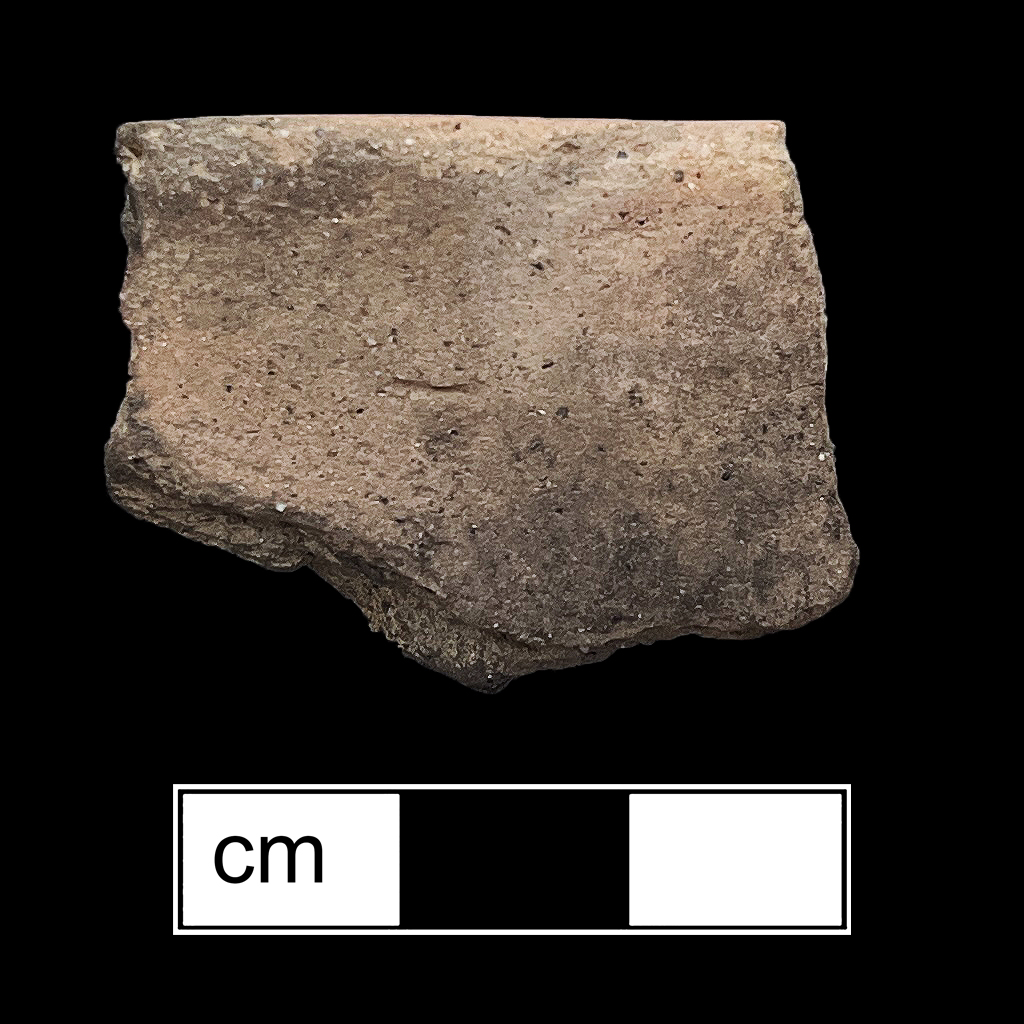
Figure 1. Example of Camden pottery.
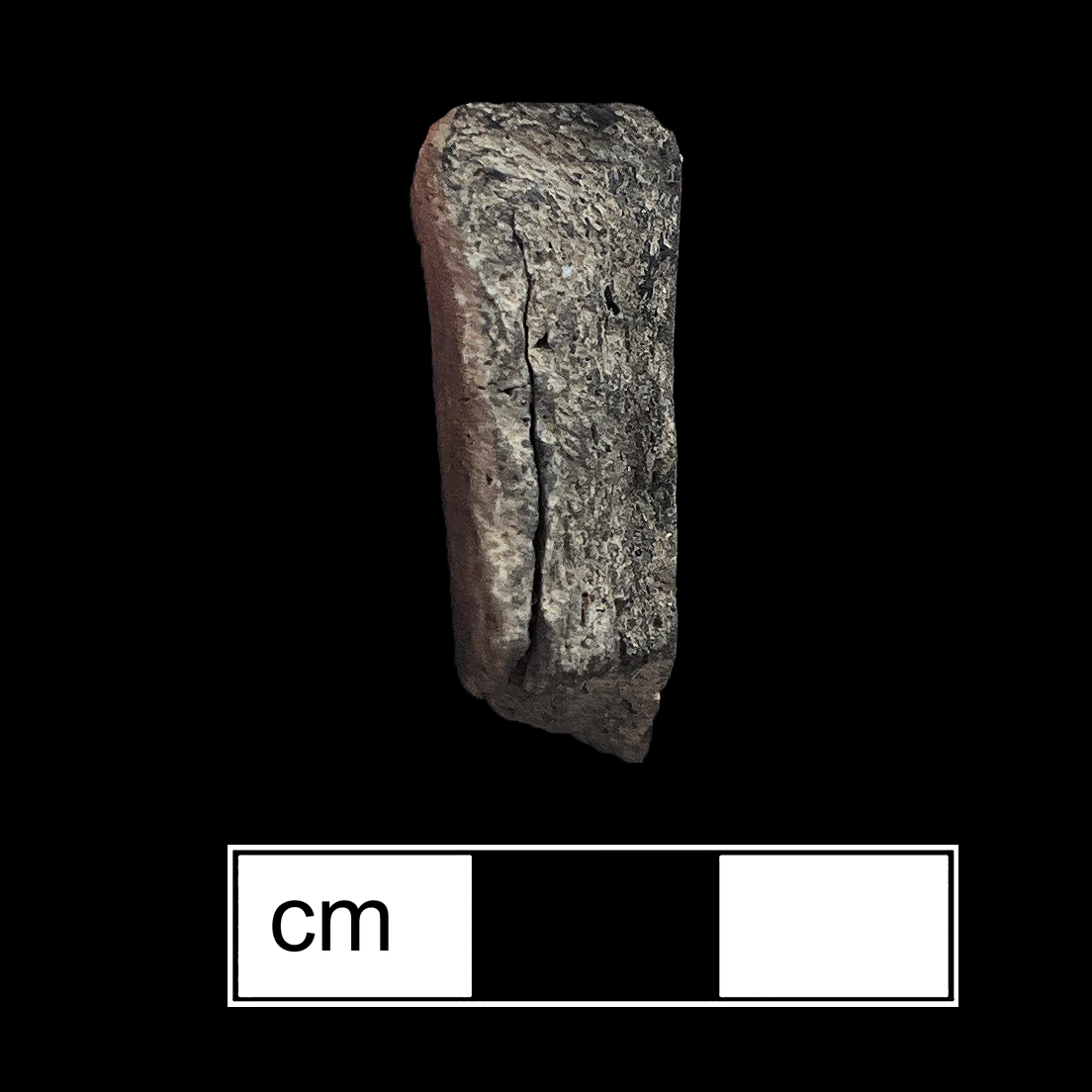
Figure 2. Paste close-up.
Distribution
Paste/Temper
The clay is low-fired giving it a silty/soft texture. There is no obvious temper, but can contain inclusions of sand or quartz, ocre, and mica depending on the local clay source. Color ranges from buff, tan, reddish-tan, and brown.
Surface Treatment
Exterior surface are smoothed over and in some cases slightly burnished. A few examples were malleated with a cord-wrapped paddle and then smoothed. Interior surfaces are usually smoothed. Fire clouding is also common on vessel exteriors.
Decoration
Most vessels are undecorated, but a few examples from the Rappahannock River valley include decorations just below the rim comprised of reed punctations. Rims of some vessels may also be pie-crust shaped.
Morphology
Camden/Colonoware are coil-constructed with paddle malleation. Vessels are small to medium in size and consist of bowls and cups with flat-bottomed or globular bases that may emulate English styles. Vessel wall thickness of sherds in the Rappahannock valley has been recorded as between 5 and 8 mm with a mean of 6 mm. Vessel diameters vary by type. Cup-sized vessels have a diameter as small as 76 mm, while bowl-shaped vessels range from 178 to 305 mm.
Defined in the Literature
Camden ware was first described and identified by Howard MacCord from pottery recovered from the Camden site in Caroline County, Virginia (MacCord 1969 and Hodges 1986). The epicenter of this type appears to be along the Rappahannock River valley, roughly between Port Royal and Tappahannock. At the Baylor North site (44EX5), across Portobago Bay from Camden, a significant number of sherds were recovered, along with possible transitional types demonstrating a link between Camden and Potomac Creek and Moyaone wares. In the late 17th century, the area around Camden and Baylor North was home to a contingent of relocated Potopaco/Portobago people. Camden has also been compared to Courtland ware (King et al. 2022).
Type Site
Camden (44CE3).
Maryland Sites with Camden Components
- Posey (18CH281)*,
- Swann Farm (18CV40)*,
- Zekiah Fort (18CH808)*
- Old Chapel Field (18ST233)*
* collections at the MAC Lab
References
1986 Archaeological Addendum to the Camden National Historic Landmark, Caroline County, Virginia. Manuscript on file, Virginia Department of Historic Resources, Richmond.
2022 Colonoware in the Rappahannock River Valley of Virginia, ca. 1665-1780. In Materializing Colonial Identities in Clay: Colonoware in the African and Indigenous Diasporas of the Southeast. Jon Bernard Marcoux and Corey A.H. Sattes (editors). The University of Alabama Press, Tuscaloosa.
1969 Camden: A Postcontact Indian Site in Caroline County. In Quarterly Bulletin of the Archeological Society of Virginia, Vol. 24(1), pp. 1-55.