Selden Island
Defining Attributes
Selden Island is an Early Woodland ware characterized by steatite temper and a cord-marked exterior.
Chronology
Stratigraphic sequences and radiometric dating indicate that Selden Island dates from ca. 1000 B.C. – 750 B.C.
Distribution
Distributed from Virginia to Delaware and southeastern Pennsylvania, Selden Island ware is found throughout the Maryland Coastal Plain and Piedmont.
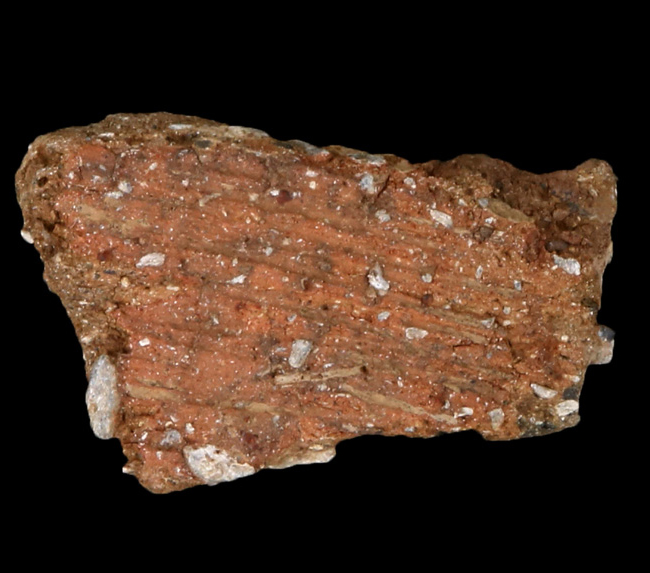
Figure 1. Example of Selden Island pottery.
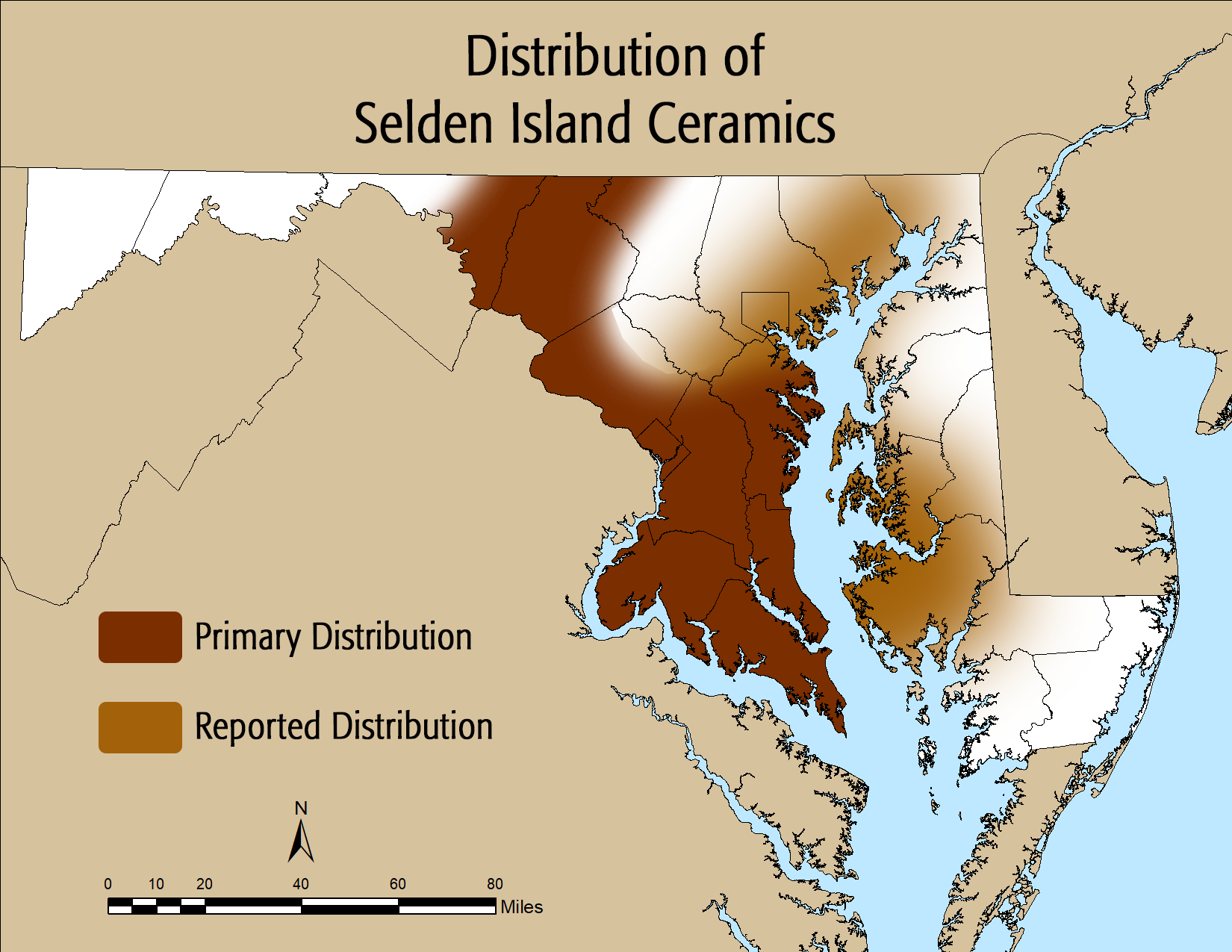
Figure 2. Distribution map.
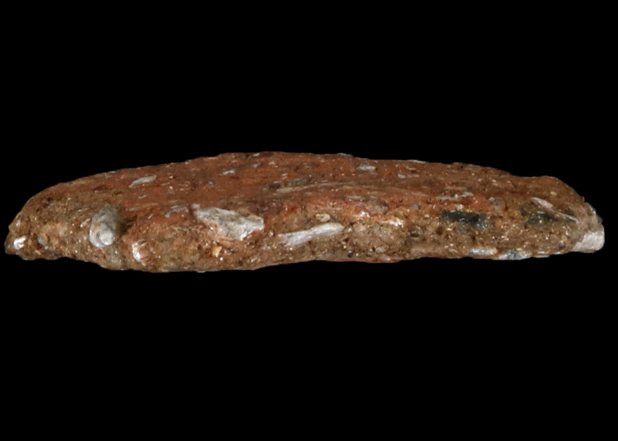
Figure 3. Paste close-up.
Description
Paste/Temper
The paste is fine-to-medium grained, compact, and cohesive, with rare extraneous inclusions. Selden Island is tempered with particles of crushed steatite ranging in size from very fine – 10 mm in diameter. The temper comprises of 25% – 50% of the paste. The steatite gives the sherds a soapy, slightly greasy feel. The texture varies between coarse and fine/smooth, depending on the size of the temper particles. Selden Island ware is very soft, with a Moh’s hardness of 1.5 – 2.0. Color ranges from an oxidized dull gray through buff and tan, to reddish brown.
Surface Treatment
Exteriors are impressed with a cord-wrapped paddle in an overlapping, crisscrossing, or oblique pattern. Some cord-marking on Selden Island would be indistinguishable from that on Accokeek ware, and the types could only be distinguished by the temper. Interior surfaces are irregularly smoothed.
Decoration
Typically none, though nicking along lip edges has been reported.
Morphology
Selden Island vessels are coil-constructed. Based on sherds discovered in Delaware, Artusy (1976:2) suggests that Selden Island vessels were conical in shape, with curved to straight sides, and with lug handles. This was in contrast to earlier researchers, who suggested that Selden Island vessels were tall, cylindrical pots or oval or rectangular bowls with flat bases (Evans 1955). Rims are thin, rounded, vertical, or slightly everted. Lips are usually thinner than the body and are rounded or slightly wedge-shaped.
Vessels are medium sized, with sherds and small sections of pots suggesting diameters of 10 cm – 35 cm. Vessel wall thickness ranges from 7 mm – 14 mm while bases are 9 mm – 15mm.
Defined in the Literature
Richard Slattery (1946) first identified Selden Island pottery from sherds found at the Selden Island site(18MO2) in Montgomery County, Maryland. Manson (1948:225) later noted that Selden Island sherds appeared to be similar to those recovered from the Marcey Creek site, Virginia, but believed Selden Island to be slightly more recent in date. The only difference he noted was that the exterior surface of Selden Island sherds appeared to be "textile-impressed." Clifford Evans later changed Manson’s definition of textile-impressed exterior to cord impressed (Evans 1955:56)
Wise (1975: 2) has suggested that after the initial development of Marcey Creek, a period of ceramic experimentation ensued in which Dames Quarter and Selden Island wares were created. Artusy (1976) observed that there were significant differences in manufacture as well as shape between Marcey Creek and Selden Island wares.
Type Site
Selden Island (18MO2)
Radiocarbon Dates
| Radiocarbon Dates | |||
|---|---|---|---|
| Date | Sample No. | Site | Reference |
| 2955 ± 90; B.C. 1005 | UGa-5376 | Clyde Farm, DE | |
References
1976 An Overview of the proposed ceramic sequence for southern Delaware. Maryland Archeology 12 (2): 1-15.
1982 Indian Ceramics from Coastal Plain Virginia. Archeology of Eastern North America 10: 95-117.
1955 A Ceramic Study of Virginia Archaeology, Bulletin 160, Bureau of American Ethnology, Smithsonian Institution, Washington, D.C.
1948 Marcey Creek Site: An Early Manifestation in the Potomac Valley. American Antiquity 13 (3): 223-227.
1946 A Prehistoric Indian Site of Selden Island, Montgomery County, Maryland. Journal of the Washington Academy of Sciences 36 (8): 262-266.
1991 Archaeology and Environment in the Upper Delaware Valley. In The People of Minisink, Papers from the 1989 Delaware Water Gap Symposium. David G. Orr and Douglas V. Campana, editors, pp. 79-116. National Park Service, Philadelphia.
1975 A Proposed Early to Middle Woodland Ceramic Sequence for the Delmarva Peninsula. Maryland Archeology 11(1): 21–29.