Dames Quarter
Defining Attributes
Dames Quarter is an Early Woodland ware characterized by crushed black rock (hornblende) or gneiss temper, with roughly smoothed exterior surfaces. This pottery is similar to Marcey Creek in appearance and manufacture.
Chronology
Stratigraphic sequences and radiometric dating indicate that Dames Quarter dates from ca. 1000 B.C. – 750 B.C.
Distribution
Dames Quarter is found throughout the southern Delmarva Peninsula, and the Eastern Shore Coastal Plain of Maryland. A few instances of Dames Quarter have been reported from the Western Shore.
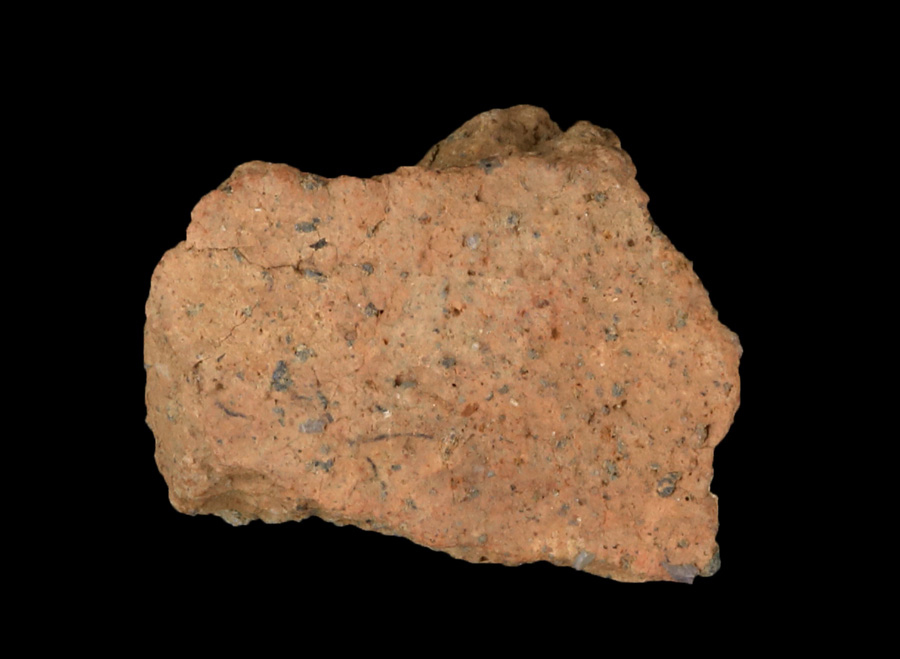
Figure 1. Example of Dames Quarter pottery.
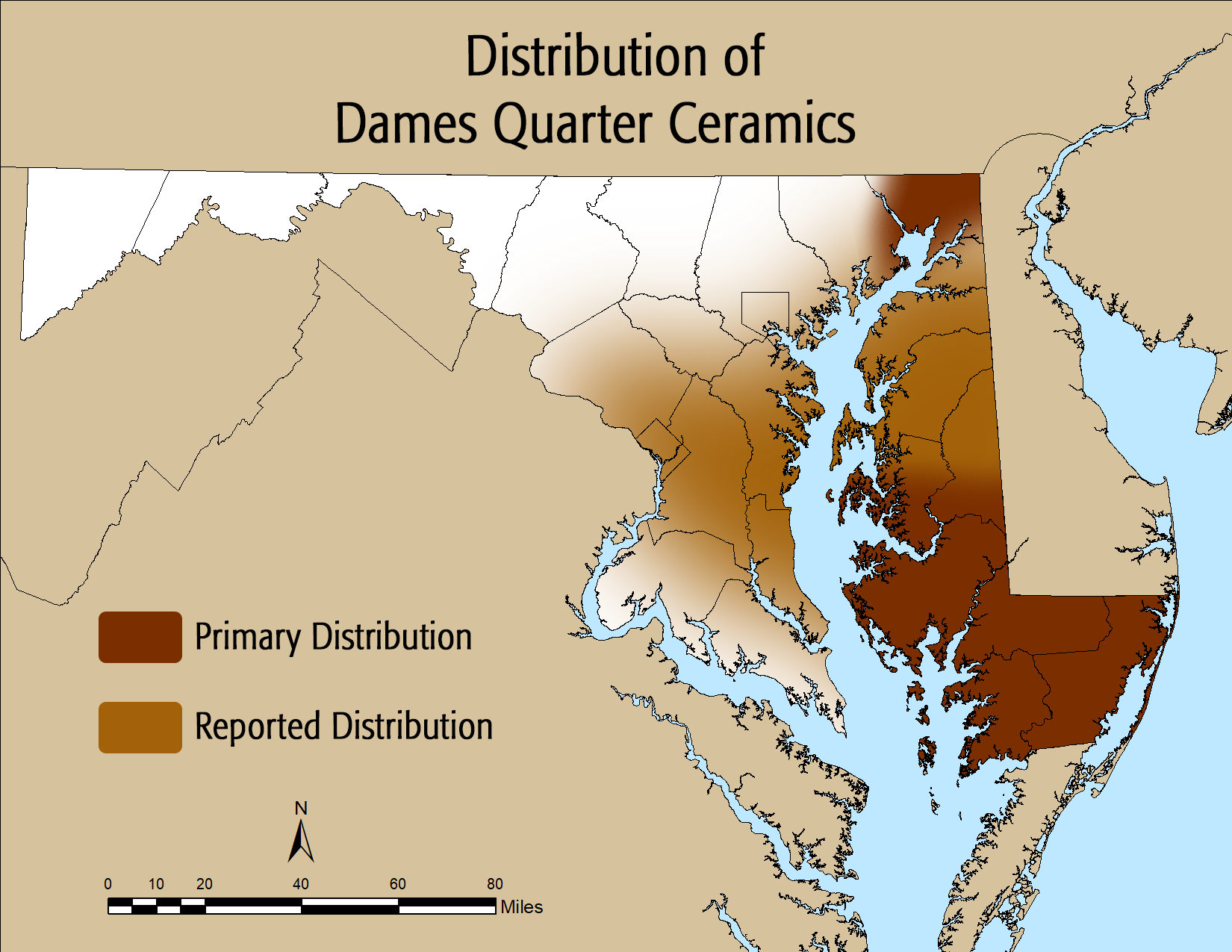
Figure 2. Distribution map.
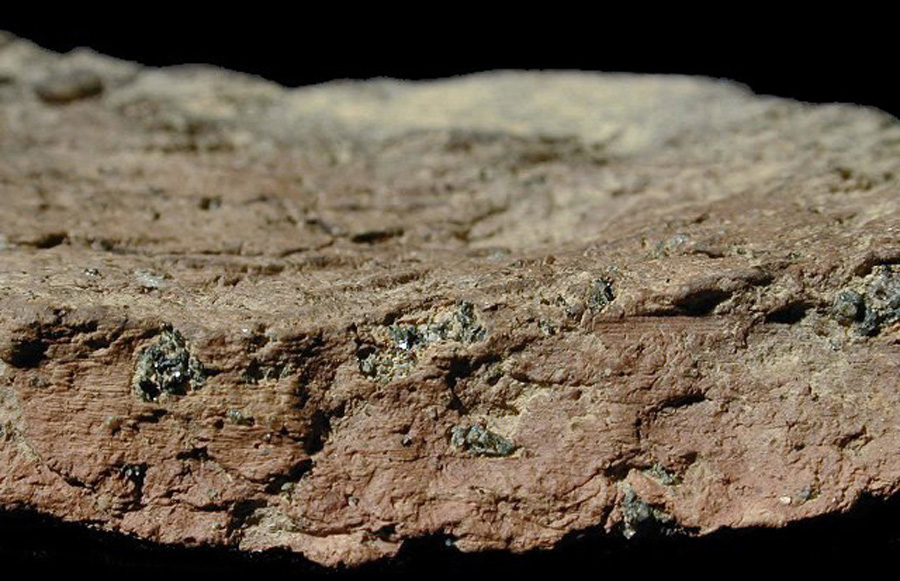
Figure 3. Paste close-up.
Description
Paste/Temper
The paste ranges from coarse to fine and smooth, depending on the size of the temper particles. The clay is fine-to-medium grained, compact, and cohesive. Dames Quarter is heavily tempered with coarse particles of black stone, such as hornblende or gneiss, which make up a high percentage of the paste. Color ranges from an oxidized buff to light orange.
Surface Treatment
Exterior surfaces are predominately smoothed, although cord-marked and fabric-impressed surfaces have been recorded. As with the exteriors, interior surfaces are commonly smoothed, but cord-marked and fabric-impressed sherds have been found.
Decoration
Wise (1975:23) noted that some sherds recovered from Deal’s Island, Delaware exhibited crudely incised designs. The use of lug handles as decorations has also been observed.
Morphology
Both hand-modeled and coil-constructed sherds have been found for Dames Quarter. Vessel shapes range from oval to cylindrical bodies with straight sides, and are medium in size. Bases are commonly flat, but conoidal ones have been recovered. Wise (1975:23) noted that some of the flat bases showed signs of coil-construction. The conoidal base sherds were very thick and appeared to have been hand molded. Rims are direct, while lips are either rounded or flattened. Vessel wall thickness ranges from 7 mm – 14 mm.
Defined in the Literature
Dames Quarter Black Stone Tempered ware was initially defined as a restricted localized development on the Delmarva Peninsula with similarities to Marcey Creek pottery (Wise 1975:23). Richard Artusy noted that large amounts of Dames Quarter had been recovered from Somerset County, Maryland, and supported the concept that ceramic experimentation was occurring between 1000 B.C. – 700 B.C. in the Mid-Atlantic region (Artusy 1976:2). Associated experimental wares include Selden Island and Ware Plain, with a mixture of manufacturing techniques, tempers and surface treatments used (Custer 1989).
Radiocarbon Dates
| Radiocarbon Dates | ||||
|---|---|---|---|---|
| Date | Sample No. | Site | Association | Reference |
| 2955 ± 90; B.C. 1005 | UGa-5376 | Clyde Farm, DE | Dames Quarter ceramics | Custer et al. 1986 |
References
1976 An Overview of the proposed ceramic sequence for southern Delaware. Maryland Archeology 12 (2): 1-15.
1989 Prehistoric Cultures of the Delmarva Peninsula: An Archaeological Study. University of Delaware Press, Newark.
1986 Archaeological Investigation of the Churchman’s Marsh Area. University of Delaware Center for Archeological Research Monograph No. 5. Newark, Delaware.
1975 A Proposed Early to Middle Woodland Ceramic Sequence for the Delmarva Peninsula. Maryland Archeology 11(1): 21–29.