Moyaone
Defining Attributes
Moyaone is a Late Woodland ware, characterized by fine grained sand and mica temper, soft texture, compact paste, and smoothed interior and exterior surfaces. Defined types include Moyaone Plain, Moyaone Cord-Impressed, and Moyaone Incised.
Chronology
Stratigraphic sequences and radiometric dating indicate that Moyaone ceramics date from ca. A.D. 1300 – A.D. 1650.
Distribution
Moyaone is found throughout the Western Shore Coastal Plain of Maryland.
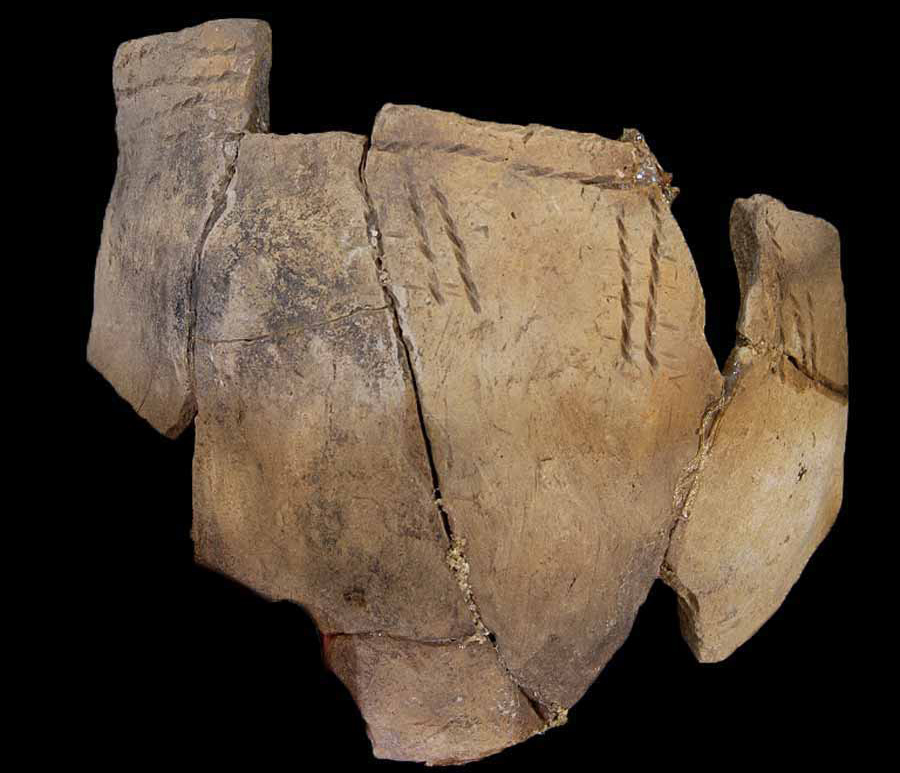
Figure 1. Example of Moyaone pottery.
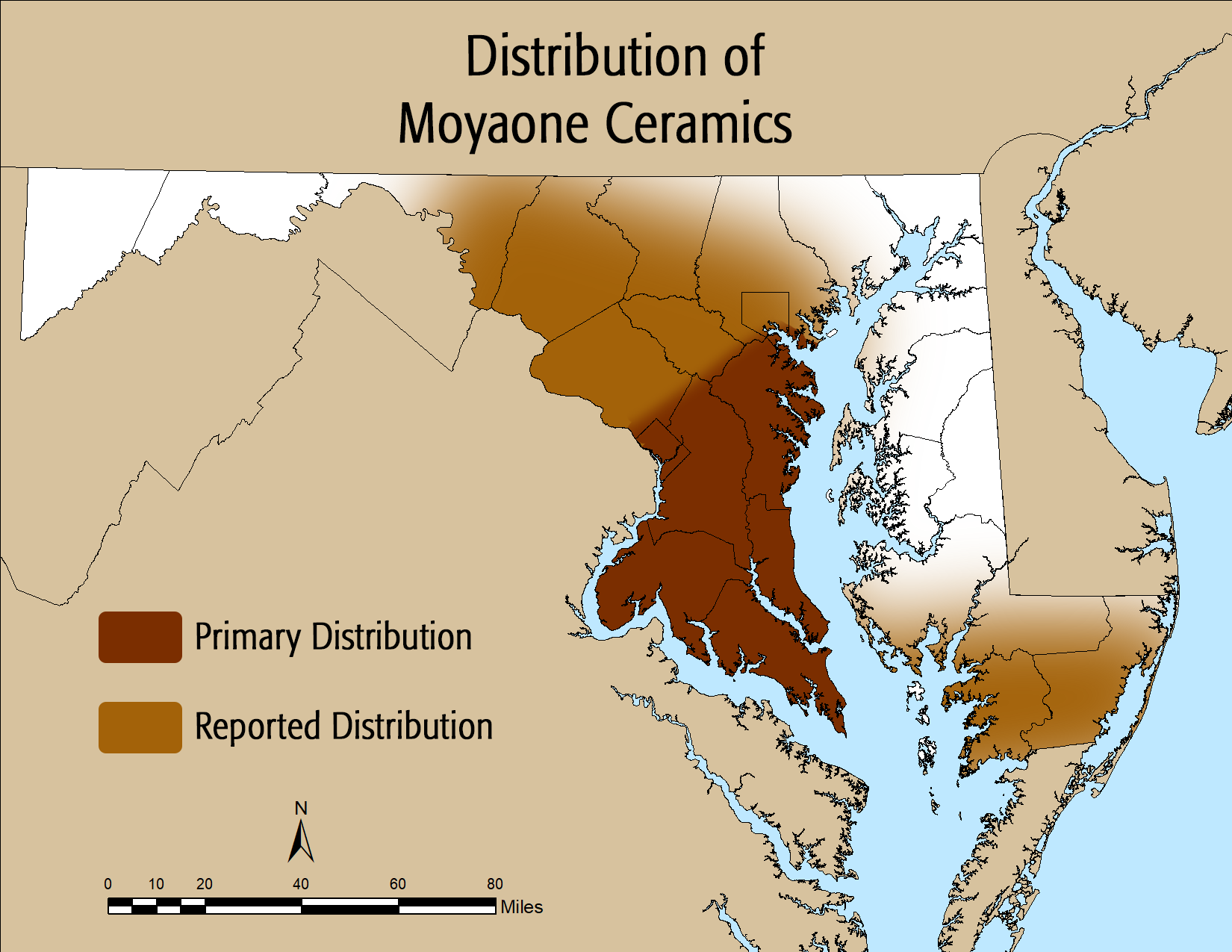
Figure 2. Distribution map.
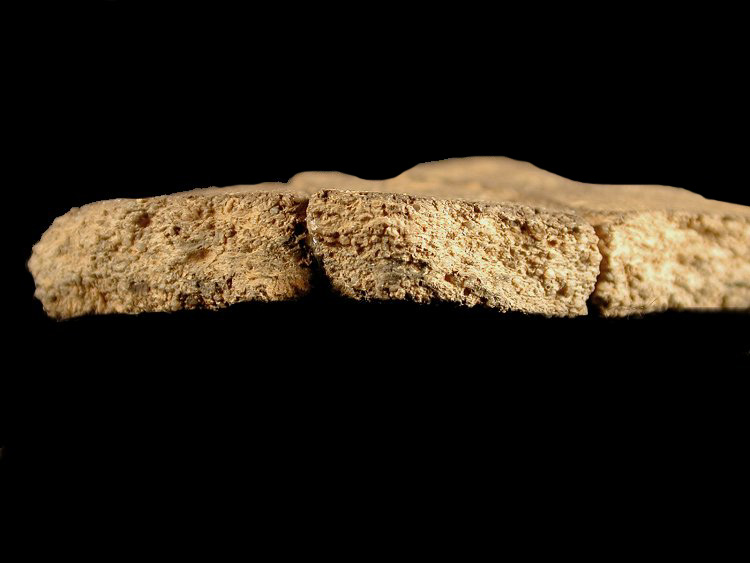
Figure 3. Paste close-up.
Description
Paste/Temper
The paste is composed of a fine-grained and compact clay and has a soft, smooth, andcompact texture. The temper consists of an extremely fine-grained sand containing minute particles of mica, and occasionally some added crushed quartz. The sand gives it a gritty feel and the mica produces a slight glitter. Moyaone has a Moh’s scale hardness of 2.0 – 2.5. Color varies from an oxidized light gray to gray-brown, but can range from almost black through brown, gray and reddish-buff to tan.
Surface Treatment
Exterior surfaces are cord-marked or smoothed over cord-marked. Marks are usually vertical to the rim but horizontal, diagonal, or criss-crossed marks have been found. Interior surfaces are smoothed, but vertical and horizontal striations have been found.
Decoration
Moyaone Plain is undecorated. Decorations on Moyaone Cord-Impressed are simple and confined to the rim and lip area. They are stamped, rolled onto the vessel, or applied as a single cord, horizontal, vertical, or diagonal to the rim. Decorations on Moyaone Incised are confined to the lip, rim, and upper body area, and consist of incised lines made with a sharp tool, a wide, dull tool, or rarely with a curved tool such as a fingernail. Designs are far more complex than on Moyaone Cord-Marked, and include horizontal lines, chevrons, crosshatching, and random lines.
Morphology
Moyaone is coil-constructed with paddle malleated or smoothed surfaces. Vessels are small to medium in size with globular, hemispherical, or cylindrical bodies. Bases are rounded. Lips are rounded, flattened, or wedge-shaped, and occasionally cord-marked. Rims are everted, inverted, or straight with a constricted neck. Occasionally a strip of clay is added around the rim to thicken it. Vessel wall thickness ranges from 5 mm – 10 mm but is usually 6 – 8 mm. Rims range from 10 mm – 12 mm. Maximum diameters are usually 8 cm – 12 cm, and depths 10 cm – 15 cm.
Defined in the Literature
Moyaone was originally defined as Potomac Creek Sand Tempered by Karl Schmitt from pottery recovered at the Potomac Creek site (44ST2). Stephenson later renamed and formally defined Moyaone from pottery recovered at the Accokeek Creek site (18PR8) in Prince George’s County, Maryland. He defined the three types, Moyaone Incised, Moyaone Cord-Impressed, and Moyaone Plain (Stephenson et al. 1963). Some researchers (e.g. Potter 1993:123) have suggested returning to the idea that Moyaone is just a variety of Potomac Creek and does not deserve a type name.
Type Site
Accokeek Creek (18PR8)
Radiocarbon Dates
| Radiocarbon Dates | ||||
|---|---|---|---|---|
| Date | Sample No. | Site | Feature | Reference |
| 640 ± 50; A.D. 1310 | DIC-1768 | White Oak Point (44WM119) | Waselkov 1982 | |
| 640 ± 50; A.D. 1310 | DIC-1764 | White Oak Point (44WM119) | Waselkov 1982 | |
| 490 ± 45; A.D. 1460 | DIC-1766 | White Oak Point (44WM119) | Waselkov 1982 | |
References
2001 Accokeek Creek: Chronology, the Potomac Creek complex, and Piscataway origins. Journal of Middle Atlantic Archaeology 17: 39-58.
1982 Indian Ceramics from Coastal Plain Virginia. Archeology of Eastern North America 10: 95-117.
1993 Commoners, Tributes, and Chiefs: The Development of Algonquian Culture in the Potomac Valley. University of Virginia Press, Charlottesville.
1963 The Accokeek Creek Site: A Middle Atlantic Seaboard Culture Sequence. Anthropological Papers, Museum of Anthropology, University of Michigan, No. 20, Ann Arbor
1982 Shellfish Gathering and Shell Midden Archaeology. Doctoral dissertation, Department of Anthropology, University of North Carolina at Greensboro, North Carolina. University Microfilms International, Ann Arbor, MI.