Popes Creek
Defining Attributes
Popes Creek is a late Early Woodland – early Middle Woodland ware that is thick, friable and heavily sand-tempered. The exterior is nearly always net-impressed though rarely it is cord-marked. Interior surfaces often show distinctive scoring.
Chronology
Stratigraphic sequences and radiometric dating indicate that Popes Creek dates from 500 B.C. – ca. A.D. 300.
Distribution
Popes Creek is found throughout the Coastal Plain and rarely in the Piedmont and Blue Ridge regions of Maryland, as well as parts of Delaware, Pennsylvania, and Virginia. The core area for Popes Creek pottery is the Estuarine Potomac River drainage.
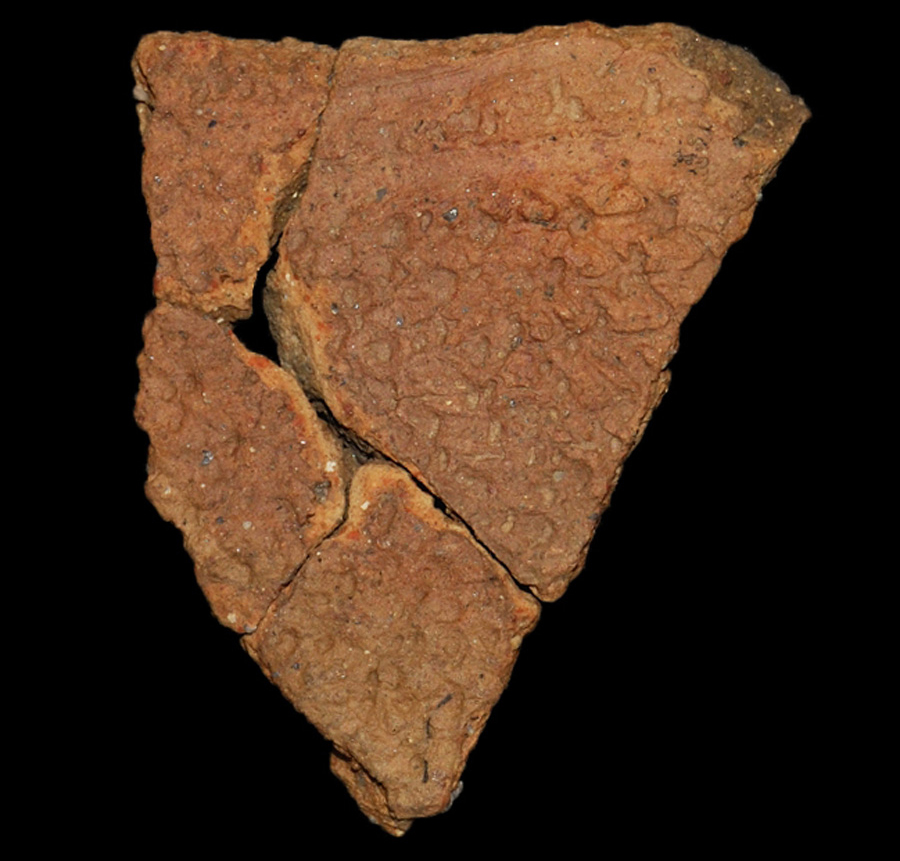
Figure 1. Example of Popes Creek pottery.
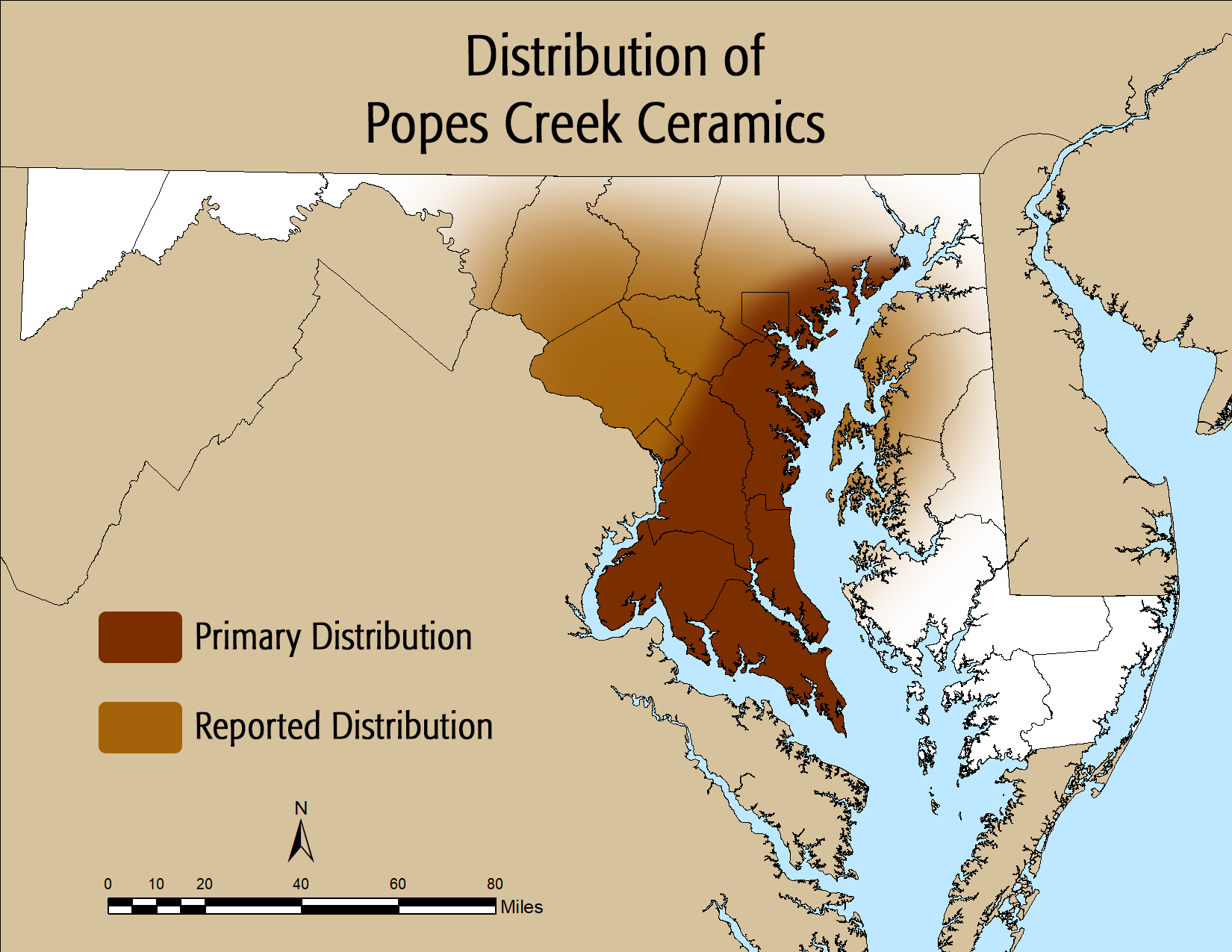
Figure 2. Distribution map.
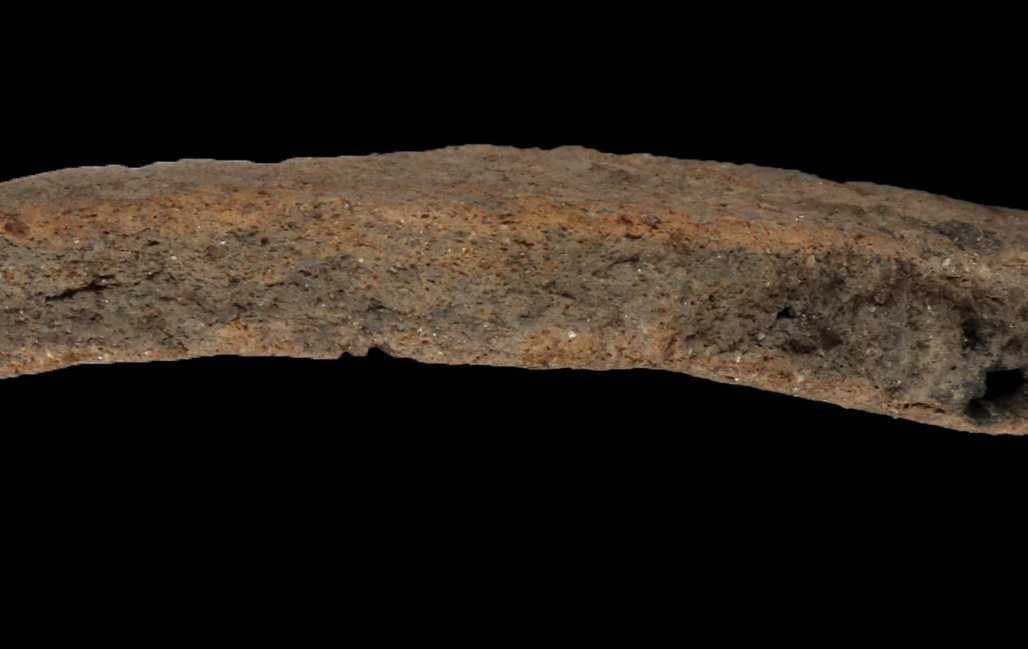
Figure 3. Paste close-up.
Description
Paste/Temper
The paste has a texture that is extremely sandy and coarse to the touch, porous, and friable. Temper consists of medium to coarse sand comprising 50% – 70% of the paste. Inclusions within the paste include coarse water-smoothed quartz pebbles, angular crushed quartz, or other lithic material. Temper particles range in size from 1 mm – 14 mm in diameter. The Moh’s hardness for Popes Creek sherds range between 2.0 and 2.5. The paste color ranges from an oxidized dark brown and black, to gray, buff, tan, and yellowish-orange and reds. The distinctive ferruginous color of Popes Creek pottery is one of its distinctive features when compared to contemporaneous wares.
Surface Treatment
Exterior surfaces are deeply net-impressed or cord-marked over the entire surface. The net-impressions are identifiable by the even patterned indentations from the knots in the netting that create a bumpy surface. The knotted mesh netting varies from fine (3 – 5 cords per cm) to coarse (1 cord per cm) with most examples impressed with a medium mesh of 2 –3 cords per cm.
The interior surface of many Popes Creek sherds is scored or combed with short, deep, patterned strokes. Diagonal strokes of 3 – 8 cm in length are met by vertical or horizontal strokes, forming irregular, geometric patterns. On some sherds, the scoring is done in long, sweeping strokes diagonal to the rim. Basal portions are not scored. In some rare instances, the net-impressions extend up over the rim onto the interior surface below the lip.
Decoration
Popes Creek ware is usually undecorated. Occasionally finger-smoothed horizontal lines, and rarely, incised horizontal lines or chevrons, were placed just below the rim.
Morphology
Pope's Creek vessels are coil-constructed, with coil widths ranging from 10 mm – 20 mm. Basal sherds often appear to have been modeled by hand from lumps of clay, with the coils beginning 40 mm – 100 mm above the basal point. Rims are vertical or slightly everted, and are usually 5 mm – 10 mm in thickness. Lips are rounded, flattened, or slightly wedge-shaped.
Vessels are typically large and conical in shape, with the upper portions of the vessel nearly cylindrical, while the lower portions taper towards the base. Bases are conical or semi-conical, and basal wall thickness ranges between 15 mm – 28 mm. Vessel size ranges from diameters of 25 cm – 35 cm and from depths of 30 cm – 45 cm. Vessel wall thickness, above the base, ranges from 6 mm to 18 mm, with most sherds measuring from 9 mm – 11 mm.
Defined in the Literature
William Henry Holmes described this pottery from the Popes Creek shell midden site (18CH74) on the Potomac River (Holmes 1903:153-155). The first formal definition was based on pottery from the Accokeek Creek site (Stephenson et al. 1963:93-96). Stephenson presumed that Popes Creek pottery was earlier than the Accokeek ware due to its more primitive appearance. Excavations at sites with stratified components and radiocarbon dates indicate that Accokeek ware pre-dated Popes Creek.
Type Site
Popes Creek (18PR74)
Maryland Sites with Popes Creek Components
- Popes Creek (18CH74)*,
- Chapel Point (18CH79)*,
- Otter II (18CV272)*,
- Abells Wharf (18ST53)*,
- Piscataway (18PR7),
- Accokeek Creek (18PR8),
- Loyola Retreat (18CH58)
*collections at the MAC Lab
Radiocarbon Dates
| Radiocarbon Dates | |||||
|---|---|---|---|---|---|
| Date | Corrected Date | Sample No. | Site | Feature | Reference |
| 2460 ± 100; B.C. 510 | B.C. 500 | SI-450 | Piscataway (18PR7) | Pit 32-1 | Woodward and Phebus 1973 |
| 2440 ± 95; B.C. 490 | B.C. 590 | I-5247 |
Lovola Retreat (18CH58) | Level 2 | Handsman and McNett 1974:4 |
| 2270 ± 95; B.C. 320 | B.C. 410 | SI-2900 | Abells Wharf (18ST53) | >1m below plow zone | Boyce and Frye 1986 |
| 2235 ± 100; B.C. 285 | B.C. 285 | AA-3867 | Chapel Point (18CH79) | Curry and Kavanagh 1993: 35 | |
References
1986 Radiocarbon Dating of Archeological Samples from Maryland. Maryland Geological Survey, Division of Archaeology, Archeological Studies No. 4.
1993 A New Radiocarbon Date for Popes Creek Ware. Maryland Archeology 29 (1 and 2):31-42.
1982 Indian Ceramics from Coastal Plain Virginia. Archeology of Eastern North America 10: 95-117.
1974 The Middle Woodland in the Middle Atlantic: Chronology, Adaptation, and Continuity. Paper presented at the 5th Middle Atlantic Archaeological Conference, Baltimore.
1903 Aboriginal pottery of the Eastern United States. U.S. Bureau of Ethnology, Washington, D. C.
1963 The Accokeek Creek Site: A Middle Atlantic Seaboard Culture Sequence. Anthropological Papers, Museum of Anthropology, University of Michigan, No. 20, Ann Arbor
1973 The Piscataway Site: A Stratified Woodland Site in Tidewater Maryland (18PR7) Prince George’s County, MD. Manuscript on file, Maryland Historical Trust, Crownsville, MD.