Sullivan Cove
Defining Attributes
Sullivan Cove is a Late Woodland ware, characterized by fine shell tempering, thin vessel walls, a hard compact paste, conoidal bases, and cord-wrapped paddle impressions on the exterior surface. Defined types consist of Sullivan Cove Cord-Marked and Sullivan Cove Plain.
Chronology
Stratigraphic sequences and radiometric dating indicate that Sullivan Cove dates from ca. 1250 A.D. – 1600 A.D.
Distribution
Sullivan Cove pottery is found in the Western Shore Coastal Plain regions of Maryland south of Annapolis.
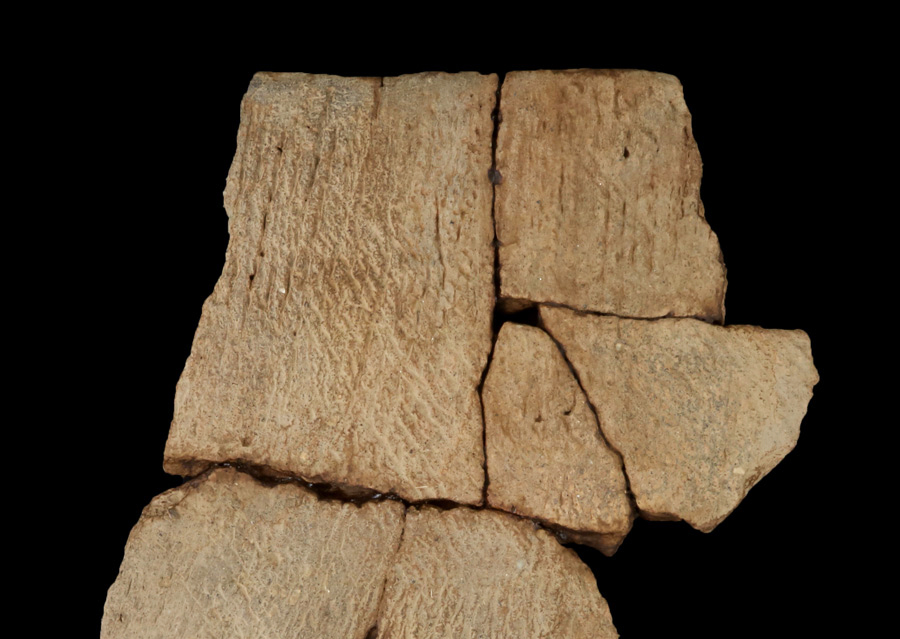
Figure 1. Example of Sullivan Cove pottery.
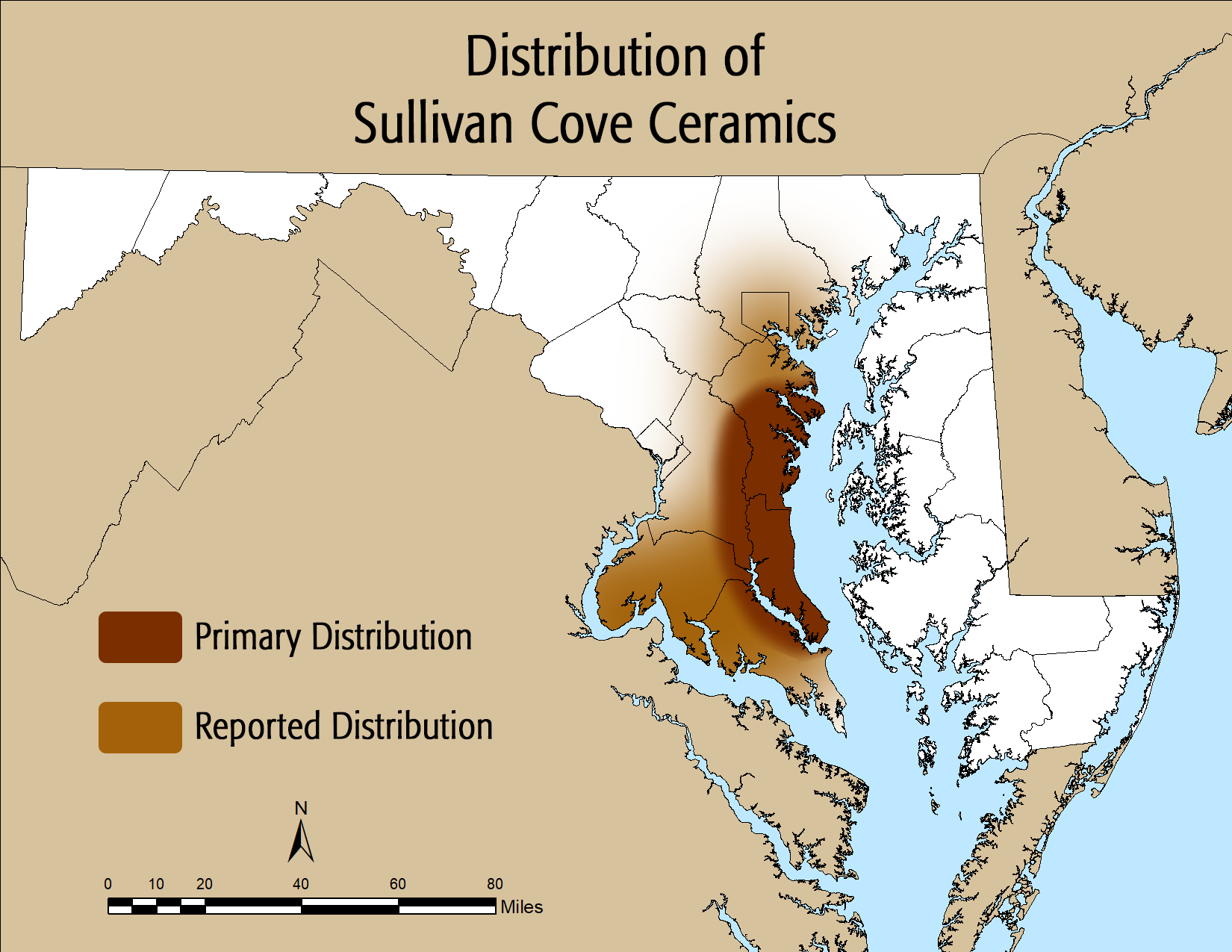
Figure 2. Distribution map.
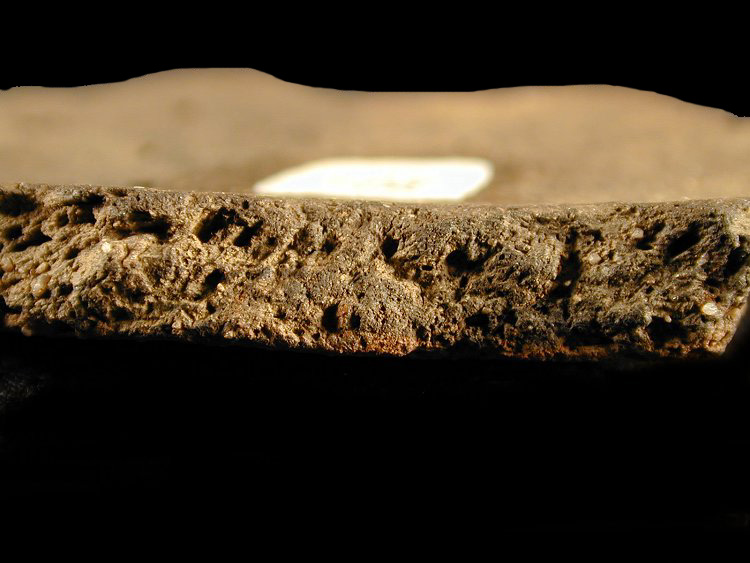
Figure 3. Paste close-up.
Description
Paste/Temper
The temper consists of very finely crushed oyster shell. The clay is compact and has a hard texture, and the color is an oxidized brown.
Surface Treatment
Exterior surfaces are partially smoothed-over cord-marked. Interior surfaces are smoothed.
Decoration
Decorative motifs consist of banded horizontal cord-wrapped dowel impressions similar to those found on Rappahannock Incised and Potomac Creek, or finely incised horizontal lines and herringbone motifs. Rarely other designs, such as incised triangles and concentric circles, along with pinched nodes and punctates, are found.
Morphology
Sullivan Cove vessels are coil-constructed with paddle malleation. Vessels are cylindrical or conical with a constricted neck, semi-conoidal base, and are of medium size. Vessel walls are thin, ranging from 4 mm – 8 mm. Along the Patuxent River, sherd thickness averages between 5 mm and 6 mm (Steponaitis 1986).
Defined in the Literature
Henry Wright (1973) first identified Sullivan Cove from the Sullivan Cove site (18AN106) located near the head of the Severn River. Peck (1978) later refined the definition with his work in Southern Maryland. Sullivan Cove is referred to as an "enigmatic ware" by Stephen Potter in his 1982 dissertation. Both Potter (1982) and Steponaitis (1986) expressed concerns about the adequacy of the type definition that have still not been addressed. The paste resembles the Townsend Series, but its surface treatment is similar to Potomac Creek. Decorative motifs are similar to both types.
Type Site
Sullivan Cove (18AN106)
Maryland sites with Sullivan Cove components
- Waveland Farm (18AN17)*
- Hillsmere Pond I (18AN197)
- Duck’s Run (18AN546)*
- Solomons (18CV254)
- 18CV362*
*collections at the MAC Lab
Radiocarbon Dates
| Radiocarbon Dates | ||||
|---|---|---|---|---|
| Date | Sample No. | Site | Feature | Reference |
| 640 ± 70; A.D. 1310 | Beta-15936 | Solomons (18CV254) | Feature A | Koski-Karell and Ortiz 1986 |
| 620 ± 50; A.D. 1330 | Beta- 13050 | Solomons (18CV254) | Feature A | Koski-Karell and Ortiz 1986 |
| 565 ± 55; A.D. 1385 | SI-3665 | Waveland Farm (18AN17) | Peck 1978 | |
| 530 ± 70; A.D. 1420 | Beta-13051 | Solomons (18CV254) | Feature B | Koski-Karell and Ortiz 1986 |
References
1986 Technical Report of the Archeological Investigations for the Solomons Island/Appeal Sewage Treatment Project, Calvert County, Maryland. Prepared for Calvert County Department of Public Facilities and Services.
1978 Preliminary Test Excavations at the Waveland Farm Site (18AN17), Anne Arundel County, Maryland. Maryland Archeology, 14 (1-2): 17-23.
1979 Aboriginal Ceramics at the Obrecht Site (18AN113). Maryland Archeology 13 (1).
1982 An analysis of Chicacoan settlement patterns. Dissertation. University of North Carolina, Chapel Hill.
1980 A Survey of Artifact Collections From the Patuxent River Drainage, Maryland. Maryland Historical Trust Monograph Series No. 1. Annapolis, MD.
1986 Prehistoric settlement patterns in the Lower Patuxent drainage, Maryland. Dissertation. SUNY Binghamton.
1973 An Archeological Sequence in the Middle Chesapeake, Maryland. Maryland Geological Survey Archeological Studies No. 1. Washington, D.C.