Page
Defining Attributes
Page is an early Late Woodland ware, characterized by limestone temper and a cord-marked exterior surface, often with an added strip or pseudo-collar around the rim. Decorative techniques include cord-wrapped stick impressions or incising on the lip and rim exterior, and rarely lugs or castellations.
Chronology
Stratigraphic sequences and radiometric dating indicate that Page dates from ca. A.D. 900 – A.D. 1450.
Distribution
Page ceramics are found in the western Piedmont region and west through the Great Valley, Ridge and Valley, and Appalachian Plateau regions of Maryland, Virginia, West Virginia, and Pennsylvania.
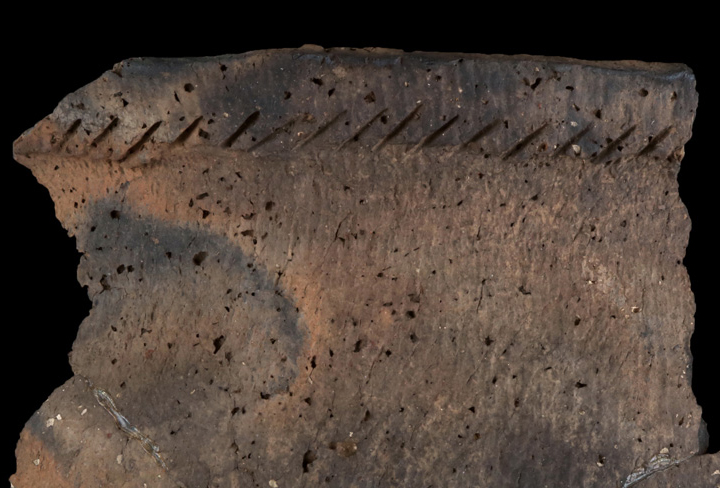
Figure 1. Example of Page pottery.
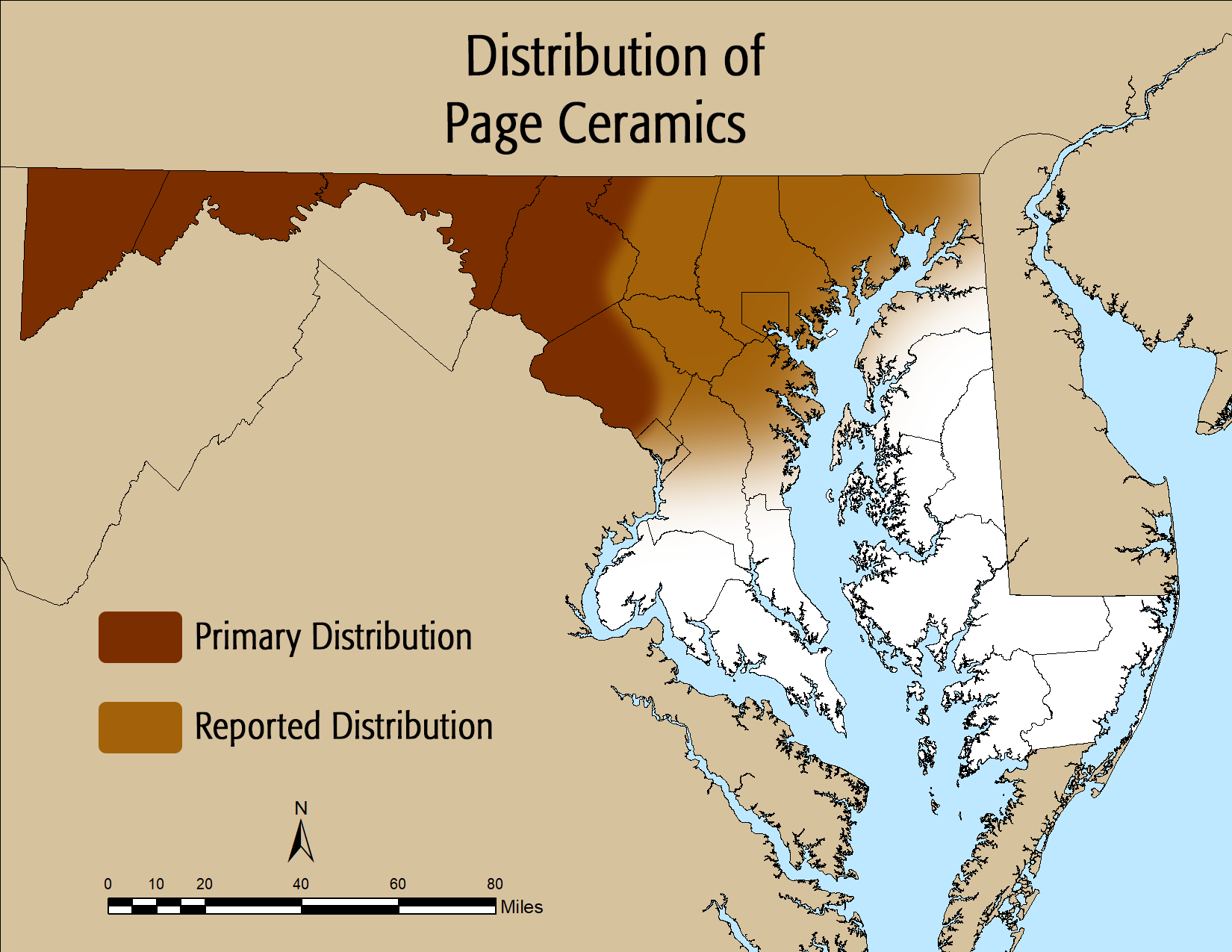
Figure 2. Distribution map.
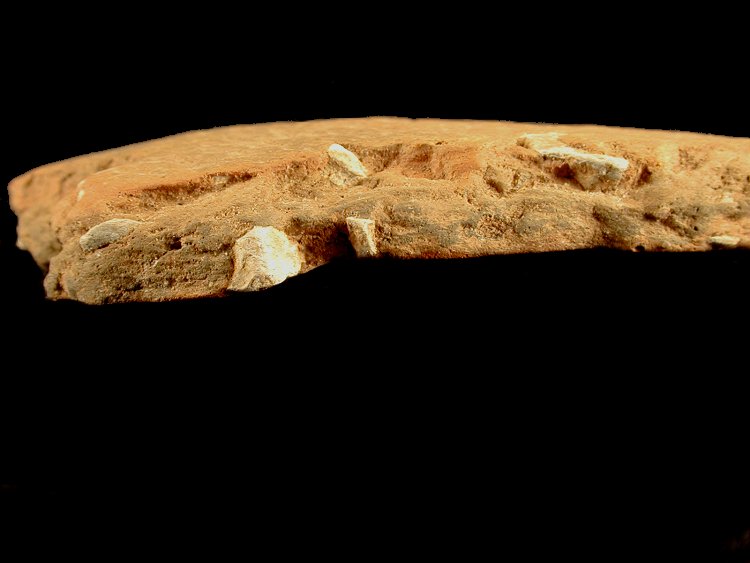
Figure 3. Paste close-up.
Description
Paste/Temper
The paste is fairly compact and not friable. The texture is medium-fine to medium-coarse and clayey. Exterior surface colors range from buff to reddish-tan. This pottery has a Moh’s scale hardness of 2 – 2.5. The temper consists of crushed limestone or calcite that varies from 1 mm – 2.5 mm thick, and makes up 25% of the paste. Page sherds frequently have square or rectangular holes where the tempering agent has leached out. A small percentage of sherds are tempered with chert or other crushed rock. A number of the Page sherds from the Friendsville site (18GA23) were tempered with crushed hematite.
Surface Treatment
Exterior surfaces are cord-marked, or have smoothed-over cord impressions that are oriented vertically or, less commonly, obliquely to the body. Final Z-twist cordage impressions are found almost exclusively. A small number of vessels exhibit fabric-impressions. Interior surfaces are smoothed.
Decoration
Oblique slashes at the rim/vessel body juncture are the primary decoration. A few rim sherds exhibit signs of criss-cross incising or punctations.
Morphology
Page vessels are mainly coil-constructed, but hand-modeled vessels have been found in rare instances. Vessel size ranges from small to large, and vessels are conoidal, globular/rounded, or conoidal/globular in shape. Lips vary from flat to slightly rounded. Rims range from vertical to slightly flaring. Rim strips are added to some vessels to form a pseudo-collar. Uncollared rims have thickened lips, which are often folded over. Vessel wall thickness ranges from 6 mm – 8 mm.
Defined in the Literature
Page Cord-Marked was first defined from pottery sherds recovered at the Keyser Farm site (44PA1), located half a mile from the South Fork of the Shenandoah River between Luray and Front Royal at the foot of Massanutten Mountain in Page County, Virginia (Manson et al. 1944:402-405). Franklin (1979) defined the Mason Island type in her M.A. thesis on the Mason Island site, 18MO13, in Montgomery County, Maryland. Mason Island ware is identical to Page and this site lies at the eastern edge of the Page ceramic distribution. Stewart (1982:82) later noted that Page was also identical to the Nolands Ferry ware described by Peck (1979) from the Monocacy River region, and to the Radford Fabric/Net-Impressed ware described by Evans (1955). Somerset Plateau (Pennsylvania) limestone-tempered Monongahela wares represented at the Gnagey site are also very similar to Page ceramics (George 1983).
Type Site
Keyser Farm (44PA1)
Maryland Sites with Page Components
- Nolands Ferry (18FR17)*,
- Mason Island (18MO13)*,
- Cresaptown (18AG119),
- Barton (18AG3),
- Sang Run 918GA22)*,
- Friendsville (18GA23)*
* collections at MAC Lab
Radiocarbon Dates
| Radiocarbon Dates | ||||
|---|---|---|---|---|
| Date | Sample No. | Site | Feature | Reference |
| 920 ± 60; calibrated A.D. 1005-1250; multiple intercepts at A.D. 1055, 1085, 1150 | Beta-143409 | Barton (18AG3) | Feature 63 | Wall 2001 |
| 830 ± 70 B.P.; calibrated A.D. 1170-1225; intercept at A.D. 1225 | Beta-87251 | Barton (18AG3) | Feature 16 | Wall 2001 |
| 900 ± 50 B.P.; calibrated A.D. 1020-1250; intercept at A.D. 1160 | Beta-143406 | Barton (18AG3) | Feature 53 | Wall 2001 |
| 830 ± 60 B.P.; calibrated A.D. 1040–1290; intercept at A.D. 1215 | Beta-24721 | Sang Run (18GA22) | Feature 11 | Wall 1989 |
| 770 ± 60; calibrated A.D. 1170-1300; intercept at A.D. 1270 | Beta-24720 | Sang Run (18GA22) | Feature 10 | Wall 1989 |
| 950 ± 45 B.P.; uncalibrated | SI-7024 | Cresaptown (18AG119) | Feature 180 | Wall 2001 |
| 915 ± 70; uncalibrated | SI-7025 | Cresaptown (18AG119) | Feature 259 | Wall 2001 |
References
1991 The Middle to Late Woodland Transition in Maryland. North American Archaeologist 12 (1):2-28.
1989 Cullers Site 44PA128, Page County, Virginia. Department of Conservation and Historic Resources, Division of Historic Landmarks, Richmond, VA.
1979 A Late Woodland Occupation Site on Lower Mason Island, Montgomery Co., MD. Masters Thesis. American University, Washington, D.C.
1985 An Ode to a 1000 Piece Puzzle: The Comparative Anatomy of Four Early Late Woodland Huffman Phase Ceramic Assemblages. Archaeological Society of Virginia Quarterly Bulletin 40:65-107.
1983 The Gnagey Site and the Monongahela Occupation of the Somerset Plateau Pennsylvania Archaeologist 53(4):1-97.
1944 The Culture of the Keyser Farm Site. In Papers of the Michigan Academy of Science, Arts, and Letters 29, edited by Eugene S. McCarthy and Henry Van der Schalie. University of Michigan Press, Ann Arbor.
1979 Archaeological Resources Assessment of the Monocacy River Region, Frederick and Carroll Counties, Maryland: Phases I and II. Maryland Geological Survey, Division of Archeology & Department of Natural Resources. Report on file at Jefferson Patterson Park and Museum.
1982 Prehistoric Ceramics of the Great Valley of Maryland. Archaeology of Eastern North America 10:69-94.
1989 A Preliminary Archaeological Data Base for the Maryland Coal Region. Maryland Historical Trust, Crownsville.
2001 Late Woodland Ceramics and Native Populations of the Upper Potomac Valley. Journal of Middle Atlantic Archaeology 17:15-37.