Shenks Ferry
Defining Attributes
Shenks Ferry is a Late Woodland ware characterized by crushed granite or quartz temper and a cord-marked exterior with the cords aligned vertically to the vessel. Decoration consists of incised lines in geometric patterns encircling the rim. Defined types include Shenks Ferry Cord-Marked, Shenks Ferry Incised, Lancaster Plain and Lancaster Incised.
Chronology
Stratigraphic sequences and radiometric dating indicate that Shenks Ferry dates from ca. A.D. 1300 – A.D. 1575.
Distribution
Shenks Ferry is found throughout the Piedmont region of Maryland and across much of the lower Susquehanna Valley in Pennsylvania. Shenks Ferry sites are also found in the West and North Branch valleys of the Susquehanna River.
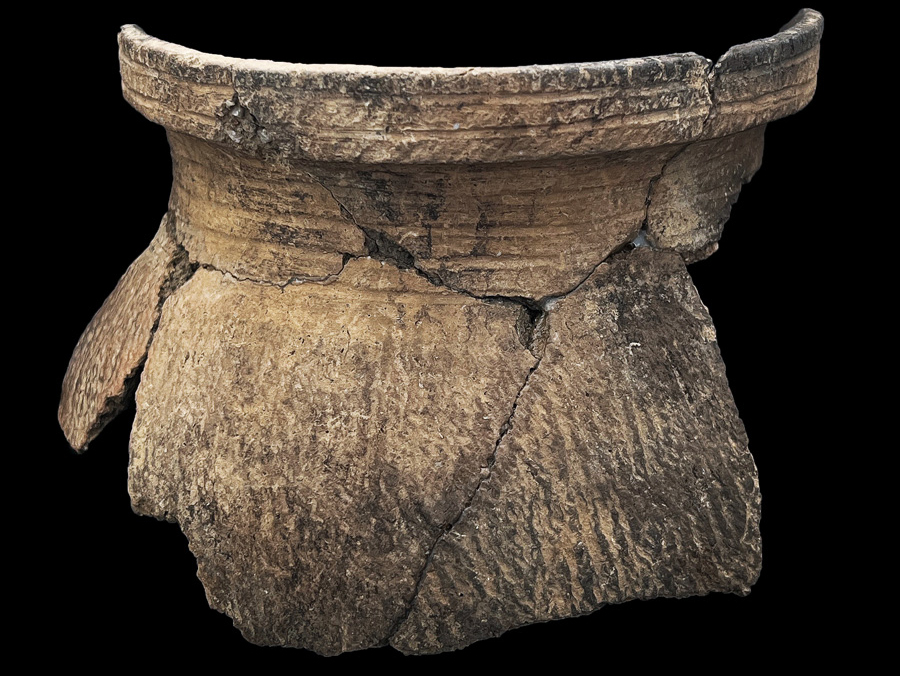
Figure 1. Example of Shenks Ferry pottery.
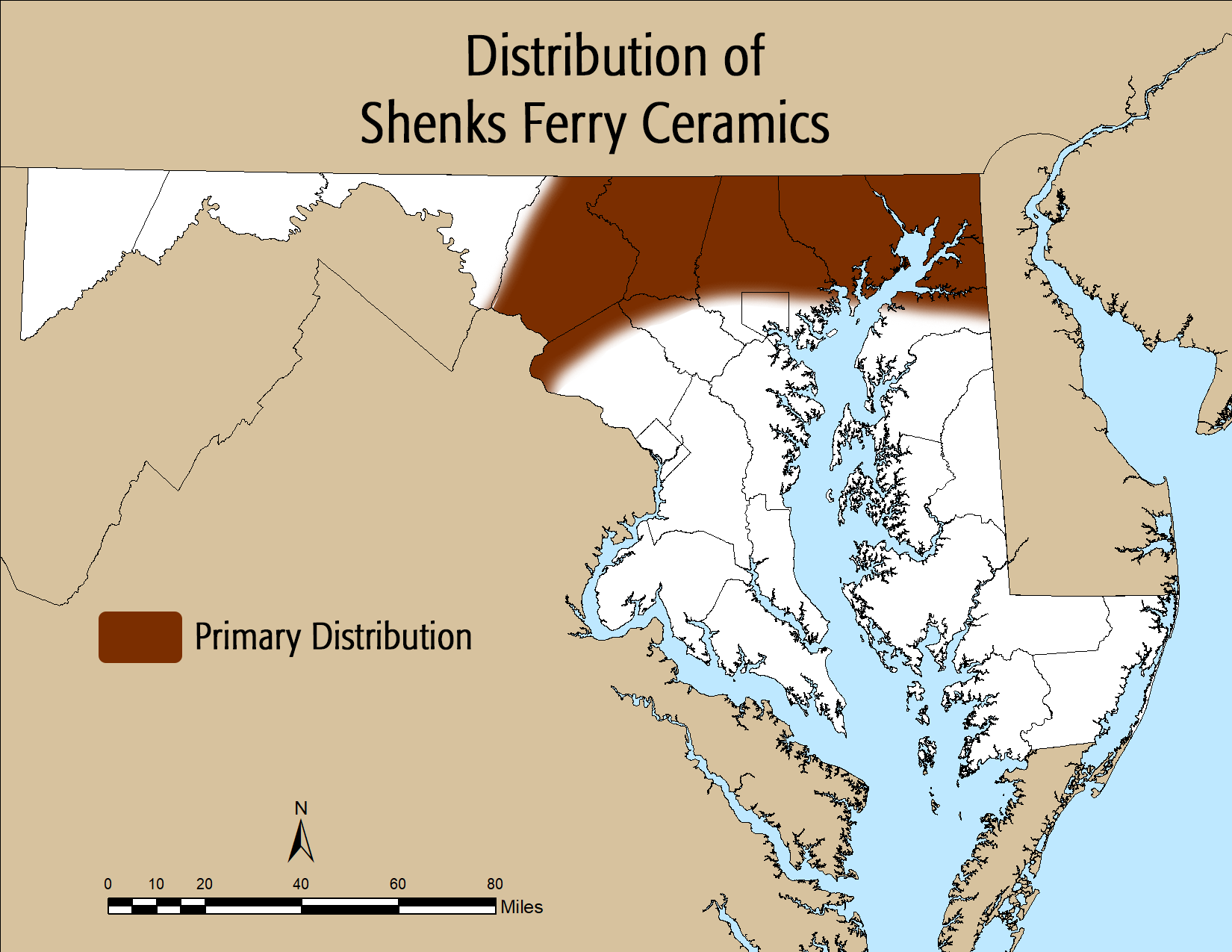
Figure 2. Distribution map.
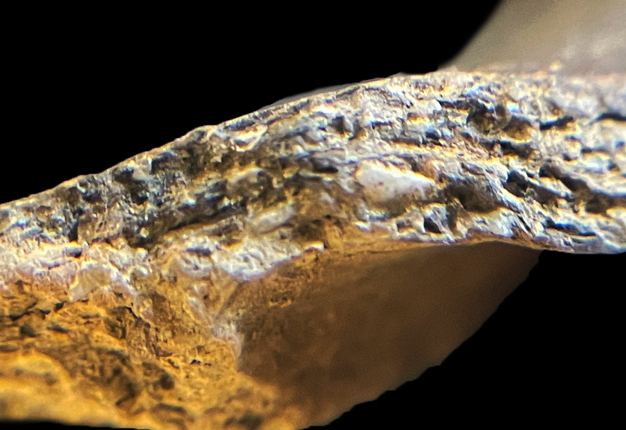
Figure 3. Paste close-up.
Description
Paste/Temper
The paste has a gritty texture, ranging from coarse to smooth. The clay is silty and micaceous. The tempering agent varies greatly, based on geographical location. Heisey (1971:45) notes that in the Pennsylvania Piedmont, temper consists of a greenish mineral that resembles "soft granite," with inclusions of schist, gneiss, and feldspar dominating. In the northern Lancaster Plain, crushed quartz, chert, and limestone are used. Temper particles are generally under 3 mm in diameter, and comprise 10% of the paste. Shenks Ferry has a Moh’s scale hardness of 2.0 – 3.0. Color ranges from an oxidized gray to reddish brown.
Surface Treatment
Exterior surfaces are marked from the base to the neck with fine to coarse cord-markings. The cord-marking is usually vertical to oblique to the rim on the vessel exterior. The neck area is always smoothed, and the base partially smoothed. Interior surfaces are smoothed by scraping.
Decoration
Shenks Ferry Cord-Marked vessels are rarely decorated with anything more than simple cord-impressions. Shenks Ferry Incised and Lancaster Incised vessels are decorated with incised lines. Rim areas are sometimes smoothed before decoration.
Incised lines are produced by short, rapid strokes that overlap at random in horizontal, vertical, diagonal and criss-cross lines. Heisey (1971:46) describes the incised lines on Shenks Ferry vessels as crude and suggests that true incised lines are rarely found. Vertical or oblique paddle edge cord-impressions are applied often at the base of the rim, at its juncture with the neck.
Morphology
Shenks Ferry vessels were coil-constructed or slab built from a mass of clay, and paddle malleated. Vessel shapes range from a narrow rounded base that flows with a continuous curve into a wider shoulder and constricted neck, to egg-shaped or globular. Shenks Ferry Cord-Marked vessels have an angular to rounded cord-marked lip, and sharply constricted necks that have short, smooth collars added. Shenks Ferry Incised vessels are the same as the Cord-Marked, except that the lips are angular only. Vessels are predominately egg-shaped, but occasionally occur as elongated globular forms with the greatest diameter at the shoulder. Vessels are commonly medium sized, with height varying between 12 cm and 34 cm.
Defined in the Literature
Christopher Wren (1914) was the first person to publish a description of Shenks Ferry pottery, although he did not name it. That occurred nearly forty years later, when Witthoft and Farver (1952:15-22) defined this pottery as Shenks Ferry. Since then, numerous archaeologists, such as Kinsey, Heisey, Graybill and Griffith, have worked on refining the definition, distribution, and dating of Shenks Ferry pottery in Pennsylvania.
Sequential phases of Shenks Ferry that have been defined include, from early to late, the Blue Rock, Funk, and Lancaster phases. There appears to be a relationship between Shenks Ferry in Pennsylvania and Montgomery Complex cultures in Maryland based on similarities in the Shenks Ferry and Shepard ceramics.
Type Site
Shenks Ferry Site, Lancaster, County, Pennsylvania
Maryland Sites with Shenk’s Ferry Ceramics
- Rosenstock (18FR18) (one vessel only)*
* collections at the MAC Lab
Radiocarbon Dates
None in Maryland
References
1993 Data Recovery Excavations of the West Water Street Site (36CN175), Lock Haven, Clinton Country, Pennsylvania. University of Delaware Center for Archaeological Research, Newark.
1982 Prehistoric Ceramics in Delaware (An Overview). Archaeology of Eastern North America 10: 46-68.
1977 Middle Woodland Ceramics from Wolfe Neck, Sussex County, Delaware. The Archeolog 28 (1): 1-28.
1995 Archaeological Investigations at the Memorial Park Site (36CN164) Clinton County, Pennsylvania. Report on file at the Defense Technical Information Center.
1971 An Interpretation of Shenks Ferry Ceramics. Pennsylvania Archaeologist, 41 (4): 44 –70.
1960 Additional Notes on the Albert Ibaugh Site. Pennsylvania Archaeologist 30: 3-4.
1971 The Murry Site and Its Role in Lancaster and Funk Phases of Shenks Ferry Culture. Pennsylvania Archaeologist 41: 4:7-44.
1978 A Potter’s Viewpoint of Susquehannock and Shenks Ferry Ceramic Wares. Masters Thesis, Department of Fine Arts, Antioch University, Columbia, Maryland.
1977 A Report on the Shenks Ferry and Susquehannock Components at the Funk Site, Lancaster County, Pennsylvania. Man in the Northeast 13:45-65.
1952 Two Shenks Ferry Sites in Lebannon County, Pennsylvania. Pennsylvania Archaeologist, 22 (1).
1914 North Appalachian Indian Pottery. Proceedings of the Wyoming Historical and Geographical Society. Wilkes-Barre, PA.