Watson
Defining Attributes
Watson is a Middle Woodland ware characterized by a crushed limestone temper and cord-marked exterior. Defined types have traditionally included Watson Cordmarked and Watson Plain.
Chronology
Stratigraphic sequences and radiometric dating indicate that Watson ceramics post-date Adena occupations in the upper Ohio River Valley and immediately precede Page components. They date to the end of the Middle Woodland period, ca. A.D. 100 – A.D. 800.
Distribution
Watson ceramics are found in the upper reaches of the Potomac River Valley in Maryland and West Virginia, as well as over a large area in the upper Ohio River Valley.
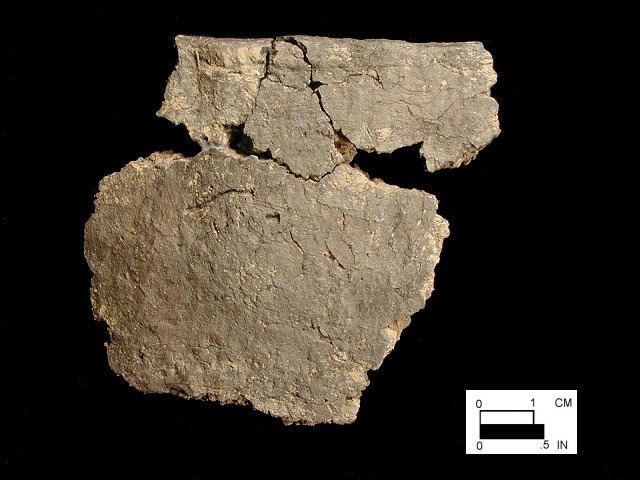
Figure 1. Example of Watson pottery.
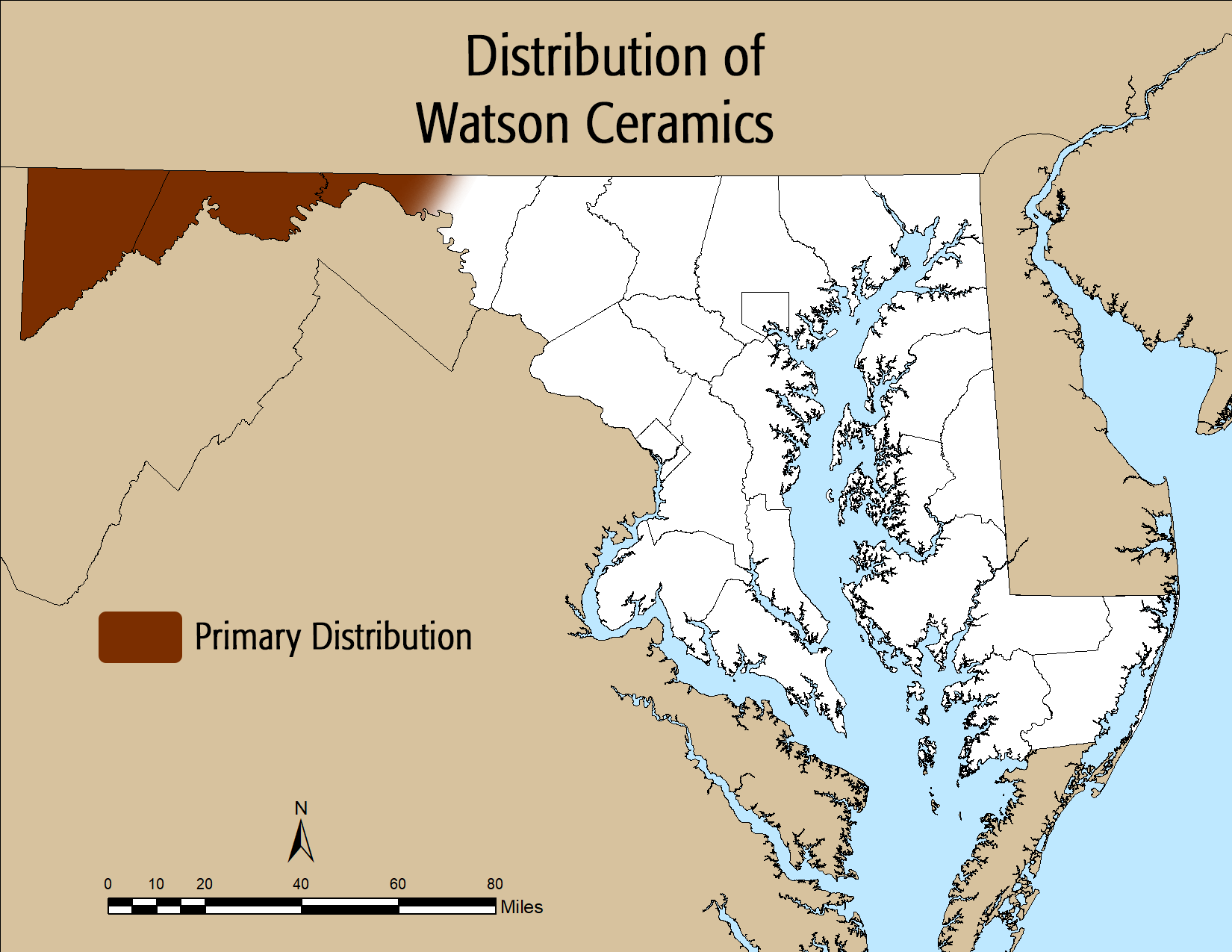
Figure 2. Distribution map.
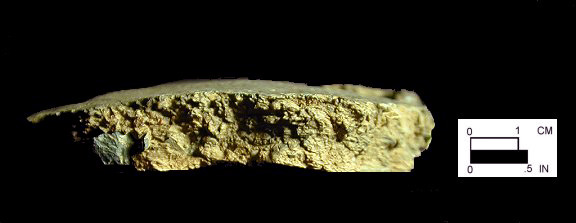
Figure 3. Paste close-up.
Description
Paste/Temper
The paste is heterogeneous, and sherds tend to break along coil lines. The temper consists of crushed limestone that is variable in size (up to 8 mm) and which comprises 20% – 50% of the paste. Temper is often leached out, leaving angular holes on sherd surfaces. Watson ceramics have a surface hardness ranging from 2.5 – 4.0 on the Moh’s hardness scale. Color ranges from a yellow-gray to tan, with slightly darker cores.
Surface Treatment
Exterior surfaces are cord-marked, plain, and, in rare instances, incised. Cord-marking is usually vertical from the lip to the base. The exterior surfaces are smoothed.
Decoration
None
Morphology
Watson wares are coil-constructed with paddle malleation. Vessels are probably rounded, with straight to slightly everted lips. Lips are squared to slightly flattened. Vessel wall thickness ranges from 5 mm – 15 mm, with a mean of 7 mm.
Defined in the Literature
This type is named for the Watson Farm site (46HK34) in the upper Ohio River Valley. Its distribution in the Potomac River Valley is not clear. However, recent evidence indicates that poorly constructed limestone-tempered ceramics from two sites show at least a tentative relationship to the Ohio River Valley Watson wares. These crudely constructed vessels appear to be typological precedents to the more refined Page wares that dominated the region by the early Late Woodland period. This Middle Woodland ware may have developed out of earlier thick Vinette-like wares, some of which have been found in western Maryland rockshelter sites.
Type Site
Watson (46HK34)
Maryland Sites with Watson Components
- Mexico Farms (18AG167)
Radiocarbon Dates
| Radiocarbon Dates | ||||
|---|---|---|---|---|
| Date | Sample No. | Site | Feature | Reference |
| 1620 ± 170; A.D. 50?-710, intercept @ A.D. 420 | Beta-42753 | Mexico Farms (18AG167) | Feature 1a | Wall 1993a, 1993b |
| 1270 ± 60; A.D. 625-980; intercepts @ A.D. 720, 745, 760 | Beta-51491 | Adell, WV (46GT67) | Wall 1993a | |
References
1956 Excavations at the Watson Site 46HK34, Hancock County, West Virginia. Pennsylvania Archaeologist 26 (2):59-88.
1955 Prehistory of the Upper Ohio Valley. Annals of the Carnegie Museum No. 34, Pittsburgh, PA.
1993a Phase III Data Recovery Excavations: Sites 18AG167 and 18AG168. Prepared for the Federal Bureau of Prisons by Louis Berger and Associates, Inc.
1993b Stratigraphy and Sequence in the South Branch of the Upper Potomac Valley, Moorefield and Petersburg, West Virginia. Journal of Middle Atlantic Archaeology 9: 49-66.