Minguannan
Defining Attributes
Minguannan is a Late Woodland ware, characterized by sand, quartz, or grit temper, cord-marked or fabric-impressed exterior surfaces, and broad line, incised direct cord and pseudo cord decorations. Defined types include Minguannan Plain, Minguannan Compound Decorated, Minguannan Incised, and Minguannan Corded.
Chronology
Stratigraphic sequence dating indicates that Minguannan dates from ca. A.D. 1200 – A.D. 1650 and is contemporary with Shenks Ferry and Townsend wares in Delaware.
Distribution
Minguannan is found throughout northern Delaware, southeastern Pennsylvania, and the Piedmont and Coastal Plain region of northern Maryland at the head of the Chesapeake Bay.
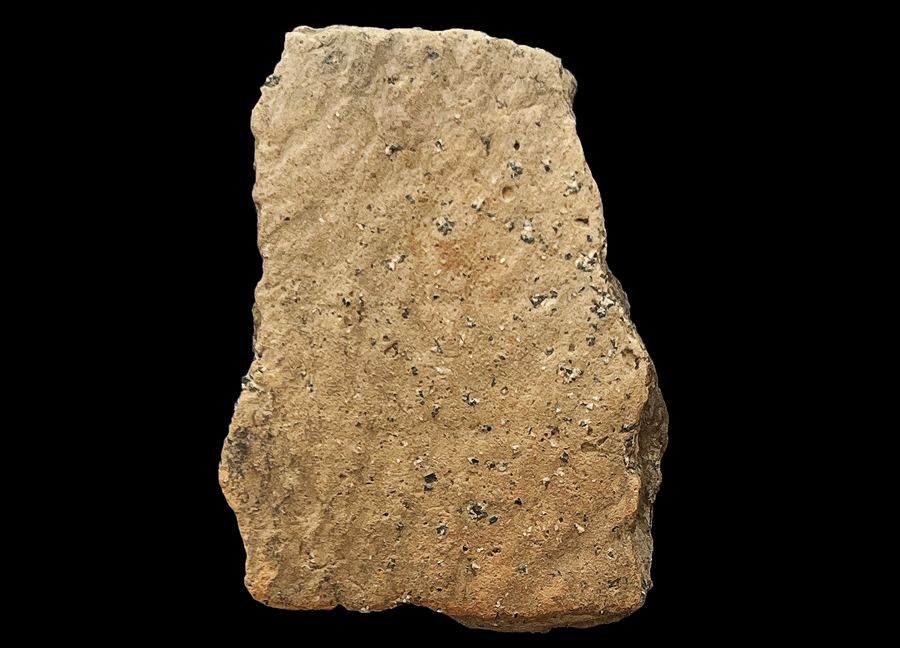
Figure 1. Example of Minguannan pottery.
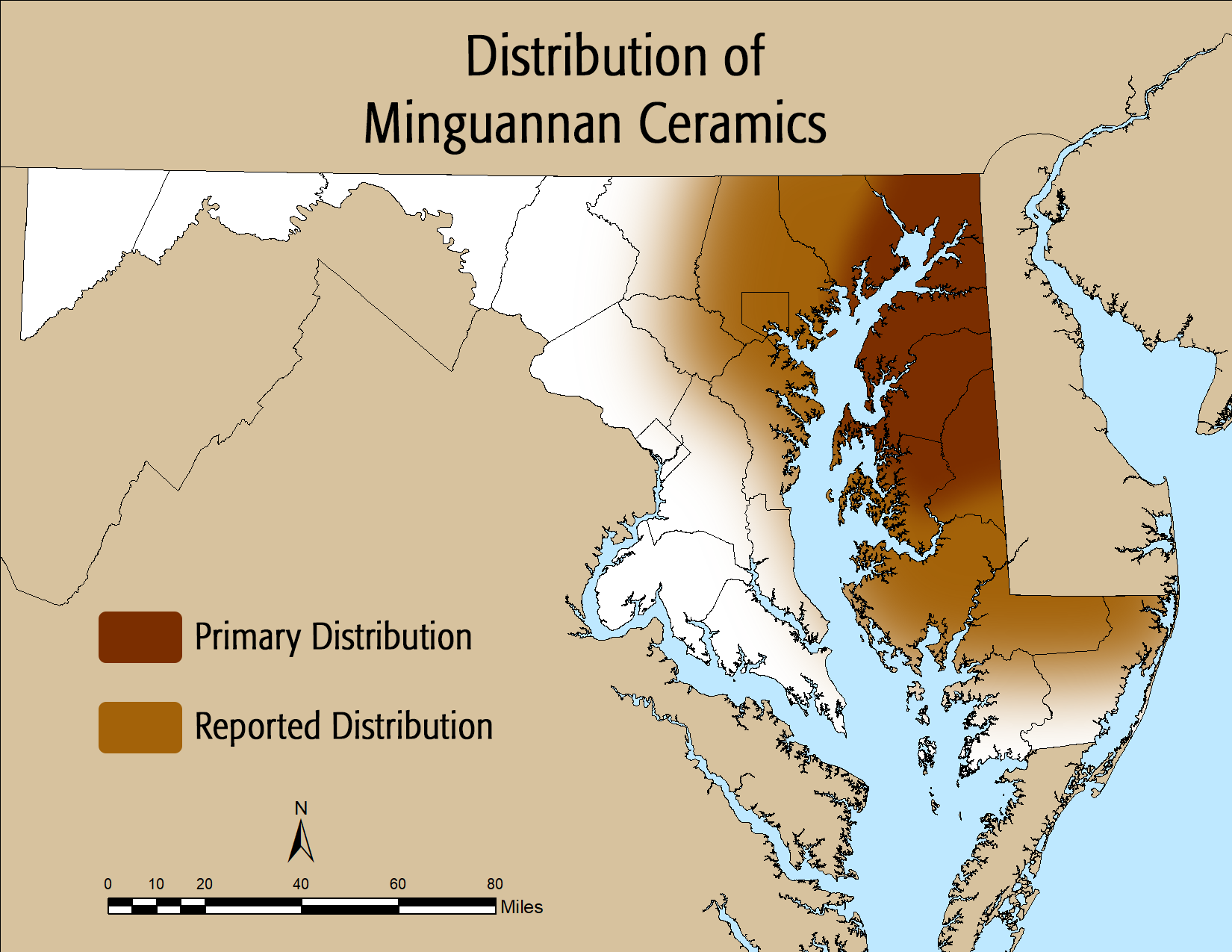
Figure 2. Distribution map.
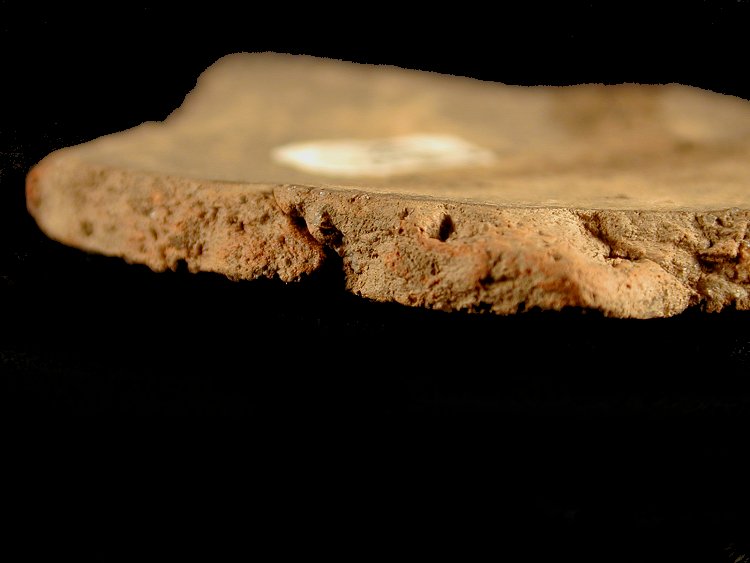
Figure 3. Paste close-up.
Description
Paste/Temper
The paste is variable and the temper consists of crushed grit, sand or quartz. No comprehensive descriptions of the paste are found in the published literature.
Surface Treatment
Exterior surfaces are commonly smoothed, but smoothed-over cord-marked, and smoothed-over fabric-impression examples have been found. Interior surfaces are smoothed.
Decoration
Many Minguannan vessels show some form of decoration, and four distinct types have been identified. Custer (1984:149) notes that decorations found on the Minguannan vessels are similar to, but slightly more complex than, Townsend designs. All decorations appear on the exterior below the lip of the rim.
Minguannan Plain has no decoration other than cord-wrapped stick impressions on the lip. Minguannan Incised is predominantly decorated with broad-line incising and occasional narrow-line incising. Griffith and Custer (1985:11) note six variations based on decoration:
- Discrete horizontal and oblique lines;
- Horizontal bands surmounting single, discrete lines;
- Horizontal bands surmounting any combination of two or more discrete lines of any type;
- Horizontal bands surmounting complex geometric shapes (zig-zags, squares, or triangles);
- Square, horizontal, oblique, or vertical lines;
- Horizontal bands with overlying embellishments.
Minguannan Corded decorations consist of pseudo cord-impressions and to a lesser extent direct cord impressions. Designs range from direct cord-impressed bands to complex geometric designs such as squares, triangles, and zigzags. Minguannan Compound Decorated designs are made with either incised lines or cord-impressions in horizontal bands that surmount any combination of two or more discrete lines.
Morphology
Minguannan ware is coil-constructed with paddle malleation. Vessel shape is conoidal with perpendicular, everted, or inverted rims. Vessel wall thickness ranges from 4.5 mm – 9 mm.
Defined in the Literature
The name Minguannan comes from the Minguannan site (36CH3) located in Southern Chester County, Pennsylvania, that was first excavated by Elwood Wilkins (1978) and the Archaeological Society of Delaware. Custer and Griffith (1985) later refined the definition of Minguannan based on decoration. Griffith also notes that design motifs used to decorate Minguannan vessels are remarkably similar to those used on Rappahannock Incised vessels in Delaware. Minguannan pottery has been identified on several Maryland sites in the upper reaches of the Chesapeake Bay, in Cecil and Harford Counties, but is not a major ware in this area.
Type Site
Minguannan (36CH3)
Radiocarbon Dates
None in Maryland
References
1984 Delaware Prehistoric Archaeology: An Ecological Approach. University of Delaware Press, Newark.
1985 Late Woodland Ceramics of Delaware: Implications for the Late Prehistoric Archaeology of Northern North America. Pennsylvania Archaeologist 55 (3): 5-20.
1978 A Selden Island Pottery Vessel From the Minguannan Site – 36ch3. Bulletin of the Archaeological Society of Delaware, No. 11. Spring 1978.