Shepard
Defining Attributes
Shepard is a Late Woodland ware, characterized by quartz and/or crushed igneous rock temper and a cord-marked exterior surface. Vessels often have added collars (applied strips of clay on the exterior of the rims).
Chronology
Stratigraphic sequences and radiometric dating indicate that Shepard dates from ca. A.D. 900 – A.D. 1450.
Distribution
Shepard is found throughout the Piedmont and Great Valley regions of Maryland, and rarely in the western Coastal Plain.
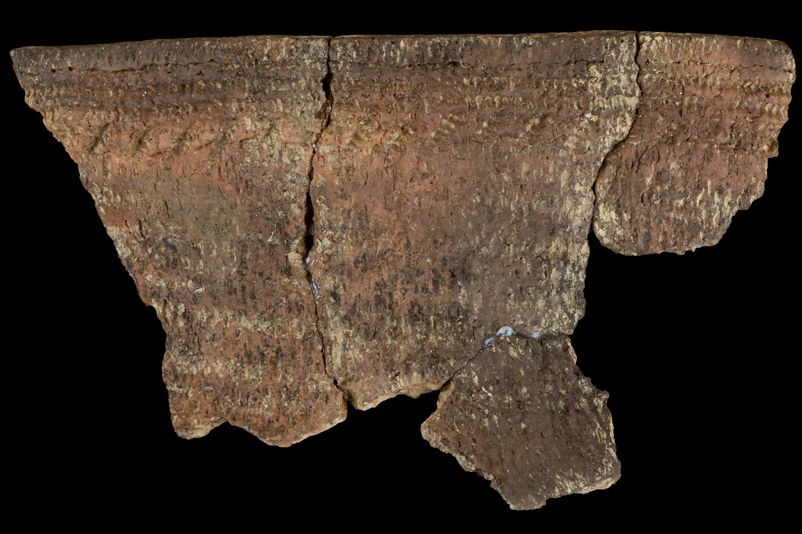
Figure 1. Example of Shepard pottery.
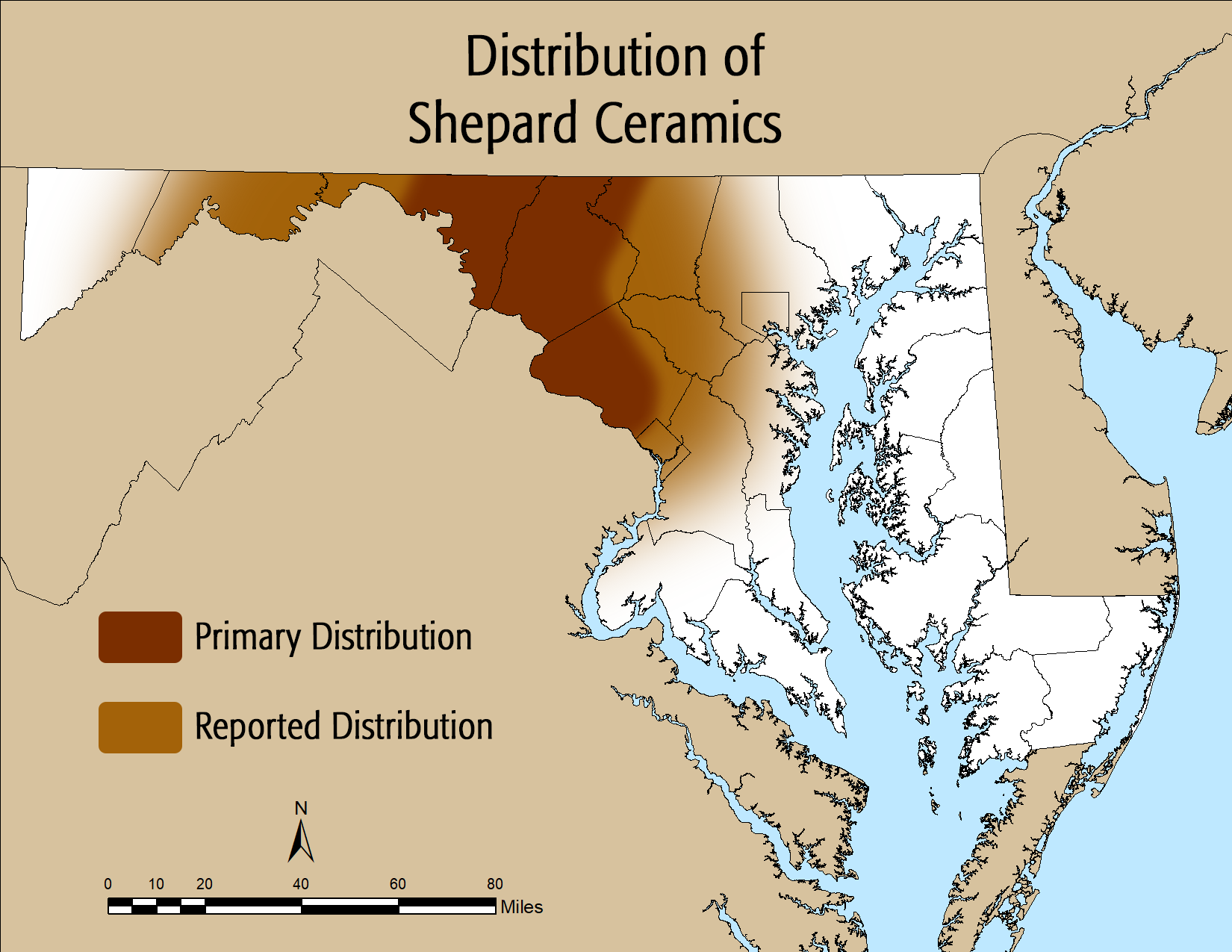
Figure 2. Distribution map.
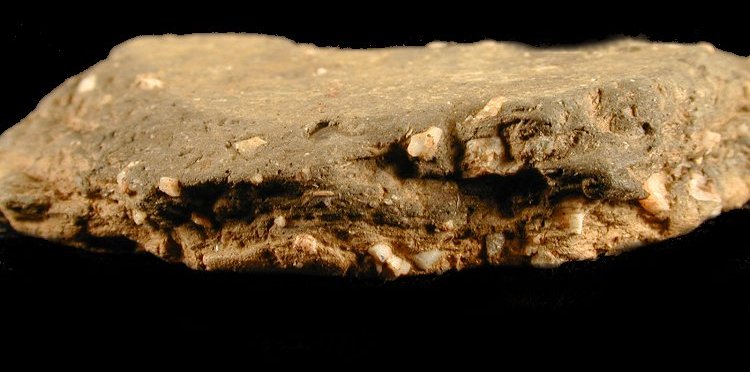
Figure 3. Paste close-up.
Description
Paste/Temper
The paste of Shepard ware is fine-grained and compact. The texture is medium-fine and clayey to the touch. Temper consists of crushed quartz or a crushed igneous rock that varies from 1 mm – 10 mm thick, and makes up 10% – 20% of the paste. Shepard has a Moh’s scale hardness of 3.0 – 4.0. Color ranges from an oxidized red to tan, brown, gray or black.
Surface Treatment
Exterior surfaces are predominantly cord-marked with a cord-wrapped paddle treatment. The cord-marking is most commonly oblique, but vertical impressions also occur. Impressions are usually clear and distinct, but not very deep. On the lower portion of the vessel, overlapping impressions made with the edge of the cord-wrapped paddle sometimes occur, creating a "fabric"-like appearance. Cordage diameter ranges from medium to coarse, and the cords are tightly wrapped around the paddle. Interior surfaces are smoothed.
Decoration
Decoration of Shepard ceramics is applied to the lip, rim, collar, neck and shoulder. Decorations are usually made with a cord-wrapped dowel or cord-wrapped paddle edge. The most common decorative techniques include rows of horizontal direct cord or cord-wrapped dowel impressions on the collar, a series of oblique cord-wrapped dowel impressions at the base of the collar, and vertical columns of cord-wrapped dowel impressions on the neck ("platting"). Incised decorations in similar motifs occur in about 20% of the decorated vessels.
Morphology
Shepard vessels are coil-constructed with paddle malleation. Vessel shapes are globular, with either a constricted orifice or a short vertical neck, rounded or straight sides, and rounded to semi-conical bases. Lips are usually flattened. Lips commonly show signs of cord-impressions, or are smoothed. Rims are vertical or slightly everted. Vessels often have added collar strips like those found on Page ceramics, a similar contemporaneous ware. Vessel walls are uniform and even, with thicknesses ranging from 4 mm – 11 mm, and vessel sizes range from medium to large.
Defined in the Literature
In 1952, Schmitt described Shepard Cord-Marked from sherds recovered at the Shepard site (18MO3) in Montgomery County, Maryland. Evans (1955) later incorporated Shepard Cord-Marked into his Albemarle Pottery Series, as did Stephenson et al. (1963) from pottery recovered at the Accokeek Creek site (18PR8) in Prince George’s County, Maryland. Slattery and Woodward (1992) provide a detailed description of Shepard ceramics from the type site and other nearby related village sites.
Type Site
Shepard Site (18MO3)
Maryland Sites with Shephard Components
- Biggs Ford (18FR14)*,
- Devilbiss (18FR38)*,
- Rosenstock (18FR18)*,
- Shepard (18MO3),
- Hughes (18MO1)*,
- Winslow (18MO9)
*collections at the MAC Lab
Radiocarbon Dates
| Radiocarbon Dates | ||||
|---|---|---|---|---|
| Date | Sample No. | Site | Feature | Reference |
| 935 ± 60; A.D. 1015 | SI-4582 | Rosenstock (18FR18) | Feature 6 | Curry and Kavanagh 2004 |
| 915 ± 60; A.D. 1035 | SI-3661 | Biggs Ford (18FR14) | Feature 4 | Curry and Kavanagh 1991 |
| 615 ± 60; A.D. 1335 | SI-4579 | Rosenstock (18FR18) | Feature 4 | Curry and Kavanagh 2004 |
| 530 ± 60; A.D. 1420 | SI-4578 | Rosenstock (18FR18) | Feature 4 | Curry and Kavanagh 2004 |
| 500 ± 30; A.D. 1450 | SI-4581 | Rosenstock (18FR18) | Feature 5 | Curry and Kavanagh 2004 |
References
1991 The Middle to Late Woodland Transition in Maryland. North American Archaeologist 12 (1):2-28.
2004 Excavations at the Rosenstock Village Site (18FR18), Frederick County, Maryland: A Preliminary Report. Maryland Archeology, 40 (1): 1-38, March 2004.
1955 A Ceramic Study of Virginia Archaeology, Bulletin 160, Bureau of American Ethnology, Smithsonian Institution, Washington, D.C.
1955 The Shepard Site Study. Archaeological Society of Maryland Bulletin 1: 1-32.
1952 An Archaeological Chronology of the Middle Atlantic States. In Archaeology of the Eastern United States, edited by James B. Griffin, editor, University of Chicago Press.
1992 The Montgomery Focus: A Late Woodland Potomac River Culture. Archeological Society of Maryland, Inc., Bulletin 2.
1963 The Accokeek Creek Site: A Middle Atlantic Seaboard Culture Sequence. Anthropological Papers, Museum of Anthropology, University of Michigan, No. 20, Ann Arbor