Keyser
Defining Attributes
Keyser is a late Late Woodland ware, characterized by shell temper, a cord-marked exterior often over-stamped obliquely, a notched lip surface, and a wide mouthed globular body and rounded base. Variations include plain-surfaced exteriors.
Chronology
Stratigraphic sequences and radiometric dating indicate that Keyser pottery dates from ca. A.D. 1400 – A.D. 1550.
Distribution
Keyser is found throughout the Piedmont, Great Valley, and Ridge and Valley regions of Maryland, Virginia, West Virginia, and Pennsylvania.
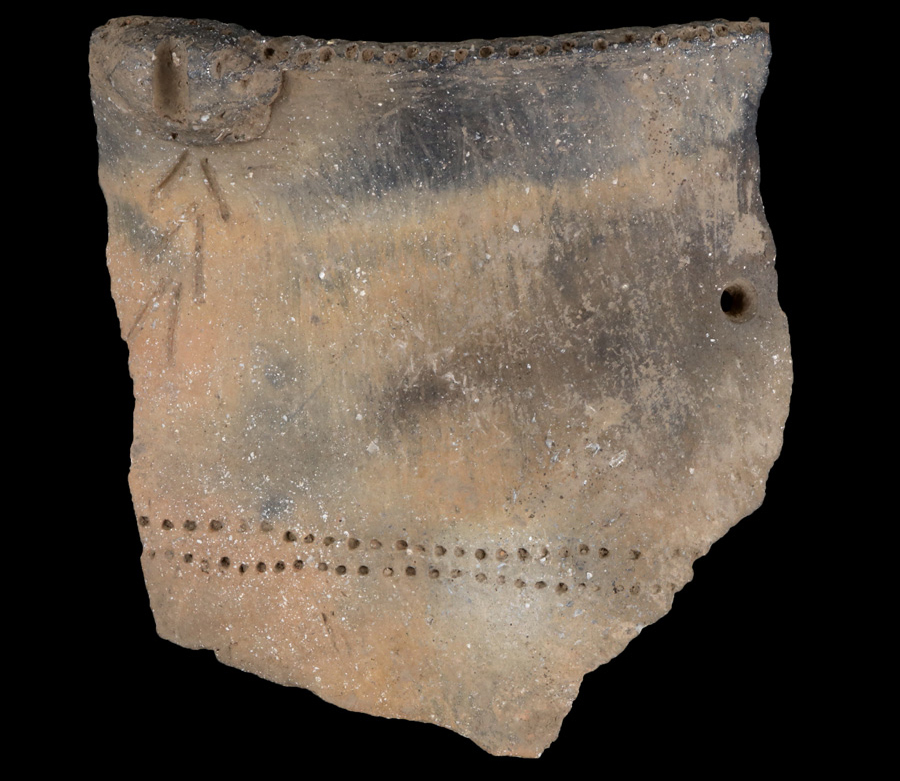
Figure 1. Example of Keyser pottery.
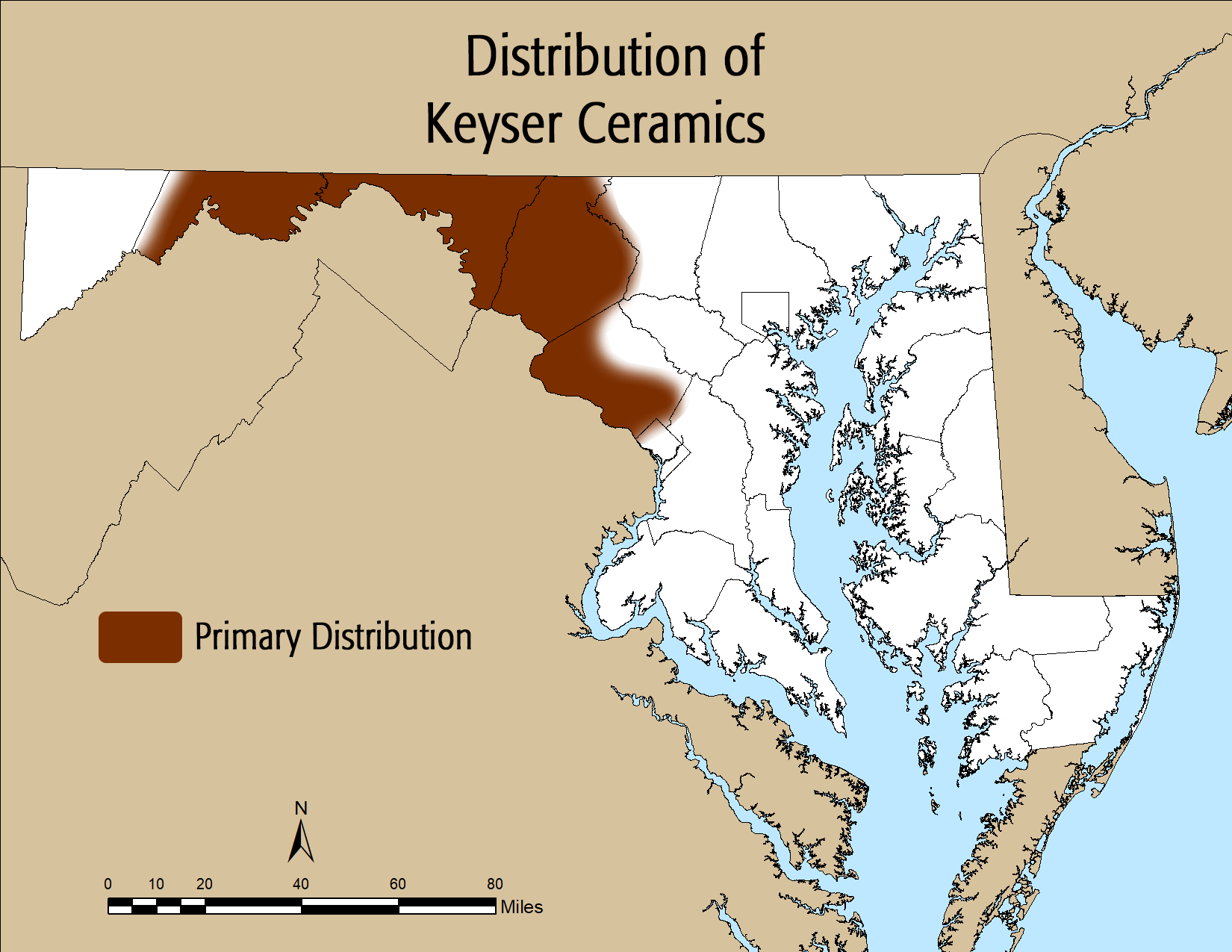
Figure 2. Distribution map.
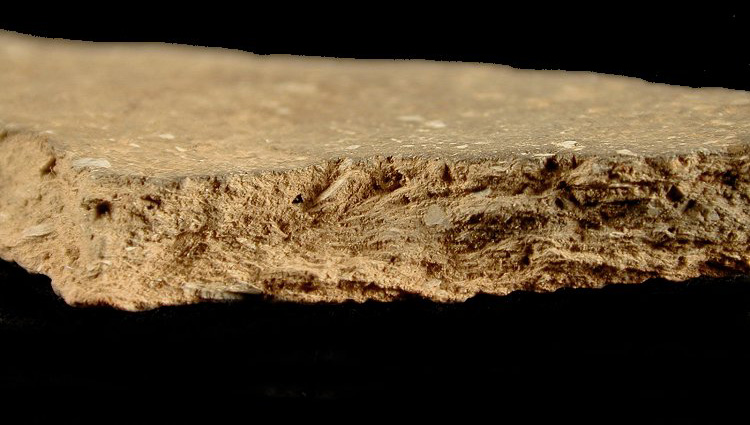
Figure 3. Paste close-up.
Description
Paste/Temper
Keyser has a compact paste that is fine to medium textured. This pottery is very hard, with an average Moh’sscale hardness of 2.5. Color ranges from an oxidized brown to reddish brown, but dull grayish brown is the dominant color. Vessel exteriors often have a blackened appearance. Keyser vessels were irregularly fired in a poorly controlled oxygen reducing atmosphere. The temper consists of finely crushed freshwater mussel shell that varies from 0.5 mm – 8 mm in diameter, and makes up 10 – 30% of the paste. Temper particles are oriented parallel to the vessel walls, creating a laminated appearance in cross-section.
Surface Treatment
Exterior surfaces are cord-marked from the lip to the base of the vessel. Most vessels show cord-marking applied vertically, but a few have cord impressions that are oblique from left to right or are over-stamped. Cord-marking was applied with a double-strand cord twined predominantly with an S-twist, but Z-twist is also well-represented in some collections. Manson, MacCord and Griffin (1944) noted that cord impressions were rarely smoothed over on sherds from the Keyser Farm site (44PA1), but most sherds recovered from the Hughes site (18MO1) and the Moore Village site (18AG43) show signs of partially smoothed-over cord-impressions (Jirikowic 1999a:2). Sherds from the Cresaptown (18AG119) and Barton (18AG3) sites also show similar smoothed-over cord-marking on vessel exteriors (Wall 2001). Interior surfaces are roughly smoothed and are dark gray to black in color.
A comparative analysis of ceramics from the Hughes site (18MO1) and the Keyser Farm site (44PA1) examined cordage twist of Keyser ceramics. While cordage twist at Hughes exhibited the typical S-twist, there was an unusually equal distribution of both S- and Z-twist examples at the Keyser Farm site. Keyser Farm may represent a blended community of practice, taking in pottery traditions from other regional communities, like those producing Potomac Creek-like wares with typical Z-twist surface treatments (Johnson 2018; Maher et al. 2025).
Decoration
Keyser is usually undecorated, but when found, decoration is confined to the exterior rim and lip area. Decoration consists of notched lips, cord-marking, single or double rows of punctations, and X- or V-shaped incised designs. The use of decorative lug handles and loop handles has also been reported, but is not common. More commonly found are pseudo-lugs, which are flat attachments to the exterior of the rim surface that are often impressed vertically with a cord-wrapped paddle or cord-wrapped stick.
Morphology
Keyser vessels are coil-constructed with paddle malleation. Vessels are large, with wide mouths, globular bodies, and rounded bases. Neck areas are very slightly constricted to straight sided. Lips are straight to slightly everted, and usually have cord-impressions made either parallel or transverse to the lip’s edge. Rims are vertical and straight or slightly flaring, and measure between 15 cm – 35 cm in diameter. Vessel wall thickness ranges between 4 mm – 5 mm with an average of 4.5 mm.
Defined in the Literature
Stearns (1940) first described a shell-tempered pottery similar to Keyser from the Hughes site (18MO1), noting its similarities to Monongahela ceramics from the Upper Ohio River Valley. Monongahela shell-tempered ceramics, however, are usually cord-marked with a final Z-twist cordage, and exhibit other elements that distinguish them from Keyser. Manson et al. (1944: 402-405) published the first definition of Keyser Cord-Marked from pottery sherds recovered at the Keyser Farm site (44PA1), located half a mile from the South Fork of the Shenandoah River between Luray and Front Royal at the foot of Massanutten Mountain in Page County, Virginia. Stewart (1982:82) noted that Keyser was identical to Biggs Ford wares defined by Peck (1979), and the New River shell-tempered ware defined by Evans (1955). In 1999, Jirikowic further refined the definition of Keyser Cord-Marked based on the work done by Manson, MacCord and Griffin and pottery recovered in the early 1990s from the Hughes site (18MO1) in Montgomery County, Maryland. Keyser cord-marked ceramics are well represented in the Keyser village component of the Barton site (18AG3) and from other sites in the area, such as Cresaptown (18AG119), where Keyser ceramics represent a minor element.
Type Site
Keyser Farm site (44PA1)
Maryland Sites with Keyser Components
- Hughes (18MO1)*,
- Biggs Ford (18FR14)*,
- Barton (18AG3),
- Moore Village (18AG43)
* collections at the MAC Lab
Radiocarbon Dates
| Date | Sample No. | Site | Feature | Reference |
|---|---|---|---|---|
| 380 ± 70; calibrated A.D. 1420–1660, intercept A.D. 1485 | Beta-87249 | Barton (18AG3) | 17A | Wall 2001 |
| 470 ± 60; calibrated A.D. 1400–1515, intercept A.D. 1485 | Beta-87248 | Barton (18AG3) | 34 | Wall 2001 |
| 420 ± 60; A.D. 1530 | Beta 49132 | Hughes (18MO1) | Feature 45 | Dent and Jirikowic 1990 |
| 450 ± 50; A.D. 1500 | Beta-6784 | Moore Village (18AG43) | Trench B | Pousson 1983 |
| 530 ± 50; A.D. 1420 | Beta-6783 | Moore Village (18AG43) | Trench A | Pousson 1983 |
| 550 ± 70; A.D. 1400 | DIC-2639 | Moore Village (18AG43) | Trench B | Pousson 1983 |
| 580 ± 60; A.D 1370 | Beta 49133 | Hughes Site (18MO1) | Feature 45 | Dent and Jirikowic 1990 |
References
1991 The Middle to Late Woodland Transition in Maryland. North American Archaeologist 12 (1):2-28.
1990 Preliminary Report of Archaeological Investigations at the Hughes Site. Potomac River Archaeological Survey, Department of Anthropology, American University, Washington, D.C.
1955 A Ceramic Study of Virginia Archaeology, Bulletin 160, Bureau of American Ethnology, Smithsonian Institution, Washington, D.C.
1999a Keyser Ware Ceramics at the Hughes Site and in the Potomac Basin. Paper presented at the 1999 Middle Atlantic Archaeological Conference.
1999b Final Report on the 1990, 1991, and 1994 Excavations at the Hughes Site (18MO1). Prepared by the American University Potomac River Archaeology Survey, Washington D.C. for the Maryland Historical Trust, Office of Archeology, Crownsville, Maryland.
2018 Population Continuity and Replacement During the Woodland and Early Contact Periods in the Potomac River Inner Coastal Plain, Piedmont, and Ridge and Valley of Virginia, Maryland, West Virginia, and Pennsylvania: Who Were Those Gals? In Journal of Middle Atlantic Archaeology, Vol 34, pp 67-105.
2025 Unraveling Keyser: Investigating Communities of Practice in the Potomac River Valley. In Journal of Middle Atlantic Archaeology, Vol. 41, pp. 25-36.
1944 The Culture of the Keyser Farm Site. In Papers of the Michigan Academy of Science, Arts, and Letters 29, edited by Eugene S. McCarthy and Henry Van der Schalie. University of Michigan Press, Ann Arbor.
1979 Aboriginal Ceramics at the Obrecht Site (18AN113). Maryland Archeology 13 (1).
1983 Archeological excavations at the Moore Village site. Chesapeake & Ohio Canal National Historical Park, Allegany County, Maryland. Report on file at Jefferson Patterson Park and Museum.
1940 The Hughes Site, An Aboriginal Village Site on the Potomac River in Montgomery County, Maryland. Proceedings of the Natural History Society of Maryland No. 6.
1982 Prehistoric Ceramics of the Great Valley of Maryland. Archaeology of Eastern North America 10:69-94.
1998 Ceramics and Delaware Valley Prehistory: Insights from the Abbott Farm. Trenton Complex Archaeology Report 14. Report prepared for the Federal Highway Administration and the New Jersey Department of Transportation by Louis Berger and Associates, Inc.
1992 Archaeological Exploration of Patawomeke: The Indian Town (44ST2) Ancestral to the One (44ST1) Visited in 1608 by Captain John Smith. Contributions to Anthropology No. 36. Smithsonian Institution Press, Washington D.C.
2001 Late Woodland Ceramics and Native Populations of the Upper Potomac Valley. Journal of Middle Atlantic Archaeology 17:15-37.