Yeocomico
Defining Attribute
Yeocomico is a shell-tempered Late Woodland ware characterized by smooth, scraped-smooth or cord-marked surfaces. Defined types include Yeocomico Plain, Yeocomico Scraped, and Yeocomico Cord-Marked.
Chronology
Stratigraphic sequences and radiometric dating indicate that Yeocomico ceramics date from ca. A.D. 1500 – A.D.1700
Distribution
Yeocomico is found in the Coastal Plain region of Southern Maryland, and in Northern Virginia. Yeocomico ware has been reported for Charles County, St. Mary’s County and the southern end of Calvert County, Maryland.
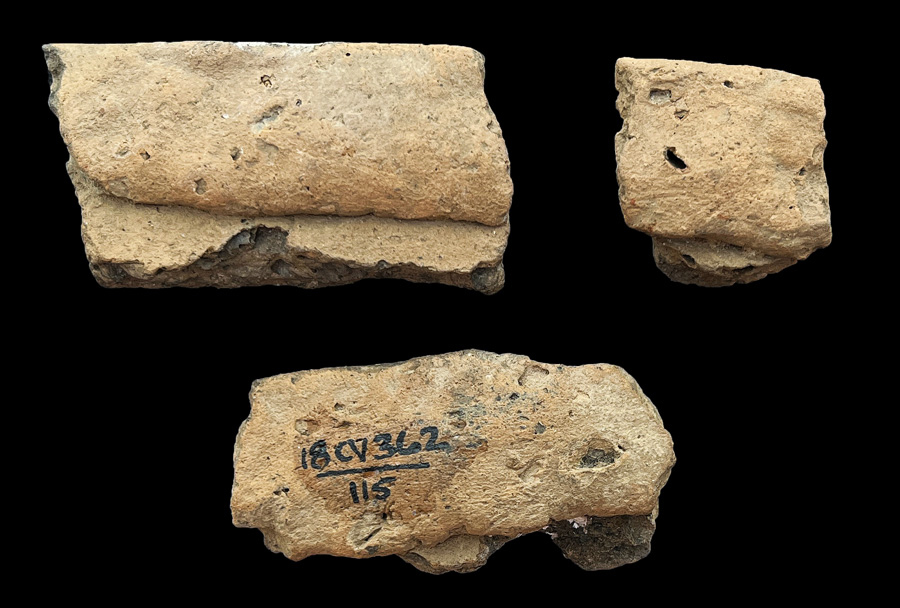
Figure 1. Example of Yeocomico pottery.
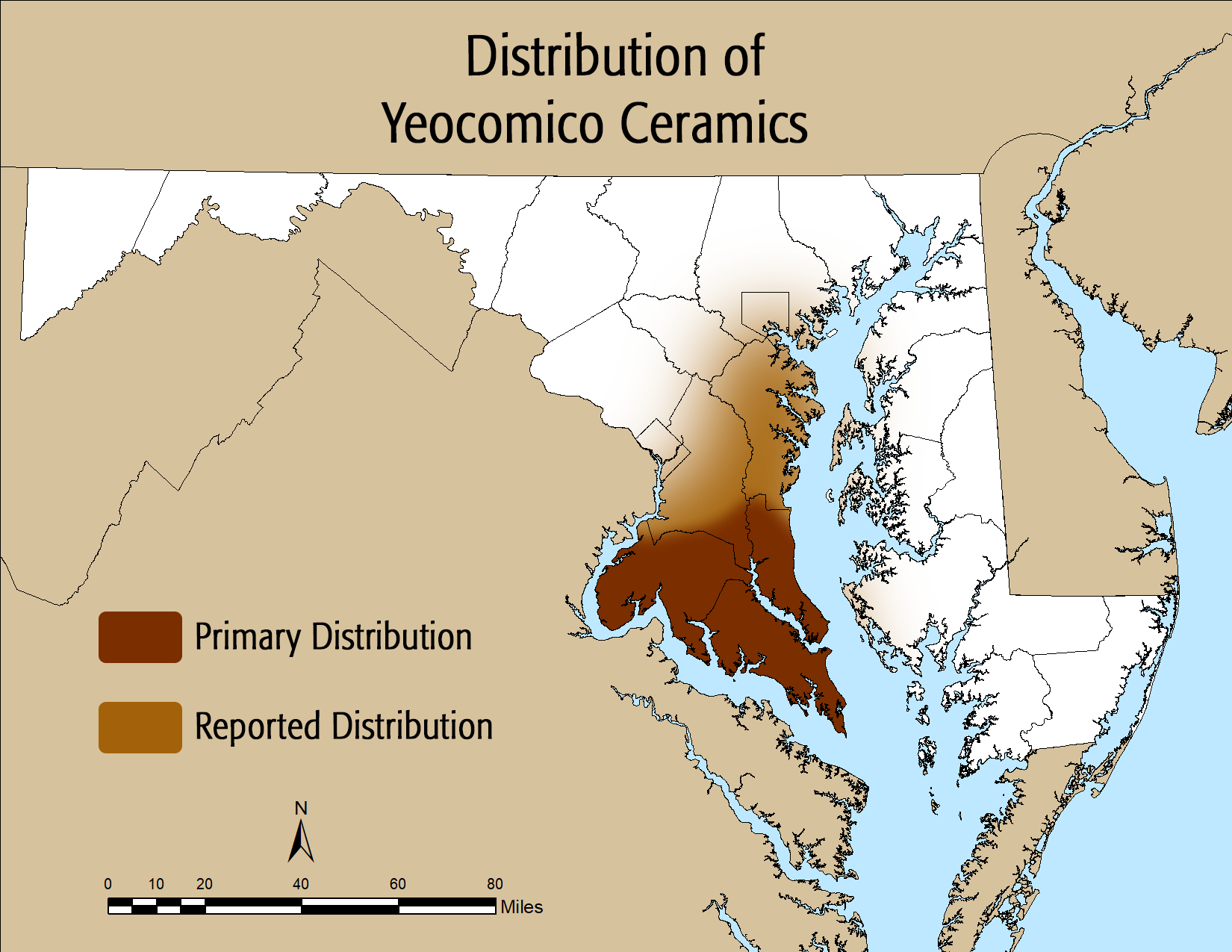
Figure 2. Distribution map.
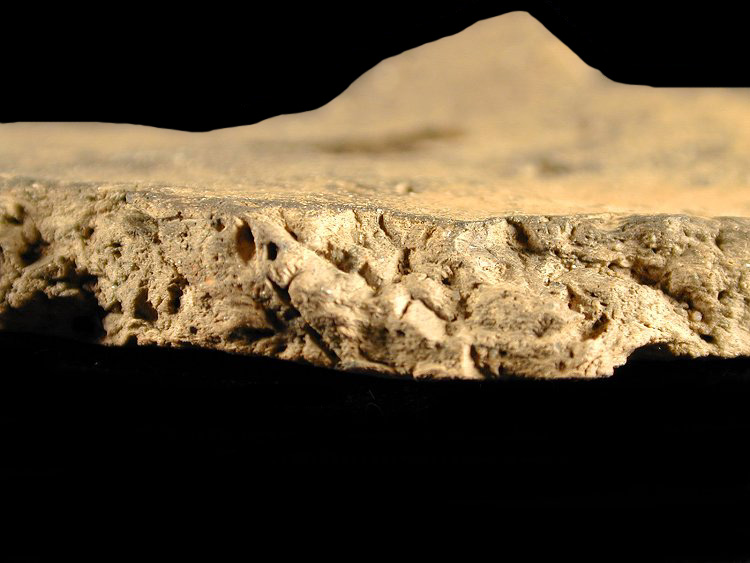
Figure 3. Paste close-up.
Description
Paste/Temper
The clay is moderately compact and silty. The temper consists of crushed oyster shell that varies from 5 mm – 9 mm in diameter, but most are only 1 mm – 2 mm in size, and make up 10% – 20% of the paste. Yeocomico has a Moh’s scale hardness of 2.0 – 2.5. Color ranges from an oxidized light reddish tan, to brown, to gray-brown.
Surface Treatment
Exterior surfaces are smoothed over, scraped with a tool, or malleated with a cord-wrapped paddle. Interior surfaces are usually smoothed, but some exhibit scraping on the interior.
Decoration
Decoration is confined to just below the exterior of the rim, and consists of horizontal, vertical, or slightly oblique lines of punctations, or horizontal cord-impressions.
Morphology
Yeocomico vessels are coil-constructed with paddle malleation. The average coil width is 10 mm. Vessels are small to medium in size, and consist of cups, bowls, and jars. Bowls are hemispherical in form, while jars are globular with slightly curved sides. Bases are rounded or semiconical. Rims are straight to excurvate, and lips are rounded, tapered, or flattened. Vessel wall thickness ranges from 4 mm to 8 mm, with mouth diameters ranging from 15 cm – 23 cm.
Defined in the Literature
Yeocomico ceramics were defined based on sherds collected from the Coan River area of Northumberland County Virginia, and the White Oak Point Site (44WM119) on Nomini Bay in Westmoreland County, Virginia. Evans (1955) defined three wares within his Chickahominy Series that are similar to Yeocomico: Sussex Plain, Potts Scraped, and Potts Cord-Wrapped Dowel. Binford’s (1965) Warekeck Ware is also similar to Yeocomico.
Type Site
White Oak Point (44WM119)
Maryland Sites with Yeocomico Components
- Cumberland (18CV171)*,
- Patuxent Point (18CV271)*,
- (18CV362)*,
- Posey (18CH281)*,
- St. Mary’s City (18ST1)
*collections at the MAC Lab
Radiocarbon Dates
| Radiocarbon Dates | ||||
|---|---|---|---|---|
| Date | Sample No. | Site | Feature | Reference |
| 440 ± 75; A.D. 1510 | DIC-1765 | White Oak Point (44WM119) | Waselkov 1982 | |
| 410 ± 55; A.D. 1540 | DIC-1770 | White Oak Point (44WM119) | Waselkov 1982 | |
| 375 ± 65; A.D. 1575 | UGa-4571 | Cumberland (18CV171) | Test Pit 12, Feature 1 | Notes on file, MAC Lab |
| 345 ± 70; A.D. 1605 | SI-4231 | Blue Fish Beach (44NB147) | Potter 1982 | |
| 344 ± 70; A.D. 1606 | UGa-5580 | Cumberland (18CV171) | Notes on file, MAC Lab | |
| 320 ± 55; A.D. 1630 | DIC-1767 | White Oak Point (44WM119) | Waselkov 1982 | |
| 305 ± 70; A.D. 1645 | SI-4372 | Blue Fish Beach (44NB147) | Waselkov 1982 | |
| 260 ± 55; A.D. 1690 | DIC-1762 | White Oak Point (44WM119) | Waselkov 1982 | |
References
1965 Colonial Period Ceramics of the Nottoway and Weanock Indians of Southeastern Virginia. Archaeological Society of Virginia Quarterly Bulletin 19: 78-87.
1982 Indian Ceramics from Coastal Plain Virginia. Archeology of Eastern North America 10: 95-117.
1955 A Ceramic Study of Virginia Archaeology, Bulletin 160, Bureau of American Ethnology, Smithsonian Institution, Washington, D.C.
1982 An analysis of Chicacoan settlement patterns. Dissertation. University of North Carolina, Chapel Hill.
1993 Commoners, Tributes, and Chiefs: The Development of Algonquian Culture in the Potomac Valley. University of Virginia Press, Charlottesville.
1982 Shellfish Gathering and Shell Midden Archaeology. Doctoral dissertation, Department of Anthropology, University of North Carolina at Greensboro, North Carolina. University Microfilms International, Ann Arbor, MI.