Vinette
Defining Attributes
Vinette is an Early to Middle Woodland ware, characterized by crushed rock temper, cord-marked exterior and interior surfaces, and a conoidal shape. It is named for the Vinette site in New York, and is tied to various cultures of the Northeast. The ware includes two types: Vinette I, and Vinette 2 dentate stamped variants. The latter have not been found in Maryland; however, some of the interior/exterior cord-marked ceramics recovered from Early to Middle Woodland contexts in Maryland appear to be Vinette variants (Wall 1992).
Chronology
Stratigraphic sequences and radiometric dating indicate that Vinette dates from ca. 1200 B.C. to 100 B.C., although some earlier and later dates have been reported. The date range seems to vary geographically; for example, in eastern Pennsylvania and the lower Delaware Valley, Vinette I seems to disappear after 600 B.C. (Custer 1996; Stewart 1998). In central New York, production of Vinette I peaks between 1000 B.C. and 500 B.C. (Sassaman 1999). In Maryland, a date range of 1000 B.C. to 100 B.C. has been suggested (Stewart 1982).
Distribution
Vinette ceramics are found along the east coast from New England to Maryland and west to central New York and the Ottawa valley of eastern Ontario. In Maryland, it has been found primarily in rockshelters and in surface collections on sites in the western part of the state (Gross 1972; Stewart 1981). Vinette I is rare east of the Hagerstown Valley, although it was reported at the Conowingo Site (18CE14) along the Susquehanna River in far northeastern Maryland (Custer et al. 1983).
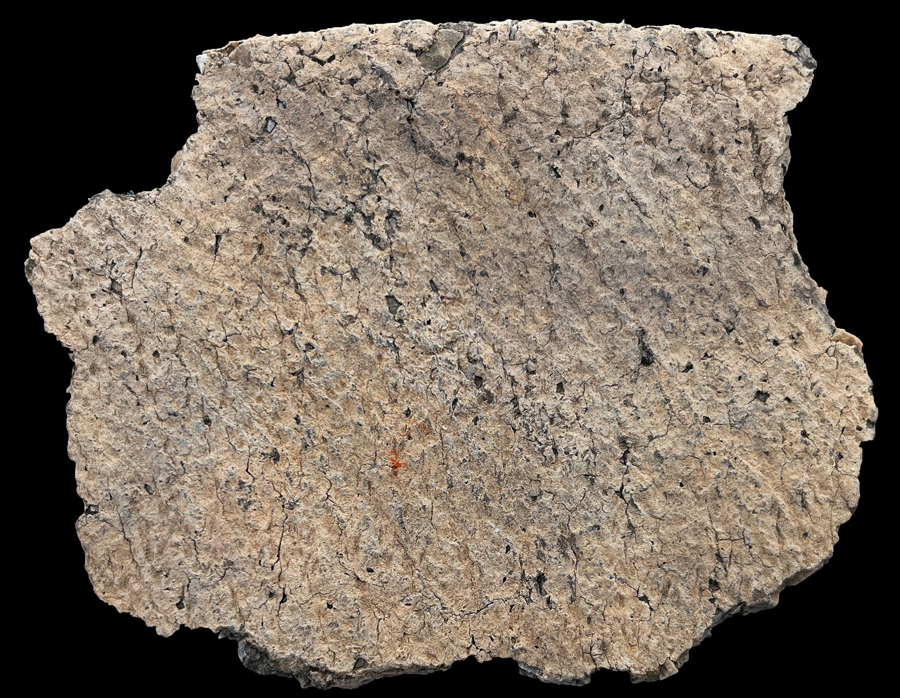
Figure 1. Example of Vinette pottery.
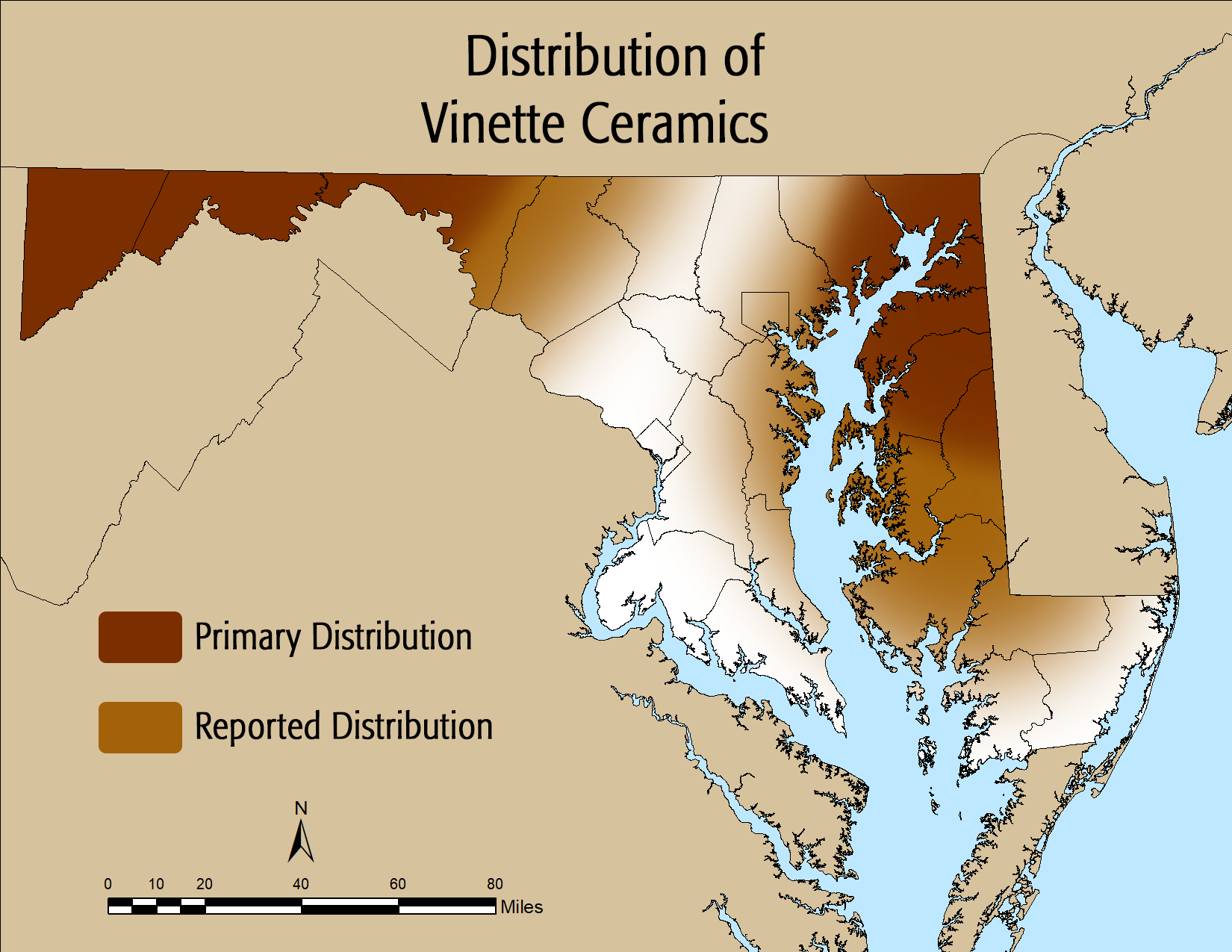
Figure 2. Distribution map.
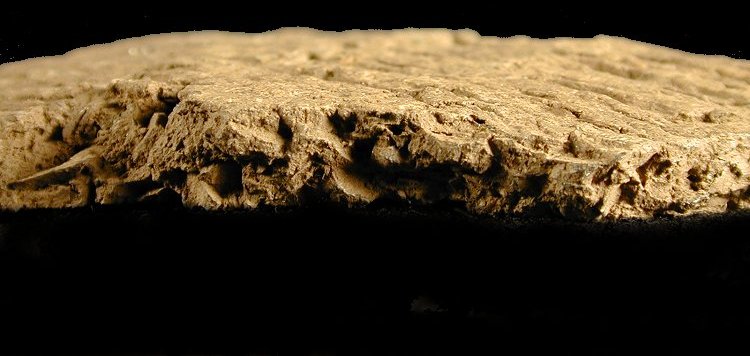
Figure 3. Paste close-up.
Description
Paste/Temper
The temper consists of high percentages of crushed rock fragments. Quartz is the predominant temper material, but limestone, chert, rhyolite, gneiss, shale, and other locally-available stones have also been reported. The particle size varies, but is often greater than 3 mm in diameter. Shell temper inclusions have also been reported in some Vinette I, and may date to the later stages of the ware’s use (Stewart 1998). Sherds have an average Moh’s scale hardness of 2.0. Color ranges from buff through gray to black, and interiors are usually gray to black. The paste of Vinette I in the Hagerstown Valley has been described as loose and friable (Stewart 1982).
Surface Treatment
The exterior is completely covered by cord-marking that tends to be vertical to the lip, but oblique orientations also occur. Interior cord-marking is mostly horizontal, running parallel to the rim.
Decoration
None
Morphology
Vinette wares were coil-constructed with corded paddle malleation. Coil breaks are frequently observed on sherds. Vessels are conoidal in shape, with wide mouths, elongated bodies, straight or slightly curved sides, and conical bases. Vessel walls tend to be thick, although this varies. Rims are collarless, and are usually straight to outflaring and thinner toward the lip. Lips are rounded and often almost pointed in profile. In western Maryland, Early Woodland wares have been reported that are similar to Vinette I, but with flat bases, flaring sides, and no interior cord marking (Stewart 1982).
Defined in the Literature
Vinette ceramics are defined in the literature for New York and southern Ontario, where they have been found in stratified contexts (Ritchie and MacNeish 1949; Spence et al. 1990). Variants of Vinette have been recovered from areas south of New York along the Coastal Plain, as well as in the Appalachian highlands. Maryland appears to represent the southern extreme of the range for this type. Early descriptions of Vinette ceramics may be found in Ritchie (1944). Stewart (1998) notes that the wide variety in the wares produced in the Northeast between 1200 B.C. and 700 B.C. tends to blur the distinctions among archaeological types, including Vinette I.
Type Site
Vinette Site, NE of Finger Lakes, New York.
Maryland Sites with Vinette Components
- Chickadee Rock Shelter (18WA13);
- Bushey’s Cavern (18WA18);
- Barton Complex (18AG3, 18AG8);
- Conowingo (18CE14);
- 18WA62
Radiocarbon Dates
None from Maryland
References
1996 Prehistoric Cultures of Eastern Pennsylvania. Pennsylvania Historical and Museums Commission, Anthropological Series, No. 7, Harrisburg.
1983 Woodland Ceramic Sequences of the Upper Delmarva Peninsula and Southeastern Pennsylvania. Maryland Archeology 19 (2): 21-30.
1972 Chickadee Rock Shelter (18WA13): The Excavation of a Small Rock Shelter in Washington County, Maryland. Master’s thesis, Department of Anthropology, University of Maryland, College Park.
2001 The Lenape-Delaware Indian Heritage: 10,000 BC to AD 2000. Lenape Books, Stanhope, NJ.
1944 The Pre-Iroquoian Occupations of New York State. Memoir 1, Rochester Museum of Arts and Sciences, Rochester.
1965 The Archaeology of New York State. The Natural History Press, Garden City, N.Y.
1949 The Pre-Iroquoian Pottery of New York State. American Antiquity 15 (2): 97-124.
1999 A Southeastern Perspective on Soapstone Vessel Technology in the Northeast. In The Archaeological Northeast, edited by M.A. Levine, K.E. Sassaman, and M.S. Nassaney, pp. 75-96. Bergin & Garvey, Westport, CT.
1990 Cultural Complexes of the Early and Middle Woodland Periods. In The Archaeology of Southern Ontario to A.D. 1650, edited by C. J. Ellis and N. Ferris, 125-169. Occasional Publication of the London Chapter, Ontario Archaeological Society, London, Ontario.
1981 The Prehistoric Ceramics of the Great Valley of Maryland. Paper presented at a Symposium on Prehistoric Ceramics held at St. Mary’s City, Maryland. St. Mary's City Commission and the Maryland Historical Trust, January 1981.
1982 Prehistoric Ceramics of the Great Valley of Maryland. Archaeology of Eastern North America 10:69-94.
1998 Ceramics and Delaware Valley Prehistory: Insights from the Abbott Farm. Trenton Complex Archaeology Report 14. Report prepared for the Federal Highway Administration and the New Jersey Department of Transportation by Louis Berger and Associates, Inc.
1992 Notes on an Early Woodland Feature from the Barton Complex (18AG8), Allegany County, Maryland. Maryland Archeology 28 (1):13.