Potomac Creek
Defining Attributes
Potomac Creek is a Late Woodland ware, characterized by a crushed quartz or sand temper, cord-marked exteriors, and rim strips (collars). Defined types include Potomac Creek Plain and Potomac Creek Cord-Marked.
Chronology
Stratigraphic sequences and radiometric dating indicate that Potomac Creek dates from ca. A.D. 1300 – A.D. 1700.
Distribution
Potomac Creek is found throughout the Maryland Coastal Plain west of the Chesapeake Bay, as well as in the Coastal Plain of Northern Virginia.
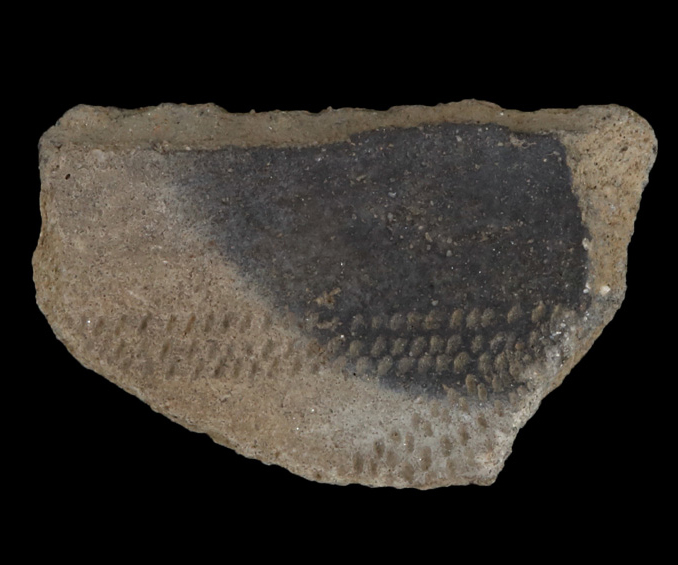
Figure 1. Example of Potomac Creek pottery.
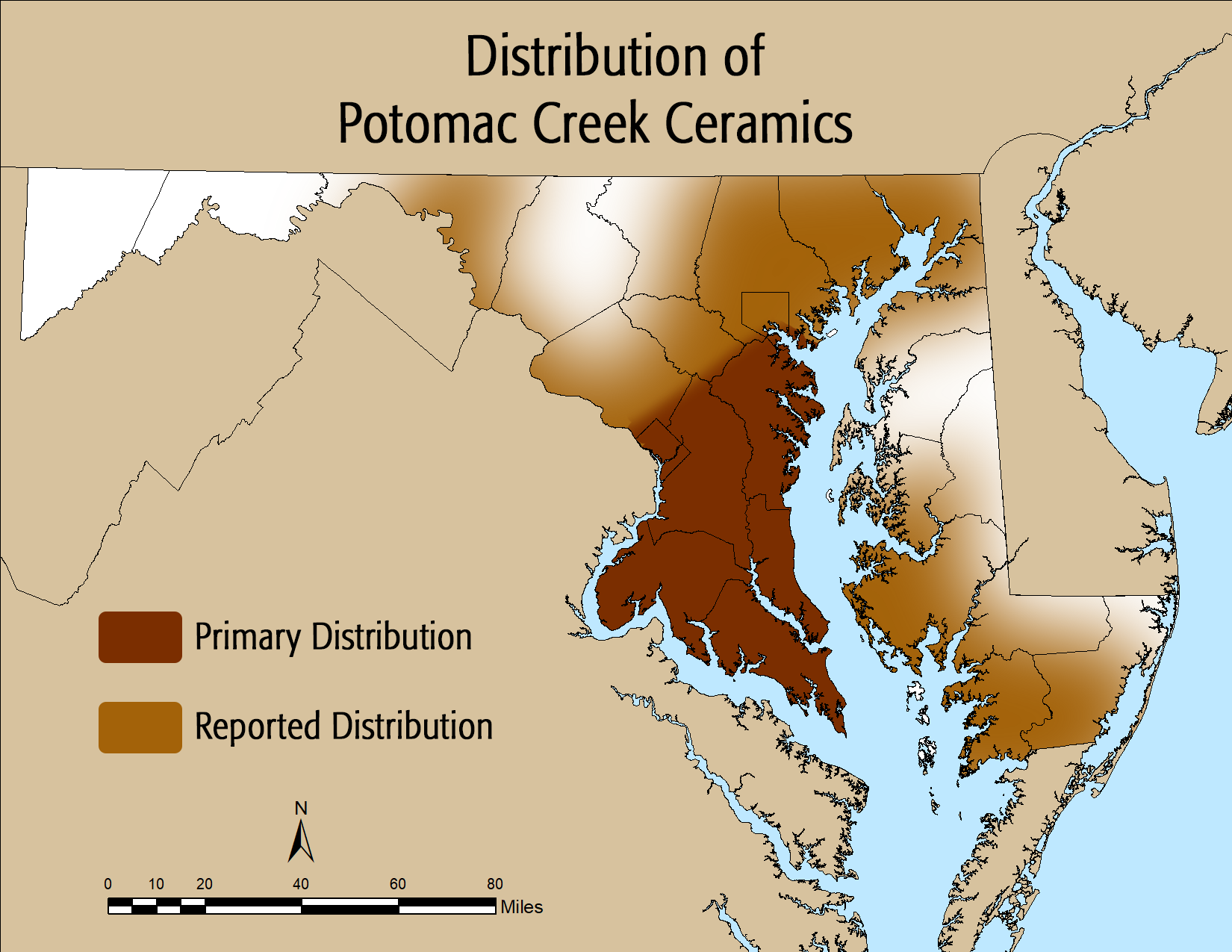
Figure 2. Distribution map.
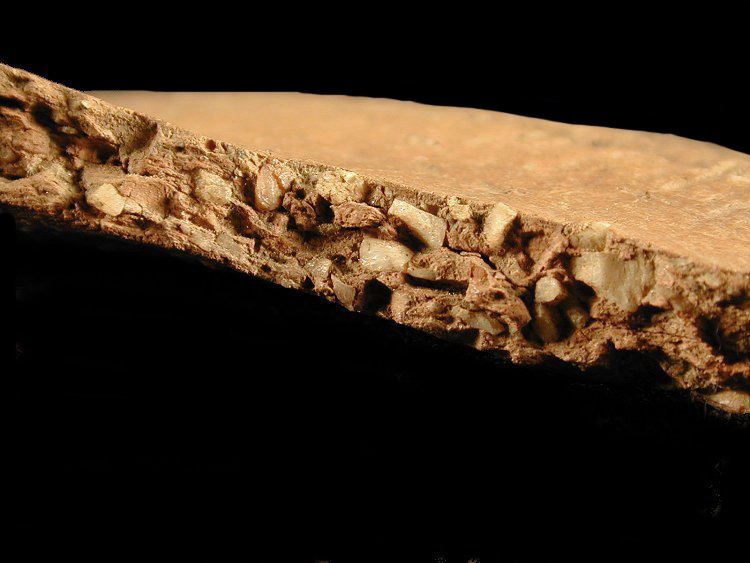
Figure 3. Paste close-up.
Description
Paste/Temper
The paste has a texture that is fine-to-medium and smooth, with a slight grittiness to the touch. Temper consists of angular crushed quartz with occasional inclusions of other crushed rock or coarse sand. Temper particles range from 1 mm – 4 mm in diameter, and constitute 20% – 35% of the paste. Stewart (1992:40) notes, however, that sherds recovered from the Potomac Creek site (44ST2) were tempered with either "grit" alone or in combination with fine-to-medium grained sand. Potomac Creek has a Moh’s scale hardness of 3.0 – 4.0. Vessels were fired at a high temperature, usually in a reducing atmosphere that produced surface smudging or uneven smudge clouds. Exterior surface colors are usually dark brown to black, but range through light brown, gray, tan, reddish, buff, and light cream.
Surface Treatment
Exterior surfaces are cord-marked from base to rim, generally diagonally to the rim, but some paddle edge impressions are vertical, horizontal, criss-crossed, or combinations of these. Cords are loosely twisted, 1.0 mm – 1.5 mm in width, and wrapped tightly about the paddle. The predominant cordage twist is Z-twist. Potomac Creek Plain vessels have exterior surface treatments that are smoothed or smoothed over cord-impressions. Interior surfaces are smoothed. Later assemblages appear more plain. Hall noted this trend continuing throughout the Contact-period of the 17th century, with a stronger preference towards smoothed exterior surfaces growing over time on known sites.
Decoration
Decorations on Potomac Creek Cord-Marked ceramics are confined to the neck and rim regions, and consist of vertical, horizontal, criss-crossed, and geometric marks applied by impressing single or multiple cords. Pseudo-cord impressions are common, where a cord-wrapped stick is impressed in the clay to form a decorative pattern. Other decorative techniques include cord and fingernail impressing and circular punctating (Schmitt 1952:63). Egloff and Potter (1982:107, 112) suggest that for both Potomac Creek and Townsend wares, decoration becomes simpler through time, and that a higher percentage of plain vessels are present in later assemblages. Stephenson et al. (1963:118) noted that a small number of sherds from the Accokeek Creek site (18PR8) were decorated with incised lines or punctations. Potomac Creek Plain is rarely decorated, with the exception of lip nicking.
Morphology
Potomac Creek is coil-constructed with paddle malleation. Coils typically begin at the apex of the base and continue up to the lip. Vessel shapes are globular, expanding evenly from the base to mid-portion, and contracting evenly to the rim juncture. Bases are rounded, but Stephenson et al. (1963) noted that a few vessels from the Accokeek Creek site (18PR8) had semi-conical or, rarely, almost flat bases. Rims are everted or straight. Lips are usually rounded, flattened, or wedge-shaped. Often the rim is thinned toward the lip and an extra band of clay is applied around it, producing a thickened rim 1 – 3 times the body thickness. Lips are also sometimes notched. Manson et al. (1943:408) noted that some lips had been notched so deeply as to appear scalloped. Vessels range from miniature pots to larger bowls, beakers, and jars. Vessels range from 13 cm – 30 cm in height, but are usually 20 cm – 25 cm tall. Diameters range from 12 cm – 28 cm, but are usually 2 cm – 4 cm less than maximum depths. Vessel walls are relatively thin, ranging from 4 mm – 7 mm. Vessels with sandier temper range from 6 mm – 10 mm in thickness. In an analysis of Potomac Creek and Moyaone sherds from 17th-century contexts in southern Maryland, Hall (2012) noted a downward trend in vessels thicknesses of 6 and 7 mm, with an upward trend in thinner-walled vessels measuring 4 and 5 mm.
Defined in the Literature
Potomac Creek ware was first described by William H. Holmes (1903:155-156) from pottery recovered from the Potomac Creek site (44ST2) in Stafford County, Virginia. The definition was expanded by James Griffin (Manson et al. 1943) and Karl Schmitt (1952) from later work. Based on the numerous sherds of Potomac Creek recovered from the Accokeek Creek site (18PR8) in Prince George’s County, Maryland, Robert Stephenson refined the definition of Potomac Creek (Stephenson et al. 1963:113-120). Two types were defined, Potomac Creek Cord-Marked and Potomac Creek Plain. A more recent analysis of the Potomac Creek complex (Dent and Jirikowic 2001) reviews the radiocarbon chronology for Potomac Creek.
Type Site
Potomac Creek (44ST2)
Maryland Sites with Potomac Creek Components
- Accokeek Creek (18PR8),
- Duck’s Run (18AN546)*,
- Loyola Retreat (18CH58),
- Cumberland (18CV171)*,
- Grant (18BA444)*
*collections at the MAC Lab
Radiocarbon Dates
| Radiocarbon Dates | |||||
|---|---|---|---|---|---|
| Date | Sample No. | Site | Feature | Associated Material | Reference |
| 350 ± 30; A.D. 1520/1570/1630 (intercept date) | Beta-104595 | Potomac Creek (44ST2) | Potomac Creek | Blanton et al. 1999 | |
| 410 ± 50; A.D. 1460 (intercept date) | Beta-102324 | Potomac Creek (44ST2) | Potomac Creek | Blanton et al. 1999 | |
| 540 ± 60; A.D. 1415 (intercept date) | Beta-102323 | Potomac Creek (44ST2) | Potomac Creek | Blanton et al. 1999 | |
| 670 ± 60; A.D. 1300 (intercept date) | Beta-102325 | Potomac Creek (44ST2) | Potomac Creek | Blanton et al. 1999 | |
References
1999 The Potomac Creek Site (44ST2) Revisited. Virginia Department of Historic Resources Research Report Series No. 10. Prepared by the William and Mary Center for Archaeological Research, The College of William and Mary, Williamsburg.
2001 Accokeek Creek: Chronology, the Potomac Creek complex, and Piscataway origins. Journal of Middle Atlantic Archaeology 17: 39-58.
1982 Indian Ceramics from Coastal Plain Virginia. Archeology of Eastern North America 10: 95-117.
2012 These Pots Do Talk: Seventeenth-Century Indigenous Women’s Influence on Transculturation in the Chesapeake Region. Master’s thesis. Department of Sociology and Anthropology, Illinois State University.
1903 Aboriginal pottery of the Eastern United States. U.S. Bureau of Ethnology, Washington, D. C.
1943 The Culture of the Keyser Farm Site. Papers of the Michigan Academy of Sciences, Arts, and Letters, 29.
1952 An Archaeological Chronology of the Middle Atlantic States. In Archaeology of the Eastern United States, edited by James B. Griffin, editor, University of Chicago Press.
1963 The Accokeek Creek Site: A Middle Atlantic Seaboard Culture Sequence. Anthropological Papers, Museum of Anthropology, University of Michigan, No. 20, Ann Arbor