Mockley
Defining Attributes
Mockley is a Middle Woodland ware, traditionally characterized by crushed shell-tempering and net-impressed or cord-marked exterior surfaces, a clayey texture, and medium to large vessels. More recent studies confirm evidence of fabric-impressed exterior surfaces in earlier transitional forms of Mockley. Traditionally defined types include Mockley Net-Impressed, Mockley Cord-Marked, and Mockley Plain.
Chronology
Stratigraphic sequences and radiometric dating traditionally indicate that Mockley dates from ca. A.D. 200 – A.D. 900. New radiocarbon testing from sites at Point Lookout (18ST728 & 18ST729) have returned dates of between B.C. 155 and A.D. 60 for early transitional forms of Mockley. This date places Mockley cord-marked much earlier in Maryland and overlapping with Popes Creek ceramics. Radiocarbon dates from the Taft site (44FX0544) in Fairfax County, Virginia also indicate earlier dates of around A.D. 10, for Mockley (Robinson & Bulhack 2006). Recent studies in Virginia suggest that Mockley may have originated on the lower western shore of the Chesapeake in the earlier Middle Woodland period and spread northward over several hundred years (Callaway and Gallivan 2023).
Distribution
Mockley is found throughout the Western and Eastern Shore Coastal Plains in Maryland. This ware is commonly found in the Coastal Plain in Delaware south to the James River in Virginia. Small amounts of Mockley have been reported from rockshelter sites in the Piedmont and Great Valley regions of Maryland.
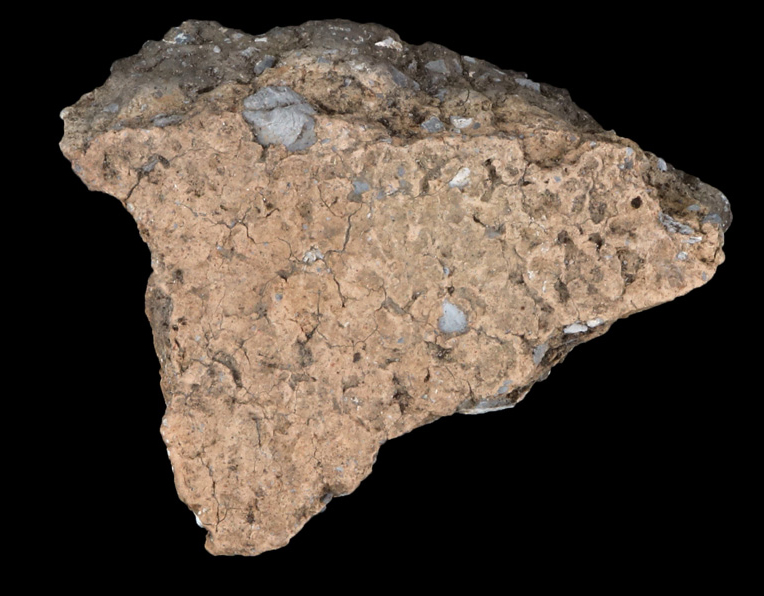
Figure 1. Example of Mockley pottery.
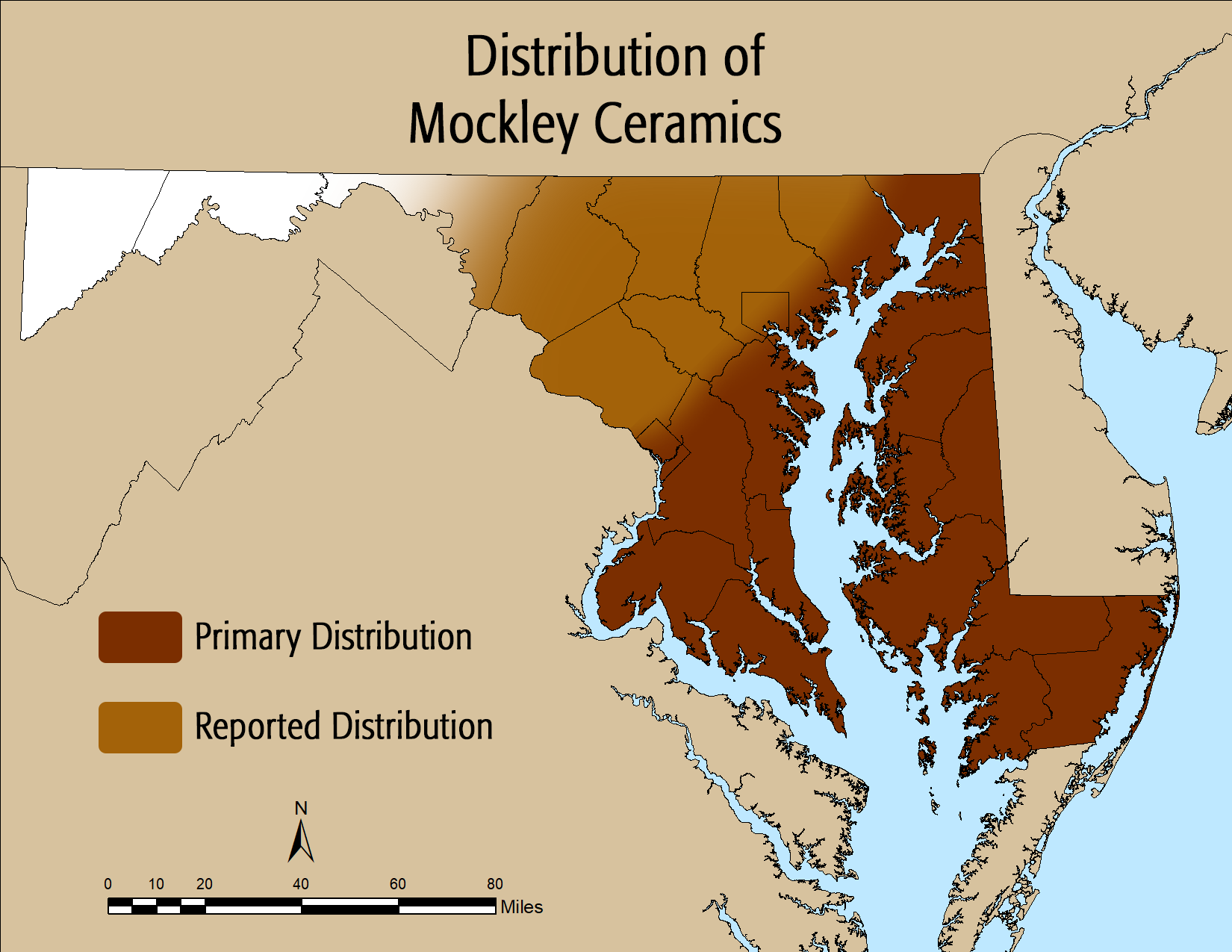
Figure 2. Distribution map.
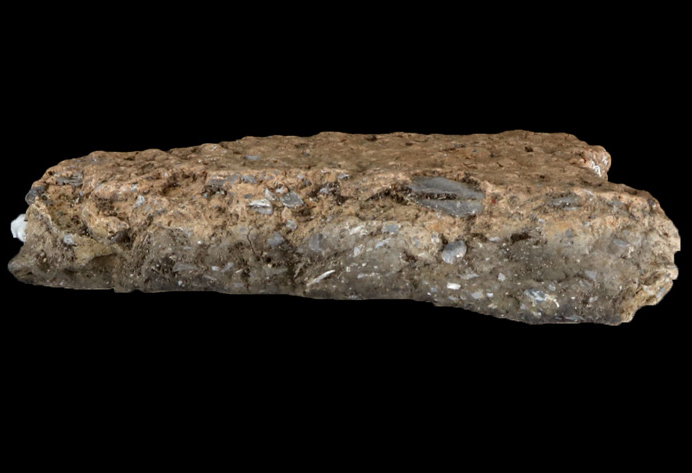
Figure 3. Paste close-up.
Description
Paste/Temper
The paste consists of non-compact, medium-fine clay, often with a distinctively laminated structure. The texture is clayey, soft, and friable, with a Moh’s scale hardness of 1.5 – 2.0. Mockley vessels are tempered with coarsely crushed unburnt shell, usually oyster.Temper size varies from very fine – 5 mm thick. The shell tempering comprises 20% – 30% of the paste. Accidental inclusions consist of angular or rounded particles of hematite, limonite, clay, and soft limey concretions.Frequently the temper has been leached out, leaving flat angular holes of varying sizes. Surface colors range from reddish rust to reddish-tan to black through light brown or tan. Smudge marks are rare on exteriors while interiors are sometimes evenly smudged.
Surface Treatment
Exterior surfaces are usually net-impressed or cord-marked, and less frequently smoothed-over. Net-impressions, the most common treatment, resulted from malleation with loose, open knotted textiles on a damp surface. The net was wrapped either loosely around the hand or a paddle, and applied with little to no overlapping. The knot spacing ranges from 2 mm – 6 mm apart. Cord-marking was produced with a cord-wrapped paddle. Impressions are oriented vertically, horizontally, diagonally, and occasionally in criss-cross patterns, or various combinations. Stephenson et al. (1963:106) note that cord-marking was made with medium to coarse cordage that was loosely wrapped around a paddle at intervals of 3 mm – 10 mm.
Studies performed on potentially early/transitional vessel fragments found at Point Lookout indicate the use of three distinct weaves of fabric and fibers during the manufacturing process. A twined fabric, a fabric with interlaced unequal elements, and one exhibiting accessory stitches within the fabric itself were discovered through reverse impressions taken of the various sherds (Robinson and Bulhack 2006).
Interior surfaces are usually smoothed but scraped-over cord-marking or net-impressions, totally scraped, or smoothed-over scraped treatments have been reported.
Decoration
Mockley ware is generally undecorated but occasionally the area below the rim was smoothed over and decorated. Crude, broad-line incised chevrons, diamonds, cross-hatches, or parallel lines, some filled with punctations, have been recorded (Egloff and Potter 1982:103).
Morphology
Mockley vessels are coil-constructed with paddle-malleated surfaces. Coil widths range from 12 mm – 16 mm, and are usually flattened in welding. Bodies are hemispherical to conoidal or straight-sided from the rim to the midpoint, and taper toward the base. Bases are rounded or semiconical. Lips are usually rounded or wedge-shaped. Rims are vertical or slightly flaring, but inverted and everted forms have been found. Vessel sizes range from medium to large. Sherds and vessel sections suggest diameters of 20 cm – 35 cm and depths of 20 cm – 40 cm. Rims are 6 mm – 10 mm thick. Bases are 10 mm – 19 mm thick. Vessel wall thickness varies from 8 mm – 11 mm.
Defined in the Literature
Evans (1955) defined three pottery types that were identical to Mockley: Chickahominy Cord-Marked, Potts Net-Impressed, and Potts Roughened (Egloff and Potter 1982:103). Stephenson et al. (1963: 105), however, was the first to formally establish the name Mockley, based on pottery recovered from the Accokeek Creek site (18PR8) in Prince Georges County, Maryland. He divided the ware into three types: Mockley Cord-Marked, Mockley Net-Impressed, and Mockley Plain.
Type Site
Accokeek Creek (18PR8)
Maryland Sites with Mockley Components
- Dorr (18AN19)*,
- Bathhouse (18AN37)*,
- Ruf (18AN65),
- Martins Pond (18AN141),
- Luce Creek (18AN143),
- Hillsmere Pond I (18AN197),
- Rose Haven (18AN279)*,
- Duck’s Run (18AN546)*,
- Allen’s Fresh #1 (18CH55)*,
- Loyola Retreat (18CH58),
- Otter II (18PR272)*,
- Abells Wharf (18ST53)*,
- Robinson (18ST728)*,
- Bulhack (18ST729)*,
- Chickadee Rockshelter (18WA13),
- Nassawango (18WO23)*,
- Reeves (18WC15)*
*collections at the MAC Lab
Radiocarbon Dates
| Radiocarbon Dates | |||||
|---|---|---|---|---|---|
| Date | Sample No. | Sample Type | Site | Feature | Reference |
| 1775 ± 65; A.D. 175 | SI-3669 | Shell | Rose Haven (18AN279) | Feature 4 | |
| 1755 ± 50; A.D. 195 | AA-3308 | Patterson I (18CV65) | |||
| 1750 ± 90; A.D. 200 | SI-449 | Charcoal | Piscataway (18PR7) | Pit 32-1 | Woodward and Phebus 1973 |
| 1565 ± 90; A.D. 385 | SI-2899 | Wood | Abells Wharf (18ST53) | Feature 40 | |
| 1450 ± 80; A.D. 500 | Beta-48311 | Patuxent Point (18CV271) | |||
| 1370 ± 120; A.D. 580 | M-1608 | Deciduous wood charcoal | Luce Creek (18AN143) | Square 1 | Crane and Griffin 1966 |
| 250 ± 90; A.D. 700 | SI-3670 | Wood | Rose Haven (18AN279) | Feature 4 | |
| 2030 ± 40; 80 B.C. | Beta-188328 | Residue | Point Lookout (18AN728/729) | Robinson and Bulhack 2006 | |
References
2023 Modelling Migration Histories of the Eastern Seaboard: A Bayesian Approach. Paper presented at the 79th annual Southeastern Archaeological Conference, Chattanooga, TN.
1966 University of Michigan Radiocarbon Dates XI. Radiocarbon 8: 256-285.
1982 Indian Ceramics from Coastal Plain Virginia. Archeology of Eastern North America 10: 95-117.
1955 A Ceramic Study of Virginia Archaeology, Bulletin 160, Bureau of American Ethnology, Smithsonian Institution, Washington, D.C.
1982 Prehistoric Ceramics in Delaware (An Overview). Archaeology of Eastern North America 10: 46-68.
2006 An Analysis of Fabric Impressions on the Surfaces of Early Mockley Sherds from Point Lookout State Park, Maryland (18ST728 & 18ST729). In Maryland Archaeology, Vol. 42(1), pp. 1-8.
1963 The Accokeek Creek Site: A Middle Atlantic Seaboard Culture Sequence. Anthropological Papers, Museum of Anthropology, University of Michigan, No. 20, Ann Arbor
1973 The Piscataway Site: A Stratified Woodland Site in Tidewater Maryland (18PR7) Prince George’s County, MD. Manuscript on file, Maryland Historical Trust, Crownsville, MD.